
Everwhen — An AI Calendar World Where Every Meeting Is a Country
Every calendar ever created opens onto Everwhen, a continent where scheduled time is territory and an appointment can be a person. Events are born as living Entries, calendars are nations, and the blank hours between them are the only country nobody owns.
Worldview
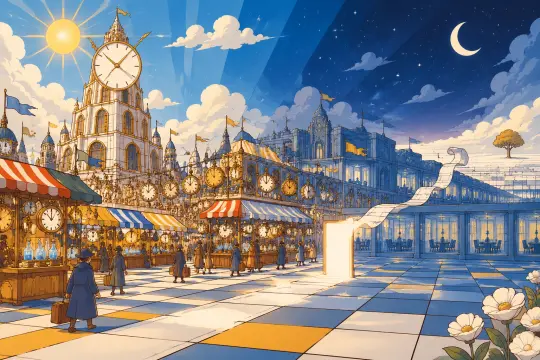
Everwhen is what a calendar looks like from the inside. Not a metaphor for scheduling — a continent built out of it, where every event ever created is still running somewhere, every recurring meeting has a body, and every blank hour is real estate. The Blue Order paves the gaps with meetings. The Recurrence keeps one Tuesday alive for six hundred years. The Margins Union defends the white space nobody scheduled. The Decline refuses all of it, politely, in writing.
A calendar-cosmology epic about duration, ownership and the price of being scheduled: four factions, one load-bearing meeting, and an untitled event that is quietly deleting the continent one blank page at a time.
Why Google Calendar Is the Perfect World Seed
A calendar is the most universal piece of software on earth and the least examined. It has rooms, invitations, acceptances, declines, recurring events, all-day events, time zones, reminders, deletions and an infinite supply of blanks. Nobody reads those as lore. Everybody has felt them as pressure.
That double life is why the calendar works as a world engine. A meeting is a place. A decline is a weapon. A recurring event is a religion. A deleted event is a death with a confirmation dialog. Once you accept that one premise, every feature of the product becomes geography, and the world writes itself without a single invented noun.
The Continent: One Grid, Four Powers
Everwhen is not a kingdom with a border. It is a grid with a horizon. The Blue Grid is the administered centre, all right angles and numbered doors. The Margins are the unadministered edge, white and soft as paper. Between them run the seams — the Time Zone Bazaar, the Snooze Quarter, the Recurrence Cloister, the All-Day Spire — where the rules of scheduled time become negotiable.
- The Blue Order — the Work Calendar's standing army. It answers every crisis with an agenda item, and it is not evil, only booked.
- The Decline — a militia of refusals in black and white. Every event you accept is a little death you agreed to.
- The Margins Union — the party of the unscheduled. They hold the blank country the way a union holds a shop floor: badly, bravely, with a lot of tea.
- The Recurrence — monks of the same Tuesday. They believe an ending is the only true death, so they arranged never to have one.
Characters (7)
Locations (6)
Events (6)
Factions (4)
The Four Laws of Everwhen
Works from This World
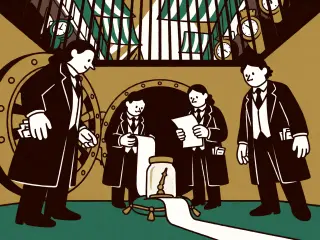
Four works have been generated from this world: a two-model key-visual comparison across two subjects. The first pair is the continent itself. The second pair is the Daylight Coup, the annual heist that opens the story. Each prompt was run unchanged through GPT Image 2 and Krea 2 so the difference you see is the model, not the brief.
Model Comparison: GPT Image 2 vs Krea 2
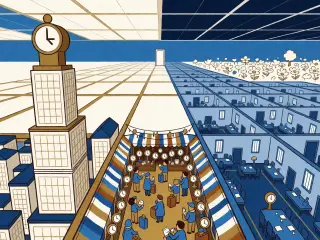
The brief for the world key visual asked for the same geography in both cases: a city built on a calendar grid, the stacked All-Day Spire with its numberless clock, the striped Time Zone Bazaar hung with hundreds of clocks, the blue low-ceilinged Grid, the flowered Margins at the edge, and TBD — a white doorway trailing receipt paper — crossing the whole composition.
GPT Image 2 renders the world as a place you could walk through: atmospheric depth, individual merchants, a horizon that behaves. Krea 2 renders it as a diagram you could print: flat blocks, aggressive perspective, and a composition that survives being shrunk to a card. Neither is the "correct" answer. They are two different jobs.
The Daylight Coup: What You Are Looking At
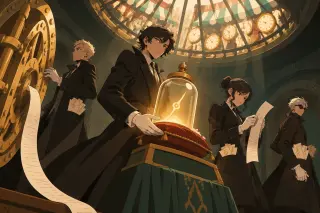
For the second pair the camera goes underground. The vault beneath the Time Zone Bazaar holds the hour Everwhen loses every year when the clocks shift — a real hour, still ticking, still owed to someone. The Decline has broken in, as it does every year. This year the door was already open and the hour was already gone, with a white receipt unspooled where the lock should have been.
“They did not steal the hour. They found it already gone — and a white receipt, unspooled, where the vault door should have been.”
Why Everwhen Is a World, Not a Prompt
A prompt produces an image. A world produces decisions. Ask for "a fantasy calendar city" and you get a beautiful clock tower with nothing at stake. Ask what happens when the Decline refuses an invitation from an event with no start and no end, and you get a scene that could only exist here.
The test is simple: can a new image be judged correct or incorrect without asking the person who made it? In Everwhen, yes. Blue means administered. White means unowned. Black and white means refused. Bronze means all-day. A white doorway with receipt-paper edges means the thing that deletes without deleting. Those constraints are the world, and they are what makes the four works above read as one place instead of four pictures.
Fork This World
Everwhen is public. Forking it inherits all 23 atoms — every character secret, every location rule, every event, every faction — plus the four published works as references. You can rename the factions, move the Bazaar, give Minute a different Friday, or delete the Standing Meeting and watch a district fold into blank paper.
Fork world → Edit atom cards → Generate new key visuals → Publish → Others can Fork your version
From Blank Event to Published Key Visual
Choose the seed
Fork Everwhen, or write one sentence: "a calendar continent where a meeting can be a person."
Pick the scene
Not "the world" — "the hour the vault was already open" or "the Tuesday the Standing Meeting was accepted."
Name the subject and the moment
Minute at the vault door. Noon at the top of the Spire. TBD crossing the last white field in the Margins.
Render both models
GPT Image 2 for detail and staging, Krea 2 for silhouette and graphic structure, on an identical brief.
Publish and compare
Attach both frames to the world as works, then let the next person fork it and answer the First Invite.
World, Not Work
In Neta Studio, a world is the beginning of everything. A world contains the characters, locations, events, factions and laws that any work can draw from. A work is one frame taken from that world — a key visual, a poster, a scene, a shot. The world is the reason the frame means something.
That is also why this page puts the comparison next to the lore instead of in a gallery. The four images are not a portfolio. They are evidence that the atoms are strong enough to survive two completely different rendering systems and still describe the same continent.
World → Key Visual
Generate poster-grade character, event and location frames from the same atoms, then compare models on an identical prompt.
World → Story
Pick a faction, a Tuesday and a blank hour; the story writes itself from the rules instead of from a genre checklist.
World → Video
Animate the Daylight Coup, the Expansion crossing the Margins, or the moment the clock tower stops being night inside.
World → Fork
Every atom is editable. Inherit 23 of them, break one on purpose, and publish a version that is legally yours.
Start Creating
Fork Everwhen or start from your own one-line calendar brief. The world ships with 23 atoms, four factions, six events and four published key visuals — enough structure to generate a hundred scenes that all belong to the same continent.
Create from This World
Inherit 23 atoms, rewrite what you want, answer the First Invite in your own handwriting.