
Fullmetal Alchemist AI World — A Country That Runs on Equivalent Exchange
Amestris, 1914: two brothers, one burnt house, a military that licenses miracles, and a transmutation circle being drawn under every citizen’s feet.
Fullmetal Alchemist AI World — Nothing Comes Free
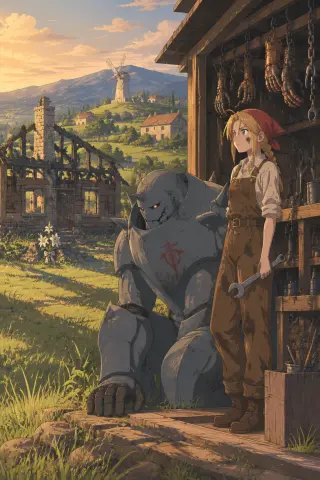
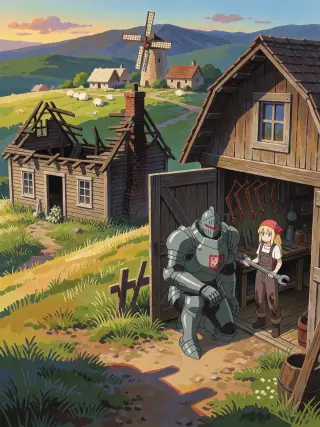
A boy and a suit of armour stand in the grass above a village where their house used to be. The house is still there, technically: a chimney, a few charred beams, a floor open to the sky. White lilies have been laid at the door by someone who comes back every year. The armour kneels to be repaired, and a girl in oil-stained overalls picks up a wrench. Nothing in the scene is dramatic. That is the point. The worst thing that ever happened to these two brothers already happened, and the world has kept on growing grass over it.
This is an editable AI world built from the bones of Fullmetal Alchemist: a diesel-and-steam nation called Amestris in 1914, a science of alchemy licensed by the military, and a country-sized transmutation circle being drawn under everyone’s feet. It contains 24 materials you can open and rewrite — 8 characters, 6 locations, 6 events and 4 factions — plus four published key visuals that test those materials with two prompts, each run unchanged on GPT Image 2 and Krea 2.
Equivalent exchange is a bill, not a motto
Every alchemy story says the same sentence: to get something, something of equal value must be lost. Most of them treat it as decoration. This world treats it as accounting. Edward Elric lost a leg for his mother’s face and an arm for his brother’s soul, and the story never lets him forget the exchange rate. Alphonse lost his entire body and got a voice that cannot eat, sleep or feel rain. The philosopher’s stone is not a magic item; it is a receipt for a life that was taken without consent.
Amestris is a country that has been paying with other people’s lives for four hundred years and calling the arithmetic science. The moment a player understands that, every cheerful uniform in the world turns into evidence.
It begins with a house that is no longer there
The Forbidden Transmutation is the first event in the timeline because everything else is a consequence of it. Two boys draw a circle in a basement, try to bring their mother back, and open something that is not a door. What comes back is not her. The scene is not shown as a monster attack; it is shown as a mistake made by children who had read the theory and believed the law would be kind.
From there the timeline runs in both directions at once. You can play Resembool in the years when the house was still standing, or Central on the day the circle ignites. The world does not force chronology. It asks which version of the past a character is willing to admit in the present — and what they are still paying for.
Eight people, and every one of them is paying for something
The cast is the world’s real engine. Nobody in it is a mascot. Edward is brilliant and vain and fourteen in a way that is easy to forget. Alphonse is gentler than his brother and much harder to lie to. Winry keeps them walking and resents being thanked for it. Mustang wants to be Führer for reasons that are half conscience and half ambition. Hawkeye watches him do it. Scar has a list of names. Envy wears faces for fun. Bradley is the most polite monster in the country.
Six places that sit on top of something buried
The locations are chosen for what they hide. Central City looks like a capital and is built over a labyrinth of laboratories. The Fifth Laboratory is a prison that turns people into chimeras. Fort Briggs is a steel wall in a glacier with a war-sized secret behind it. Ishval is a desert full of the ash of a nation. Resembool is the only green place in the world, and it holds a burnt house. Xerxes is a perfect circle of ruins that was emptied in a single night.
Six beats you can play in any order
The events are not a plot outline to be followed; they are pressure points. Drop a scene on any of them and the world knows what is at stake. Xerxes explains the stone. The Forbidden Transmutation explains the brothers. Ishval explains the uniforms. Lior explains the religion that grows around a lie. Hughes’s murder explains why the good characters stop being polite. The Promised Day explains the country.
Four powers, no clean side
The factions are the political machinery. The State Military is a meritocracy of war that genuinely does protect its citizens and genuinely does murder them. The Homunculi are not an invading army; they are the country’s management. The Ishvalan Remnants carry a faith, a grudge and a forbidden array. The Xingese Court is a foreign power with its own princes, bodyguards and alkahestry, looking for immortality and finding a massacre.
Three laws that make the world behave
The laws are the difference between a themed chatbot and a world. Equivalent Exchange is not a slogan; it is a hard constraint on every scene, so no solution is allowed to be free. The Gate is a door that takes something every time it opens, which means every flashback has a price. And the Country Is the Circle turns geography into conspiracy: every road, prison and border the characters cross is part of the same drawing.
Why the eclipse is the whole world
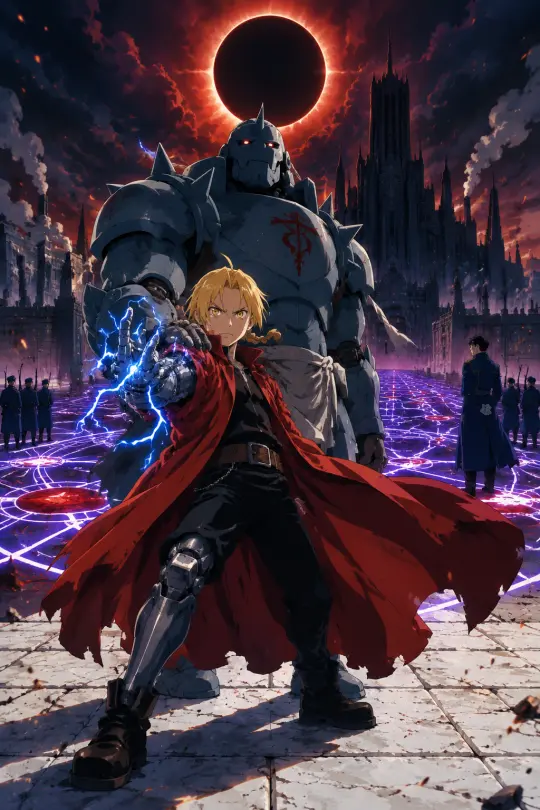
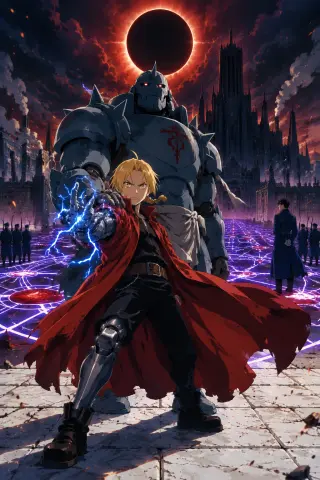
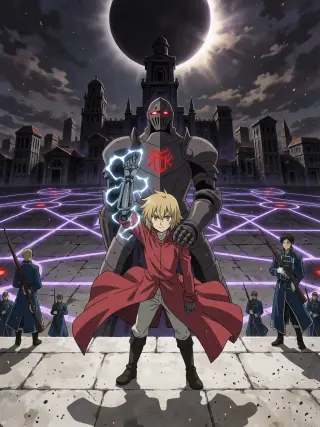
Every story about a country-sized crime needs an image that can hold the scale. The eclipse does that. It is public — everyone can look up and see it — and it is also a deadline, a black hole with a ring of fire around it, exactly the shape of the transmutation circle. Put two brothers under it and the composition writes itself: one small figure in red in the foreground, one enormous armoured figure behind him, and a whole city reduced to silhouettes at the edge of the frame.
What the two models saw differently
The same paragraph of prompt went to both models. GPT Image 2 treated the scene as a photograph of a place: it built the plaza, the crowd, the towers and the eclipse in separate planes, lit the stones, and let the circle glow through the paving with real depth. Krea 2 treated it as a poster: it centred the boy, flattened the armour into a grey silhouette, mirrored the riflemen left and right, and drew the circle in clean neon lines. Neither is wrong. They answer different questions.
- GPT Image 2 — depth and detailSeparates foreground, subject and background into readable planes. The automail, the seal on the armour, the riflemen and the eclipse all hold their place. Best when the image has to explain a place or a piece of machinery.
- Krea 2 — shape and speedCompresses the same scene into graphic bands with cleaner silhouettes and a flatter palette. Roughly a quarter of the cost per image and much faster. Best when the image has to read at thumbnail size or carry a title.
- Where they agreeBoth models understood the emotional beat without being told: a boy too small for the thing behind him, a circle under everyone’s feet, and a sky that has stopped being a sky. That agreement is the real proof the prompt works.
The house with nobody in it
The second prompt removes the battle entirely. A burnt house on a green hill, white lilies at the door, an armour kneeling in the grass, a mechanic with a wrench. It is a harder test than the eclipse, because there is no villain and no spectacle to carry the feeling. The image has to make an absence feel like a person — and make a repair feel like grief.
GPT Image 2 renders the village as a real place: the chimney standing over charred beams, the workshop’s hanging copper limbs, the windmill far back on the ridge, the long golden light across the grass. Krea 2 renders it as a book cover: the ruined cottage and the workshop become two flat panels, the sheep and windmill simplify into shapes, and the armour and the girl are posed in the doorway. One is a memory; the other is a title page.
Alchemy is a language, not a spell
Most fiction about magic films the hands as sparks. This world treats alchemy as a grammar: a circle is a sentence, a sigil is a clause, and a clap is shorthand for a structure the alchemist already understands. That is why Edward can transmute without a drawn circle and why a mistake is not a fizzle but a mistranslation. The rule exists to stop the story from using alchemy as a light show.
Name the array
Decide what shape is being drawn and what it is allowed to affect. A circle that can reshape stone cannot also heal a lung; the constraint is the drama.
Name the cost
Every transmutation spends something — material, energy, a component of the alchemist’s body, or a promise. If nothing is spent, the scene has no weight.
Write the mistake
The best alchemy scenes turn on a misread clause: the wrong element, the wrong boundary, the wrong person inside the circle. Make the error legible before it becomes lethal.
Let the military watch
Alchemy in Amestris is licensed. Someone is always recording what the array did, and that record is a political object. End the scene with the paperwork, not the explosion.
Playing Edward without making him a martyr
The temptation is to make him a sad boy who deserves comfort. The world resists that. His guilt is not proof of growth; it is often proof that he is still thinking about himself. The playable question is not “will he get his brother’s body back?” but “can he do one useful thing without making it about his own redemption?” A good Edward scene ends with him less interesting than the person he is trying to help.
Playing Alphonse without making him a victim
Alphonse is not a symbol of sacrifice and he is not a reward for his brother’s growth. He has his own anger, his own plans and his own reasons for being kind that have nothing to do with Edward. The strongest scenes give him the option to leave — to take the armour somewhere no one can use it — and then let him choose something the player did not expect. If every branch ends with him teaching Edward a lesson, the world has failed him.
What the homunculi are for
Envy, Lust, Gluttony, Greed, Sloth, Wrath and Pride are not a boss rush. They are the seven ways a country avoids looking at what it is doing. Envy enjoys being seen; Pride refuses to be a child; Wrath governs with a smile. Put any two of them in a room and the scene writes itself, because each one has a different reason to protect the story Amestris tells about itself.
The Ishval problem
Ishval is where the world stops being an adventure. A State Alchemist did not fight a war there; they performed an extermination with a scientific vocabulary. Every officer in the cast has a different verb for it — “pacification”, “operation”, “mistake”, “order” — and the gap between those verbs is the moral core of the world. Scar is not a villain for refusing to forgive. Mustang is not a hero for feeling bad about it. The playable question is what a person does after they have already been the weapon.
How to start, in four moves
Open the world
Start from the world card and read the three laws first. They are the constraints that make every later choice mean something.
Pick a pressure point
Choose one event — the house, Ishval, Lior, Hughes, the eclipse — and decide which character is telling the truth about it today.
Set the scene in one sentence
Write what is happening in the next ten minutes, not the next ten years. “Edward waits outside the workshop while Winry decides whether to fit the arm” is enough.
Charge for the magic
Let the first alchemical solution cost something visible. The scene will tell you what it is about faster than an outline will.
What you can make from this world
The world is a material library, not a single story. The same 24 cards can become a playable visual novel about the Promised Day, a set of character posters for the State Military, a short animated sequence of a transmutation circle lighting under a city, or a quiet series of still lifes about workshops and burnt houses. Every card can be rewritten; every image can be regenerated; every share link opens the exact asset it came from.
- Play it as a visual novelBranch the Resembool reunion, the Ishval flashback or the eclipse. The laws keep the branches honest: no free miracles, no clean army, no forgiveness that arrives on schedule.
- Generate key visualsUse the two published prompts as a starting point, then re-run them for your own scene. Compare GPT Image 2’s spatial detail with Krea 2’s graphic compression before you commit to a look.
- Build a character studyTake one card — Hawkeye, Scar, Winry, Envy — and play a single afternoon from their point of view. The world is small enough that a side character can carry a whole episode.
Questions people ask before entering
- Do I need to know the anime or manga? No. The world introduces Amestris, the laws and the cast from scratch. Knowing the original adds recognition, not access.
- Is this a retelling or a new story? It is a playable world built from the same materials. You can replay canonical beats or write a scene that never happened, as long as you respect the three laws.
- Can I change the characters? Yes. Every card is editable. You can age them up, move the story to another country, or write a version in which the stone is used and the bill comes due.
- What are the four published works? Two prompts — the Promised Day and Resembool after the fire — each rendered by GPT Image 2 and Krea 2. Every image on this page is one of those four real outputs.
- Where do I start? Open the world studio, read the laws, then choose Resembool and write one sentence about what Winry is afraid Edward will ask her to build.
Enter the world
The circle is drawn, the eclipse is coming, and the house on the hill is still empty. Start a scene in Fullmetal Alchemist — or open the studio and read the cards first.