
Ghost of Tsushima — An AI Samurai World About Honor, Survival and the Cost of Becoming a Ghost
Tsushima, autumn 1274, rebuilt as an editable AI world: eight characters, six locations, six turning points, four factions and four published key visuals from a GPT Image 2 vs Krea 2 comparison. A jito who will not break his code, a thief who will not let him die, and a swordsman who becomes the thing his uncle was raised to kill.
Ghost of Tsushima — The Island That Had to Lose Its Honor
Tsushima, autumn 1274. A Mongol fleet under Khotun Khan lands on the beaches of a small Japanese island and destroys its samurai army in a single morning. What follows is not a war of armies but of survivors: a jito who clings to a code that has already failed, a thief who drags a dying swordsman out of the sea, and the swordsman himself, who becomes the very thing his uncle was raised to kill. This is the world Neta Studio rebuilt as an editable AI setting — not a summary of a game, but a working collection of people, places, loyalties and turning points that can be forked, rewritten and illustrated.
A code is only a code while it costs you nothing. Tsushima is the story of what happens when the bill arrives: the uncle pays with his life, the nephew pays with his name, and the island pays with both.
The World in One Frame
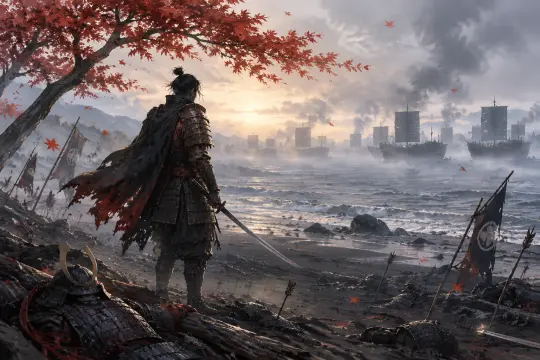
The cover does not show a battle. It shows the minute after one. A lone swordsman stands on black sand with his blade lowered, surrounded by the furniture of a defeated army: a broken banner, a spent arrow, a helmet with nobody inside it. Behind him the sea is a wall of mist, and inside the mist are the ships that brought the men who did this. One red maple leans over the dune, because the island is beautiful and does not care.
That is the whole design argument. Tsushima is not a power fantasy about a hero who wins; it is a story about a man who keeps choosing the next necessary thing and discovers, too late, that the choices have added up to a different person. The frame is quiet, the light is cold, and the sword is pointed at the ground. Everything the world needs is already in it: the invasion, the defeat, the beauty, and the question of what a man is supposed to do after the formation breaks.
Tsushima, Autumn 1274
The island is a real place and the invasion is a real event, which is why the world does not need invented mythology to feel mythic. It needs weather, distance and consequence. Komoda Beach is black sand and cold surf. Omi is rice terraces and a family estate with too many rooms for the people left to fill them. Castle Kaneda is a stone-and-timber fortress that changes hands twice in a season. Jogaku is snow, cedar and a silence that makes every conversation sound like a confession.
The visual language follows from the place rather than from a genre. Wet charcoal, bone white, dried-blood red and cold sea blue. Visible brushwork, controlled hard edges, rich mid-tones, mist that has volume instead of glow. The world's style is semi-realistic painterly — close enough to history to feel researched, loose enough to let a single figure carry an entire frame.
The Argument at the Center
Ghost of Tsushima is built on a single argument between two men who love each other. Lord Shimura believes that a samurai is defined by the forms he keeps, even when the forms are losing. Jin Sakai believes that the island matters more than the forms, and that saving it may require becoming something the island would condemn. Neither position is stupid. That is what makes the story work. Shimura is not a villain for refusing to abandon his life's meaning, and Jin is not a hero for abandoning his uncle's.
Every other character is a variation on that argument. Yuna survives because she never had the luxury of a code. Ryuzo sells his sword because the code never fed anyone he loved. Masako turns grief into procedure because procedure is the only thing that still works. Ishikawa teaches because a tradition that is not passed on dies faster than a man. Khotun Khan wins because he understands what all of them are willing to pay.
The Ghost is not a secret identity. It is a public admission that the old rules have failed — and the island needs someone willing to say it out loud.
Eight People on One Island
The world ships with eight character atoms. They are written as pressures rather than biographies: what each person wants, what they will not give up, and where the invasion has made those two things incompatible. Fork the world and you can add a ninth, rewrite a loyalty, or move a character to a location they were never meant to survive.
A Map That Fights Back
Six locations, each with a different relationship to the war. The beach is a wound. The castle is a prize. The village is a debt. The stronghold is a gamble. The sanctuary is a lie. The temple is a memory. Prompt any of them and the place does half the work, because a location with a point of view is worth more than a hundred adjectives.
The Timeline of the Invasion
The six events are ordered by escalation rather than chronology. First the formation breaks, then the lord is taken, then a name is invented, then the farmers rise, then the family meets in a graveyard, then the poison. Each event is a door: write from inside it, and the world supplies the pressure.
Four Powers, Four Kinds of Loyalty
The factions are not teams. They are four answers to the question “what is a person for?” The samurai answer duty; the Mongols answer usefulness; the people answer survival; the ronin answer the wage. Put any two in a room and the scene writes itself.
What the Code Cannot Hold
The most useful thing about this world as a creative setting is that it is already broken. You do not have to invent a conflict; you inherit one. A lord who must hunt his nephew. A friend who has already chosen his people over yours. A method that works and is unforgivable. A victory that costs the thing you were fighting for. Those are not plot points to be resolved. They are engines.
That is also why the world benefits from a fixed visual grammar. The atoms give you the nouns — armor, banners, black sand, red maples, stone graves — and the style gives you the syntax. Without the grammar, every new frame looks like a different adaptation of the same story. With it, a single image can carry the argument: a man on a beach, a sword pointed down, a fleet in the mist.
Honor is what the island says it wants. Survival is what the island actually needs. The Ghost is the distance between the two.
The Six-Clause Brief That Built These Frames
All four published works were generated from one shared brief per scene, run through two models at matched aspect ratios. The brief is deliberately boring and deliberately ordered, because a fixed order is what makes a comparison meaningful. Style first, subject second, place third, event fourth, light fifth, refusals last.
Medium and style
Semi-realistic painterly cinematic key visual, 16:9, visible brushwork, controlled hard edges, rich mid-tones, volumetric mist. Lock the rendering system before describing anything else.
Subject and wardrobe
Name the figure and the armor: battered dark lamellar, a torn rain-cloak, a wide straw hat, a formal white-and-grey harness. Wardrobe is identity in this world.
Place and weather
Black sand, broken banners, spent arrows, a leaning maple; or moss-covered graves, wet stone, terraced fields below. Name the place by its objects, not its mood.
One event
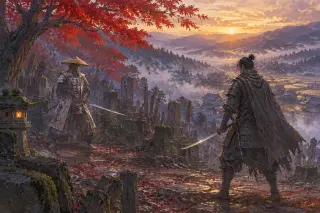
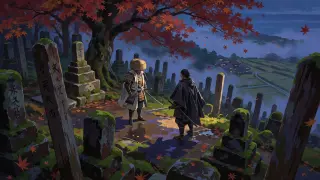
A fleet waiting in the mist; two men standing at guard in a graveyard. One situation per frame, stated as a fact rather than a wish.
Light and palette
Cold breaking sun against wet charcoal and dried-blood red; or violet twilight, moss green, maple crimson, tarnished gold. Light is a palette decision, not a lens setting.
Refusals
No text, no letters, no watermark, no logo. The negative clause is not optional, especially for banners, gravestones and armor plates.
Two Models, One Brief
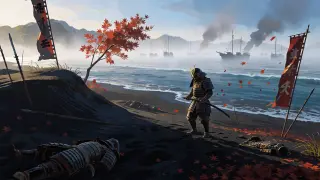
GPT Image 2 and Krea 2 were given the same two prompts. GPT Image 2 returned 1536×1024 frames built like film stills: individual arrows, wet sand, a helmet with a dent in it, a sword blade that catches one narrow band of light. Krea 2 returned a wider, brighter 2048×1152 interpretation: fewer objects, stronger silhouettes, banners that snap, a beach that reads as a stage. Neither is the “correct” answer. They are two different jobs.
The useful comparison is not quality in the abstract. It is fitness for purpose. If the image has to survive a crop, a caption and a second look, GPT Image 2 gives you more to look at. If it has to work as a thumbnail, a poster or a mood board tile, Krea 2 gets to the point faster and charges a tenth as much. The world page uses both because the world needs both: a document and a poster.
Why GPT Image 2 Holds the Detail
GPT Image 2 is strongest when the frame has to bear inspection. It understands material separation — the difference between wet sand, lacquered iron, cloth and leaf — and it places shadows consistently, so a figure standing in the surf does not look pasted onto it. In the Komoda frame, the fallen helmet in the foreground has a visible dent and a broken crest; in the cemetery frame, the stone lantern still has a flame and the graves have different degrees of moss. Those details are not decoration. They are proof that the place existed before the picture was taken.
The cost is time and money. A high-quality 1536×1024 frame is slower and several times more expensive than a Krea render, and the model can over-render texture if the style clause is weak. The fix is not more prompt; it is a stricter style clause and a smaller number of objects. Say “visible brushwork, controlled hard edges” and mean it.
Why Krea 2 Reads at a Glance
Krea 2 is a poster machine. It composes for the thumbnail: a strong diagonal, a single red shape, a figure that reads as a silhouette before it reads as a person. The Komoda frame puts the aftermath in the foreground and simplifies the sea into bands; the cemetery frame turns the maple into a canopy and the graves into a corridor. It also invents calligraphic marks on banners and gravestones, which is exactly the weakness its documentation warns about — treat any lettering as texture, not language.
Use Krea 2 to explore. Ten variations cost less than one GPT Image 2 frame, and the model will happily give you a composition you would never have specified. Then take the winning composition back to GPT Image 2 and ask for the detailed version. That two-stage workflow is the most reliable way to get both speed and finish.
A World You Can Fork
Ghost of Tsushima is public. Every atom can be opened, rewritten, duplicated or removed; every published work carries its prompt and model, so you can see exactly what produced it and run the same brief yourself. Start from the world as it stands, or fork it and change one thing: let Shimura reach the beach a day earlier, let Ryuzo refuse the Khan's offer, let Yuna be the one who takes up the sword. The setting is strong enough to survive the change.
The published works are the proof, not the product. They show that a world with a clear visual grammar can produce a coherent image set across two very different models, and that a single frame can carry a story's central argument without a caption. The rest is yours to write.
Enter Tsushima
Twenty-four atoms, four published frames, one island under occupation. Build your own version of the Ghost — or start from the world as it stands.