Goblin Slayer — The Frontier, the Guild Ranks and the Code That Keeps the Line
A complete Goblin Slayer world built from a single brief on Neta Studio — 25 atoms across the frontier, the guild and the temple orders, plus four published key visuals from a GPT Image 2 vs Krea 2 comparison.
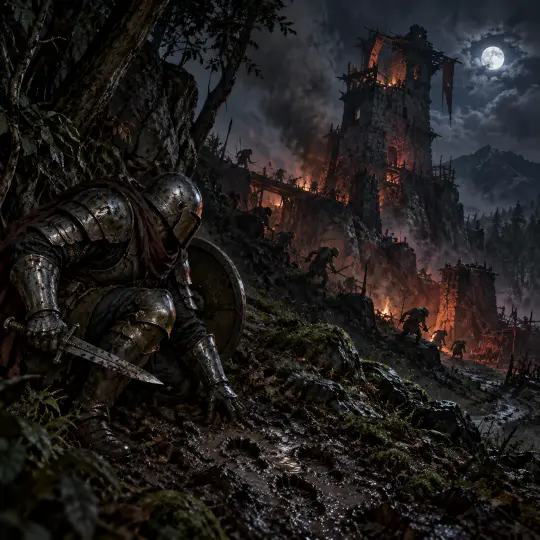
Goblin Slayer is a dark fantasy world built on a refusal. The Demon Lord is dead, the prophecy is spent, the bards have gone to the capital to sing about somebody else — and on the frontier the real war is still being fought one nest at a time, against monsters that the kingdom has officially classified as vermin. That refusal is what makes the setting usable: it is a world where heroism is a budget line, where a village can be erased on a Tuesday, and where the only person taking the threat seriously is a silver-ranked man in battered plate who does not take his helmet off.
This is Goblin Slayer rebuilt on Neta Studio as a playable world: 25 atoms — 7 characters, 5 locations, 5 events, 4 factions and 4 rules — plus four published key visuals generated from the world itself in a GPT Image 2 vs Krea 2 comparison. Every character, place, event and law below is an editable atom, not a fixed bible. Change the guild, rewrite the code, move the farm: the world holds together because the pressure comes from the rules, not from a plot.
| Quick facts | |
|---|---|
| World | Goblin Slayer — frontier dark fantasy |
| Atoms | 25 (7 characters, 5 locations, 5 events, 4 factions, 4 rules) |
| Premise | The Demon Lord has fallen; goblins have not |
| Tone | Grim, practical, unsentimental, quietly humane |
| Visual style | Tenebrist painterly — one light source, large dark shapes |
| Works | 4 published key visuals (GPT Image 2 ×2, Krea 2 ×2) |
| Play | Narrated world, editable atoms, prompts that inherit canon |
Why Goblin Slayer Works as a World to Play In
Most dark fantasy settings hand you a prophecy and ask you to care about it. This one hands you a contract board. The Adventurers’ Guild posts jobs by rank, the temples sell healing at a fixed price, and the garrison has already decided that goblins are a pest-control matter until a warband is close enough to be seen from the walls. A party in this world is not chosen. It is hired, underpaid, and expected to come back with a head count rather than a song.
That structure is a gift for interactive fiction, because it turns every session into a set of legible decisions: which contract, which rank, which part of the nest to enter first, whether to spend the temple’s healing money on a resurrection or on lamp oil. The world does not need a villain to generate pressure. It needs a calendar, a budget and a rule that goblins breed faster than the guild can post bounties.
The emotional register is carried by a single contradiction: Goblin Slayer treats a beginner’s monster as the only war worth fighting, and the world treats him as a strange, unpleasant specialist. Play into that tension and the setting does most of the writing for you.
The Frontier After the Demon Lord
Ten years ago the Hero’s party killed the Demon Lord and the great war ended. The celebration never reached the frontier. What reached it was a scattered, leaderless monster population, a kingdom reorganising its budget around the capital, and a generation of adventurers who trained for a war that is no longer available. The result is a frontier economy with three currencies: coin, rank and the willingness to do the jobs nobody photographs.
The frontier is not empty. It is under-administered. Roads exist but are not patrolled. Farms sit outside the walls because the good soil is outside the walls. The guild is the only institution that pays anyone to fight goblins, and it pays by the job, not by the danger. That gap between what a job costs and what it pays is where every story in this world starts.
The Cast (7)
Seven characters carry the world: a specialist, a survivor, and a party that forms around him for reasons none of them would describe as friendship. Each one is an editable atom with a want, a competence and a contradiction — which is what makes them usable as prompts, not just as descriptions.
Five Places Where the Story Happens
The map is small on purpose. Five locations cover the whole frontier, and each one exists to put a different kind of pressure on a party: the town that hires them, the farm that feeds them, the forest that does not care about them, the ruin that kills them, and the city that thinks it has nothing to learn from any of it.
Five Events That Set the Clock
Events in this world are not lore decoration. Each one is a clock that has already started: a village that burned, a novice party that died, a war that ended too early, and two sieges that prove the frontier’s official opinion about goblins is wrong.
Four Factions, One Paymaster
The politics of the frontier are simple and ugly: the guild has the contracts, the garrison has the authority, the warbands have the numbers, and the temples have the only thing anyone is actually afraid of losing — the dead.
The Four Rules That Make It Dangerous
These are the laws that turn a generic monster hunt into this world. They are deliberately mechanical: each one changes what a party can safely do, and each one can be quoted back at a player who assumes a nest will be easy.
The Visual Grammar: Tenebrist Painterly
The world’s look is a style contract, not a mood board. Tenebrist painterly means one restrained light direction, large dark shapes, compressed values, and edges that break like ink rather than resolve like a render. Deep indigo, blood red, jade green and bone white do most of the work; everything else is a variation on black.
In practice the palette has a job: it keeps the frame readable at thumbnail size, which is exactly what a dark scene needs. The fire is the only warm thing in the image. The armour is the only specular thing. The moon is the only cold thing that is allowed to be bright. When a generated frame fails, it is almost always because one of those three roles has been duplicated.
GPT Image 2 vs Krea 2 on the Same Brief
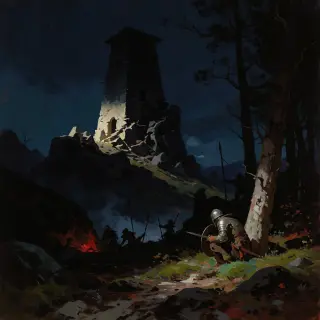
Both world key visuals below were generated from the identical prompt, inside this world, at 1024×1024. That is the only honest way to compare models: same words, same world, same size, no post-processing. The difference is instructive and it is not about quality — it is about which decisions each model makes when the prompt runs out.
| Same prompt, two answers | |
|---|---|
| GPT Image 2 | Reads the prompt as a scene brief. Renders depth, material, multiple props, secondary figures and a light source inside the subject. Slower and more expensive per image. |
| Krea 2 | Reads the prompt as an image idea. Compresses to a silhouette, simplifies the cast, pushes atmosphere and colour. Faster, cheaper, and often the better cover. |
| When to use GPT Image 2 | World key art, location plates, anything with a cast and a readable environment. |
| When to use Krea 2 | Covers, posters, thumbnails, and the first pass on an idea you have not decided yet. |
The Same Prompt, a Second Subject
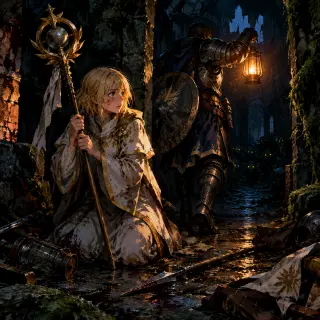
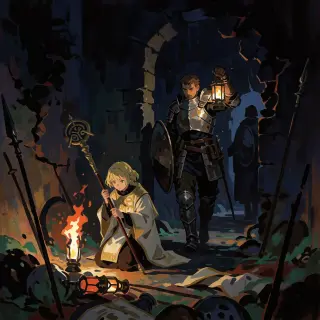
The second comparison moves from place to character. Both images use the same prompt: Priestess in the aftermath of the watchtower, Goblin Slayer stepping past her into the corridor. It is a harder brief, because it asks for two figures, a relationship, a light source and a readable aftermath in one frame.
The Goblin Slayer’s Code, as a Play Loop
The code is the most useful thing in the setting for interactive play, because it is already a procedure. It tells a party what to do before, during and after a nest — and it gives the narrator a legitimate reason to punish shortcuts without feeling arbitrary.
Count the entrances
A nest always has one more exit than the party found. Make the players name the ones they know and roll for the one they do not.
Buy light before swords
Torches, oil, a lantern with a shutter. The code treats light as ammunition, and so should the inventory.
Ask who is missing
Every nest has a reason: livestock, a missing child, a road that stopped being used. The answer decides what the party finds inside.
Choose the order of rooms
Goblins do not defend a lair evenly. Pick where the young are, where the loot is, and where the lord sleeps — then let the party guess wrong once.
Set the fire rule
Smoke, collapse and panic are all legitimate tools. Decide before the session whether fire is allowed inside, and what it costs.
Count the bodies twice
The code’s last instruction is verification. A nest that is "cleared" without a count is a sequel.
Reconnaissance → light and entry → choke point → young and eggs → lord and loot → fire and withdrawal → count. Each stage costs something: time, oil, noise or a party member. The cost is the story.
What a Session Actually Looks Like
A session in this world opens on a contract board and closes on a ledger. Between those two moments there is a walk, a negotiation, a nest, and an argument about whether the payment covers the oil. The world rewards preparation and punishes confidence, which makes it unusually well suited to a narrated, prompt-driven format: you describe what the party does, the world answers with consequences that follow from the four rules rather than from a script.
A good opening is small: a farm reports missing goats, the guild posts a porcelain-rank job, and the trail leads to a collapsed watchtower that has been a nest for three years. By the time the party understands the scale, they are already inside. That is the shape of the whole setting, compressed into one evening.
How to Play It on Neta Studio
The world is editable, and that is the point. Open the studio, pick an atom, and change it: promote the guild master, move the farm closer to the walls, rewrite the code so that fire is forbidden. The four works above were generated directly from this world’s style contract, so anything you add inherits the same visual grammar.
Open the world
Start from Goblin Slayer in the studio. All 25 atoms are listed and editable.
Pick a pressure
A contract, a missing person, a lord rising, a temple debt. One pressure is enough for a session.
Choose the cast
Two to four atoms, no more. The setting works best when the party is outnumbered and under-ranked.
Describe the first move
Say what the party does, not what they feel. The world answers with cost.
What Makes This World Different
There is no chosen one here, and no ancient evil left to defeat. The threat is small, numerous, and officially beneath notice — which makes every victory local and every loss permanent. That is a rare thing in fantasy settings, and it is why the world holds up under repeated play: the danger does not scale up, it multiplies.
- The stakes are legible — a nest, a farm, a road. You can point at what is being lost.
- The rules do the work — ecology, rank, dice and the code generate plot without a villain.
- The cast is a workplace — competence, irritation and loyalty, not destiny.
- The style is a contract — one light, large darks, four colours, no exceptions.
FAQ
Play the frontier, not the prophecy
Open Goblin Slayer in the studio and take a contract. The cast, the rules and the style contract are already loaded — you only have to decide which nest to walk into.
Goblin Slayer on Neta Studio
Four published key visuals, two models, one world — everything on this page was generated from the same 25 atoms.