
Half-Life — An AI Sci-Fi World Where the Door Never Closed
Black Mesa, Xen and occupied City 17 rebuilt as an explorable AI world: eight characters, six locations, six events and four factions — plus four published key visuals from a GPT Image 2 vs Krea 2 comparison on identical prompts. One sample broke the sky, and nobody has closed it since.
Worldview
Half-Life is the story of a species that opened a door it could not shut. In a New Mexico desert, a classified research facility splits more than the atom: it tears a sustained rift into Xen, a borderworld of floating rock and living darkness, and holds the wound open long enough for an empire to notice. Everything that follows — the soldiers, the occupation, the resistance — grows out of one badly supervised morning in a test chamber.
Twenty years later Earth survives as a vassal of the Combine: its cities rebuilt around alien spires, its police recruited from its own neighbours, its water treated as a ration. The story is not about killing a monster. It is about who is allowed to close a door.
The Cascade at the Centre
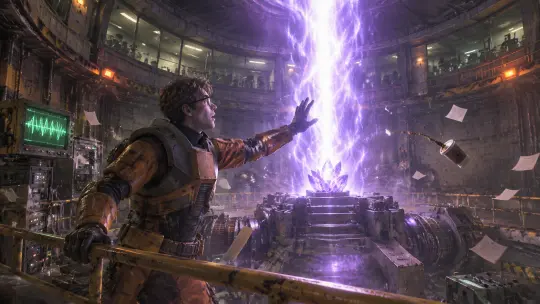
The Resonance Cascade is the engine of the setting, and it is a useful engine because it produces consequences instead of mysteries. A crystal sample is inserted into an anti-mass spectrometer that has been tuned past its safe envelope. The rift opens upward through the chamber floor, Xen's wildlife follows the pressure gradient, and the facility's own containment protocols turn the building into a maze of locked doors and failing lights.
What makes the event durable as worldbuilding is the paperwork around it. Somebody approved the sample. Somebody over-tuned the spectrometer. Somebody in a grey suit was already taking notes. The disaster is not a natural accident but an authorised one, which means every later atrocity in the timeline can be traced back to a signature.
The Unwritten Laws
Six Places, One Planet
The world is small in the way that a wound is small: a handful of locations carry the whole argument. Black Mesa is what curiosity looks like before it is punished. Xen is what the punishment looks like from the other side. City 17 is what happens when the punishment wins and settles down to govern.
Eight Lives at the Hinge
The cast is arranged around a single absence: a physicist who never speaks. Everyone else defines themselves by what they do with the silence he leaves behind — inherit it, protect it, exploit it, or sell it to the highest bidder.
The Timeline Is a Damage Report
Six events are enough to carry two decades, because each one changes the rules rather than the scenery. Read in order, they describe a single escalating transaction: curiosity buys knowledge, knowledge buys attention, attention buys occupation.
Four Powers, One Question
Every faction answers the same question — who owns the door? — and each answer produces a different kind of violence. That is what makes the politics legible without a map of troop movements.
How the Occupation Works on the Page
The Combine is written as a bureaucracy with a military wing, which is why its details are so usable in a scene: ration cards, checkpoints, public screens, a curfew siren, a train station that processes people instead of luggage. A single correct prop does more than a paragraph of exposition.
- Show the queue, not the army. A line of citizens waiting at a scanner describes the occupation faster than a squadron of soldiers.
- Keep one human face in the uniform. Civil Protection is frightening because the masks are on neighbours, not because the armour is shiny.
- Let the architecture speak. The Citadel is visible from everywhere. No character has to explain it.
- Never let the resistance look like a state. No ranks, no flags, no parades — only painted lambdas and borrowed rooms.
Works from This World
Four works have been published from this world: two briefs, each rendered by two models on an identical prompt. The first brief is the world key visual — the Cascade inside the test chamber. The second is a location — an occupied city at dusk. Neither model received a reference image, so the difference you see is the model's reading of the brief, not the brief.
Model Comparison: GPT Image 2 vs Krea 2
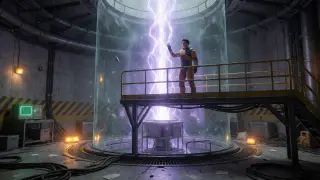
GPT Image 2 renders an event with a history. The physicist has weight on his front foot, the room has smoke in layers, the paper is at different heights because the air is actually moving, and the observers behind the glass are a crowd rather than a texture. Krea 2 renders the same event as a poster: fewer tonal steps, cleaner silhouettes, one light source that behaves, and a figure you can read at thumbnail size. Neither is wrong. One is built to be inspected; the other is built to be seen.
The Resonance Cascade — GPT Image 2 vs Krea 2
Compare the near plane first. In the GPT Image 2 frame the physicist occupies the left third with his forearm and the rim of his glasses in focus, and the energy column sits behind him without blowing out his silhouette. In the Krea 2 frame the figure is smaller, centred and almost diagrammatic on a yellow catwalk, and the rift is a single bright filament inside a glass cylinder. GPT gives you a place where something happened; Krea gives you a plate that explains what the place is for.
City 17 — GPT Image 2 vs Krea 2
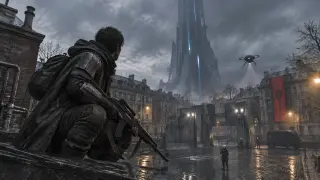
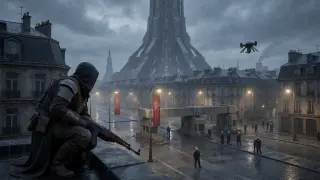
The city brief splits the models the same way. GPT Image 2 builds a pass you could walk through: rain on the ledge, a drone with a searchlight, a checkpoint with a queue, the Citadel half-dissolved in cloud, and a red banner that reads as cloth rather than graphic. Krea 2 compresses the same city into a poster — the hood becomes a shape with no face, the patrol becomes an evenly spaced row of white dots, the Citadel becomes a broad ziggurat — and it is instantly legible, and much less afraid.
What the Comparison Proves
Run the same sentence twice and you learn more about a model than any benchmark. GPT Image 2 follows a compound brief the way a production designer follows a script: it allocates the frame into planes, gives each prop a material, and keeps the crowd doing something. Krea 2 follows the same brief the way a poster artist does: it finds the one shape that survives scale, removes the detail that would muddy it, and commits to a palette.
- Use GPT Image 2 for the frame that has to survive a caption. Test chambers, checkpoints, crowds, anything with more than one actor.
- Use Krea 2 for the frame that has to survive a thumbnail. Covers, banners, social cards, mood plates.
- Publish both. A comparison is content. It shows the world is coherent enough that two models can disagree about it.
From Seed to Key Visual
Read the laws
Open the world and read the rules before writing a prompt. The rift, the suit and the occupation are the three constraints; every frame in this world has to honour at least one of them.
Pick a consequence
A frame in this world should show somebody paying for the Cascade: a physicist at the console, a citizen at a checkpoint, a scout on a rooftop. Choose one and make the cost visible.
Name one light
Emergency amber, cold rift violet, sodium streetlight. One dominant source, one accent. Two competing key lights turn grounded sci-fi into generic dusk.
Render both models
Send the identical prompt to GPT Image 2 and Krea 2 and publish both as works with their own share pages. The difference is the argument.
Keep the frame that survives the crop
Check the image at 1200 pixels wide and at 300. If the subject disappears at thumbnail size, re-prompt the composition instead of adding adjectives.
World, Not Work
In Neta Studio a world is the beginning of everything. A world holds characters, locations, events and factions, and every image you publish is attached to those cards rather than floating free. That is why the same seed can produce a test chamber, a checkpoint and a rooftop without any of them contradicting the others.
A world is not a single image. A world is the source of every image: the location list becomes a shot list, the faction list becomes a costume department, and the timeline becomes a queue of scenes waiting to be rendered. This page is one world with four proofs, not four unrelated pictures.
World → Key Visual
Pick a consequence from the timeline and stage it with the cast and the location cards. The studio keeps the palette and the light logic consistent across renders.
World → Sequence
Turn the Cascade into a run of frames: the sample, the rift, the evacuation, the silence afterwards. Same rules, four posters, one story.
World → Asset Library
Each character yields a portrait, each location a plate. The world becomes a reusable art department you can hand to a team.
Why This World Still Matters
Half-Life is usually remembered for a crowbar and a mute protagonist, but its real contribution is a tone: science as a blue-collar job, apocalypse as an administrative failure, heroism as the thing that happens when the chain of command breaks. That tone is unusually friendly to AI image work, because it rewards props, rooms and uniforms over spectacle.
- Grounded sci-fi is a materials problem. Concrete, wet asphalt, brushed steel, scratched orange rubber. Name the material and the model stops drifting into fantasy.
- The apocalypse is quiet in the middle. Most of this world happens in corridors and kitchens, not on battlefields.
- The enemy is a system. You can photograph a system through its furniture: barriers, scanners, queues, screens.
Motifs: The Crowbar, the Suit, the Lambda
Three objects carry the world. The crowbar is competence without firepower — a tool that opens things. The HEV suit is survival made visible, orange against grey concrete so the frame always knows where its subject is. The lambda is a stencil, not a flag: it appears on walls, crates and doors because a network has no headquarters.
If you are directing a render, treat those three as continuity rules. A frame with no tool, no suit and no stencil can still belong to this world, but it has to earn it with a room: a checkpoint, a ration queue, a Citadel window. The motifs are shortcuts, not requirements.
Fork This World
This world is public. You can fork it, inherit its characters, locations, events and factions, and render your own frames against the same rules. The four works on this page keep their prompts, so the comparison is reproducible rather than decorative.
Collaborative workflow
Start Creating
Create from This World
Take the rift, the suit and the occupation, and light the frame with one source.
Every image on this page is a published work from this world, not a demo render: four frames, two briefs, two models, the same written world underneath. The studio link opens the living world where the cards can still be edited.