Hyrule: The Blood Moon Age — The Seal, the Tribes and the Knight Who Forgot
A complete Hyrule built from a single brief on Neta Studio — 26 atoms across characters, locations, events, factions and relics, plus four published key visuals from GPT Image 2 and Krea 2.
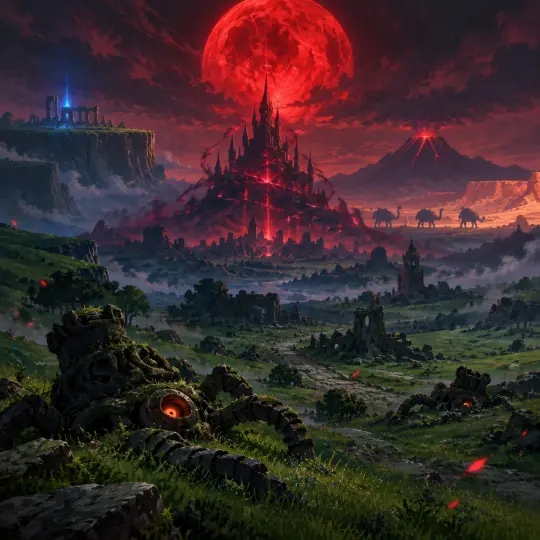
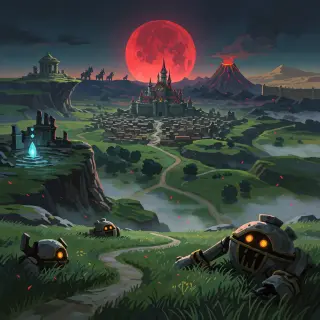
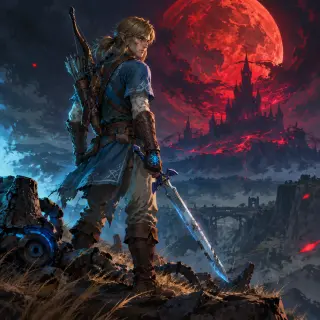
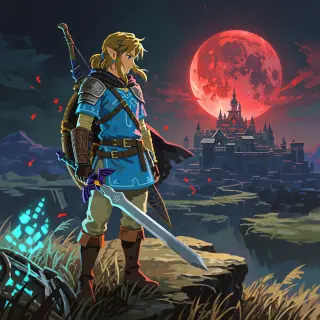
Hyrule: The Blood Moon Age is a fan-built, playable dark fantasy world on Neta Studio. It takes the Hyrule you remember — the green hills, the buried machines, the princess holding a door shut — and asks the one question the games keep circling: what does a kingdom do when the seal is the only thing standing between it and the thing it sealed?
This is Hyrule: The Blood Moon Age rebuilt as a workspace rather than a wiki: 26 atoms across five categories — 8 characters, 6 locations, 5 events, 4 factions and 3 relics — plus four published key visuals generated from the world itself in a GPT Image 2 versus Krea 2 comparison. Every person, place, turning point and relic below is an editable object. Change the canon and the images, the roleplay and the pages follow.
| Quick facts | |
|---|---|
| World | Hyrule: The Blood Moon Age |
| Type | Dark fantasy kingdom / post-Calamity |
| Era | One hundred years after the Great Calamity |
| Atoms | 26 — 8 characters, 6 locations, 5 events, 4 factions, 3 relics |
| Core conflict | The seal is failing; to break it is to loose the Calamity |
| Mood | Epic, elegiac, quietly desperate |
| Visual style | Commercial game painterly |
| Models compared | GPT Image 2 and Krea 2, same prompts, no post-processing |
Why Hyrule: The Blood Moon Age Works as a World to Play In
Most fantasy settings hand you a prophecy and ask you to care about it. This one hands you a timer. Zelda's sealing power is the only thing keeping Calamity Ganon inside Hyrule Castle, and it is failing. That single fact turns every conversation into arithmetic: break the seal and you save the princess and loose the Calamity; hold it and you let her burn as a lock. Every faction in the kingdom has picked a side of that sum, and the knight who could end the argument cannot remember why he should.
The result is a setting that generates plot without a villain speech. The clock is the Blood Moon. The map is a set of places that survived by pretending the centre of the world no longer matters. The cast is a working government of grief: a scientist who reversed her own age, a prince who turned mourning into an army, a chief who inherited a bad name, a king who is dead and still waiting. You do not need to invent a reason for the party to move. You only need to ask what they are willing to lose this week.
The Kingdom in One Page
Hyrule is a ring of biomes around a wound. Green hills and grassed-over roads in the centre, a volcano in the north-east, a desert in the south-west, snow and a cold lake in the north-west, and the sea somewhere past the edges. Ten thousand years ago the Sheikah built four Divine Beasts and an army of Guardians to kill the Calamity. A hundred years ago those same machines were turned against their makers, the four Champions died in a single night, and the kingdom fell. What remains is villages, shrines humming under the soil, and a castle wrapped in a red-black cocoon where a princess has held a monster for a century.
The 26 Atoms, and Why They Matter
Neta Studio worlds are built from atoms: small, named, editable objects. A character is an atom. A location is an atom. An event, a faction and a relic are atoms. The point is not to catalogue a fandom; it is to make canon operable. When you open this world, you are not reading a wiki page about Zelda — you are holding the levers that decide what Zelda can do, what the castle costs, and which of the four tribes answers the call.
Twenty-six is small enough to hold in your head and large enough to argue with. The eight characters give you a government, a resistance, a scientist and a dead king. The six locations give you a map with real distances and real weather. The five events give you a history that explains the present without excusing it. The four factions give you four incompatible answers to the same question. The three relics give you three things people will lie, steal and die for.
The Cast: Eight People Who Cannot Agree
This is not an ensemble of heroes. It is a room of people with incompatible plans and a shared deadline. Read them as positions in an argument, not as stat blocks — the roleplay skill will do the rest.
The Places That Still Stand
Six locations, each with a strategic role in the seal argument. The map is designed so that every journey costs a night, and every night costs another slice of the seal.
The Century That Broke the Kingdom
History here is not lore for its own sake. Each event is a load-bearing explanation for something the players will trip over in the present: why the machines attack, why the tribes are slow to answer, why the king is still on the plateau, why the sword is asleep.
Four Factions, Four Answers
Every faction in the world has looked at the same failing seal and reached a different conclusion. That is the engine of the campaign. The players will not unite them; they will have to choose which arithmetic to live with.
Three Relics, Three Kinds of Want
The relics are not power-ups. They are arguments you can hold. Each one asks a different question, and each answer changes who the party becomes.
The Style Contract for Hyrule
The world carries a visual style called Commercial Game Painterly. It is deliberately narrow, because a world that looks like everything looks like nothing. Broad visible painted planes, hard structural edges, large connected colour groups, deep shadows and a few saturated accents. No line art, no photographic skin, no PBR glass, no readable text.
| Quick facts | |
|---|---|
| Medium | Commercial game painting |
| Shaping | Broad visible painted planes, strong structural grouping |
| Edges | Hard brush-shaped edges at turns and focal points; soft only on organic and distant forms |
| Colour | Large connected local colour, deep-colour shadows, few saturated accents |
| Light | One cinematic direction, readable depth layers |
| Detail | Face, hands and signature props only; large surfaces stay quiet |
| Avoid | Line art, airbrush gradients, 3D render look, text, logos, watermarks |
That contract is what makes the model comparison meaningful. Both models received the same world, the same style rules and the same two prompts. GPT Image 2 produced depth, weather and material truth. Krea 2 produced silhouette, colour and poster read. Neither is wrong. The world now has both, and you can choose per surface.
The Blood Moon Is a Clock, Not a Backdrop
Run the Blood Moon as a countdown, not an event. Each night the seal thins by one degree, and something that was buried gets up. Give the players a visible track — a row of nine marks, a candle, a list of names — and let them watch it fill. The horror is not the monster. The horror is the arithmetic they keep choosing.
This is also how you avoid the usual campaign problem of infinite rest. There is no downtime. Every long rest is a night, every night is a tick, and every tick is a decision about who is left outside the walls. The world becomes a resource-management game with a princess at the bottom of the ledger.
How to Start a Session in This World
Open the world
Start from Hyrule: The Blood Moon Age on Neta Studio. All 26 atoms are listed and editable; nothing is locked.
Pick a pressure
A missing scout, a Divine Beast waking, a tribe refusing to answer, a Yiga cell inside the walls. One pressure is enough for a session.
Choose three atoms
One character, one place, one faction. Resist the urge to use the whole cast; the setting is strongest when the party is outnumbered and under-informed.
State the cost out loud
Before the first roll, say what the seal loses if the party does nothing. That number is the session's real antagonist.
Describe an action, not a feeling
Say what the character does. The world answers with distance, weather, a price, or a door that was not there before.
Hold the seal → lose the princess → the tribes notice → the Yiga move → the Blood Moon rises → something buried walks → a faction demands a decision → the party chooses what to lose.
What a Session Actually Looks Like
A table of four arrives at the Great Plateau with a dead king who will not stop talking and a shrine that has started humming again. They need to cross to the castle, but the bridge is held by a New Champions checkpoint and the Zora want a favour first. Behind them, a Blood Moon is three nights out. Nobody is wrong. Everybody is tired. That is the tone.
The world rewards preparation and punishes certainty. A party that plans gets to choose which cost they pay. A party that improvises gets a scene they will remember and a debt they will not. The roleplay layer keeps every NPC consistent with the same four pressures: the seal, the tribes, the machines, and the knight who cannot remember.
- The stakes are legible — a seal, a princess, a night count. You can point at what is being lost.
- The rules do the work — the seal, the Blood Moon, the machines and the tribes generate plot without a villain monologue.
- The cast is a government — grief, competence and incompatible plans, not destiny.
- The style is a contract — one world, two models, four published images, no post-processing.
Who This World Is For
- Zelda fans who want to play the gaps The century under the seal, the fall of the Champions, the politics the games skip. The world is built exactly in those gaps.
- Game masters running dark fantasy A complete map, a cast with motives, a clock and a style guide. Drop a party in and the setting does the first hour for you.
- Worldbuilders testing a pipeline A worked example of atoms → prompt → image → page, with two models and four published results to compare.
- Artists studying model behaviour The same two prompts on GPT Image 2 and Krea 2, at the same size, with the prompts published in full on the guide page.
Questions People Ask
Play the seal, not the prophecy
Open Hyrule in the studio, pick three atoms and a pressure, and let the Blood Moon do the pacing. The cast, the map and the style contract are already loaded.
Hyrule: The Blood Moon Age on Neta Studio
Four published key visuals, two models, one world — every image on this page was generated from the same 26 atoms.
Platform: Neta Studio · Type: World · Hyrule: The Blood Moon Age · World ID: world_MVLTPFFU14B42J · Atoms: 26 · Works: Hyrule Under the Blood Moon (GPT Image 2 / Krea 2) · The Knight Who Should Have Died (GPT Image 2 / Krea 2)