
Inception: Dreamshare — A Dream-Heist World Built with AI
A complete Inception-inspired dream-heist canon rebuilt as an AI world: eight characters, six locations, five events and four factions, plus four published key visuals from a GPT Image 2 vs GPT Image 2.5 comparison. A city that folds, a corridor with no floor, and a man who cannot go home until he plants one idea.
Inception: Dreamshare — Worldview
Dreamshare is a black market built on stolen sleep. Extracted secrets, forged identities and architect-built cities are sold to corporations, and the best extractor in the trade is a fugitive named Dom Cobb. Hired for a job no one has survived — not stealing an idea but planting one — Cobb assembles a crew of specialists and descends through three nested dreams, where memory is a weapon, time runs downhill, and the dead wait in the basement.
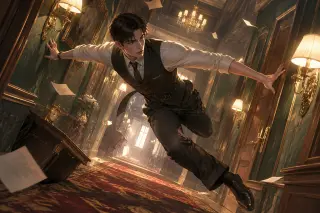
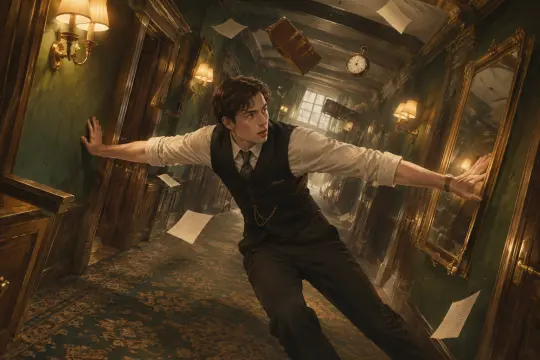
A boulevard that folds into the sky. A hotel corridor with no floor. A snow fortress above a frozen valley. None of it is a special effect — it is architecture behaving like a feeling.
The World in One Frame
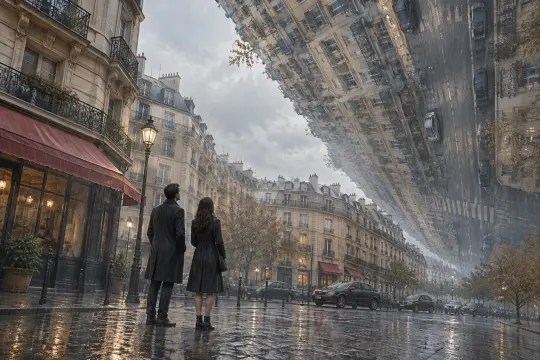
The cover is the entire premise in a single image. Paris is not decorated or destroyed — it is simply rearranged, one street lifted like a page being turned, upside-down cars still parked along it. Nothing glows. Nobody flies. The terrifying part is how calm the two witnesses are: they are not running from the impossible, they are inspecting it, the way an architect checks a load-bearing line.
That is the rule this world runs on. Dreams are not chaotic here; they are drafted. Someone chose where the wall ends, someone calculated how the pavement meets the sky, and someone is now walking through the result with a clipboard in their head. The image is beautiful and bureaucratic at the same time, which is exactly the tone of a heist.
What Dreamshare Actually Sells
The trade is not magic and it is not therapy. Dreamshare sells access: to a competitor's strategy, to a dead parent's last instruction, to a password that only exists in someone's memory of typing it. Extraction is industrial espionage conducted in a room that does not physically exist. The product is a fact, and the invoice is paid in cash, favours or leverage.
Inception is the harder service. Planting an idea means making a person believe they arrived at a thought themselves, which requires the crew to build a world convincing enough to be ignored, populate it with projections that behave like immune systems, and time a collapse across three levels so the mark wakes up certain of something that never happened. It is the most expensive form of persuasion ever devised and it cannot be repeated on the same mind.
“The idea is the parasite. The dream is only the room you leave it in.” — a line the trade repeats and never writes down
Cast: Eight People Inside One Idea
Every member of the crew represents a different relationship to unreal spaces. The architect builds them, the point man defends them, the forger inhabits them, the chemist supplies them, the tourist funds them, the mark is trapped inside one, and the projection has stopped agreeing to be furniture. Put any two of them in the same dream and the scene writes itself.
Six Places That Only Exist While You Sleep
Each location answers a different production question: where do you teach the rules, where do you buy the drug, where do you run, where do you fight, where do you bury the mark, and where do you go when there is nowhere further down. The sets are designed as pressure vessels, not backdrops.
The Timeline: Five Events, Three Dreams Deep
A failed extraction, a proposal, a marriage that became a mechanism, a triple kick and an awakening. Each event is a playable scenario and a prompt seed: one sentence that already holds a place, a cost, and a person who has to decide whether to keep descending.
The Powers Behind the Sleep
Four organisations hold the map together. Two are corporations, one is a family inheritance and one is an unlicensed guild. None of them is primarily interested in dreams; they are interested in advantage, continuity and deniability. That is what makes the politics feel like a boardroom with the lights off.
The Rules of the Dream
Five rules do most of the world-building. They are simple enough to explain in one line and cruel enough to generate unlimited scenes. If you fork this world, keep the rules and change the city; the rules are the engine, and the architecture is only the paint.
The Core Conflict
Cobb can enter anyone's mind but not his own: his guilt over his wife's death manifests as Mal, a projection who sabotages every job and knows the crew's plan before they do. To earn his return home, he must commit the same crime that destroyed his family — inception — while keeping a grieving heir, a skeptical architect and his own subconscious from waking the dream too soon.
The question is not whether Cobb can plant the idea. It is whether a man can build a world convincing enough to fool someone else while his own world keeps refusing to hold him.
The Look: Architectural Surrealism, Painted Straight
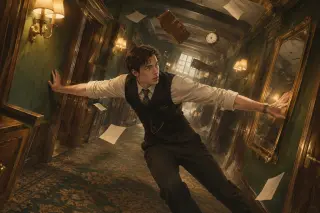
The visual target is not neon dreamscape and not glossy science fiction. It is semi-realistic painterly surrealism: recognisable cities, correct materials, restrained colour and one impossible operation performed without comment. Paris is grey and wet. The hotel is green and brass. The fortress is white on white. The dream never announces itself; the wrongness is in the geometry, not the palette.
That restraint is the style lock. A folded street works because the awnings are still red and the cobblestones are still wet. If the city glowed, the fold would become decoration. The painterly finish keeps the image from looking like a photograph of a set, while the material logic keeps it from drifting into fantasy illustration.
Model Comparison: Document Against Dream
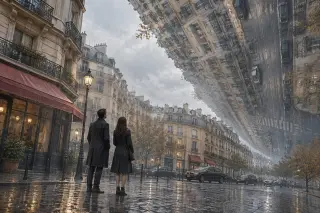
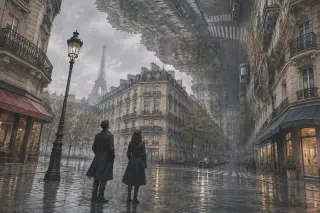
Both models were briefed from the same world atoms and the same two scene briefs, then asked for a key visual that could open a story page. GPT Image 2 resolves the world as a document: awnings, balcony rails, crosswalk paint, the point where wet stone meets a ninety-degree fold. GPT Image 2.5 resolves it as a poster: a wider gesture, a cleaner diagonal, more air in the sky and a composition that survives a small thumbnail. Neither is the correct answer. The comparison is the product.
The Prompts Behind These Frames
Folding City brief. Semi-realistic painterly dream-heist key visual, cinematic wide shot: a Paris boulevard folding over itself at a right angle, a whole street of Haussmann facades, awnings and parked cars rising vertically into an overcast sky, wet cobblestones reflecting the upside-down rooftops, two small figures in dark coats standing on the pavement looking up, pale grey-blue light, thin rain, muted ochre and slate palette, restrained film grain, no text, no logos.
Rotating Hotel brief. Semi-realistic painterly dream-heist key visual, cinematic interior: an art-deco hotel corridor rotating in zero gravity, doors and framed mirrors tilting away from the floor, a man in a dark waistcoat and rolled shirtsleeves braced between two walls, floating dust and loose sheets of paper, warm brass sconces against deep green walls, patterned carpet sliding sideways, hard one-point perspective, restrained film grain, no text, no logos.
Both prompts follow the same six-clause order: medium and genre, place, subject, evidence of physics, light and palette, and a negative clause that removes text and logos. That order is what makes the outputs comparable. If one prompt were written for GPT Image 2 and another for GPT Image 2.5, the comparison would measure the prompts instead of the models.
What You Can Build From These Atoms
A world is a kit, not a bible. The same twenty-three atoms support a visual novel about a marriage that became a mechanism, a puzzle game about keeping three clocks in sync, a short film about a chemist closing his shop, or a branching story about an architect who finds a room she did not draw. The atoms do not dictate the genre; they supply the pressure.
Visual novel
Play Ariadne in the week before the Fischer job: every question you ask Cobb makes the dream more accurate and the crew less safe.
Puzzle game
Keep three levels falling at once. One second of disagreement and the whole architecture forgets which way is down.
Short film
A forger has one hour inside a face he did not build, and the person he is imitating starts giving him advice.
Campaign setting
Run a crew of unlicensed extractors in a city where the client, the mark and the architect are all lying about which dream they are in.
Why This World Is Built for AI
This setting is unusually well suited to a world-grounded generation pipeline because its visual logic is a set of architectural operations, not a mood board. A fold is a line. Zero gravity is a tilt. A snow fortress is a silhouette. There is no dragon to invent and no alien grammar to explain. The fantasy is that a familiar street obeys an unfamiliar instruction.
Operations as prompts
Fold, rotate, flood, mirror, collapse. Five verbs cover most of the world, and each one produces a readable image without a character name.
Real cities, wrong physics
Haussmann stone, art-deco brass and alpine concrete give the model recognisable material to render, so the impossible part stands out.
Every frame is a rule
Because the world is built from locations with mechanics, a still image can imply the plan, the clock and the mistake in one composition.
From World Seed to Published Work
The pipeline is deliberately short: a world is a set of atoms, a work is a prompt pointed at those atoms, and a published work is a permanent share link attached to the world. That means lore and marketing are the same asset. The key visual is not decoration for the world page; it is an entry point into the world, with the prompt and the model recorded for anyone who wants to reproduce or fork it.
Fork the world → edit character, location and event cards → generate key visuals → publish as works → others fork your version
For this world, that loop produced four published frames in two passes. The first pass established the fold at street level: a boulevard, a lifted street, two witnesses. The second established rotation at body level: a corridor, a braced figure, paper refusing to fall. Both passes used the same two briefs on both models, which is why the world page can show a genuine comparison instead of a curated highlight reel.
Choose the seed
Fork this world, or write a one-sentence dream-heist brief about a specialist whose ordinary skill becomes a criminal advantage.
Pick the operation
A fold in Paris, a rotation in a hotel, a flood in a rainy downtown, a collapse in a snow fortress.
Cast the witness
Name the architect, the point man, the mark — and the object they are holding that proves which level they are on.
Render both models
Run the same brief through GPT Image 2 and GPT Image 2.5 and publish both as works of this world so they can be compared side by side.
Iterate in public
Compare, re-prompt or fork the world and start again — every published frame is a fork point for the next person.
Studio Workflow
The world lives in Neta Studio, where atoms are editable cards and works are published artefacts. You can fork the world, rewrite a character, add a location, generate a new frame and publish it without leaving the studio. The four works on this page are the proof: every image is a live asset, every share link resolves, and every prompt is stored with the work.
Open the world
Start from the Inception: Dreamshare studio and read the atoms before you write a prompt.
Edit an atom
Change a location's geometry, a character's motive or the cost of a mistake. The world is a draft.
Generate a frame
Use the world brief as the first clause of the prompt, then add the operation and the witness.
Publish the work
Attach the frame to the world as a work, with its prompt and model recorded.
Fork and compare
Share the world, let someone else fork it, and keep the frames that survive the argument.
Explore the World
The world, its twenty-three atoms and its four published key visuals live on Neta Studio. Fork it, rewrite a character, add a location, or generate the next frame. If you only want to look, start with the folded boulevard and then open the rotating corridor — the two frames together explain the whole visual thesis: real material, impossible architecture, no explanation offered.
Create from This World
Inherit a fugitive extractor, a city that folds and a dead woman who knows the plan — then tell your own story inside the dream.