Inkwell Isles — A 1930s Rubber-Hose Cartoon World of Contracts, Casinos and Cup-Headed Debtors
A chain of inked islands where nothing dies, every soul can be signed away, and two cup-headed brothers have one year to beat the Devil at his own ledger.
Worldview
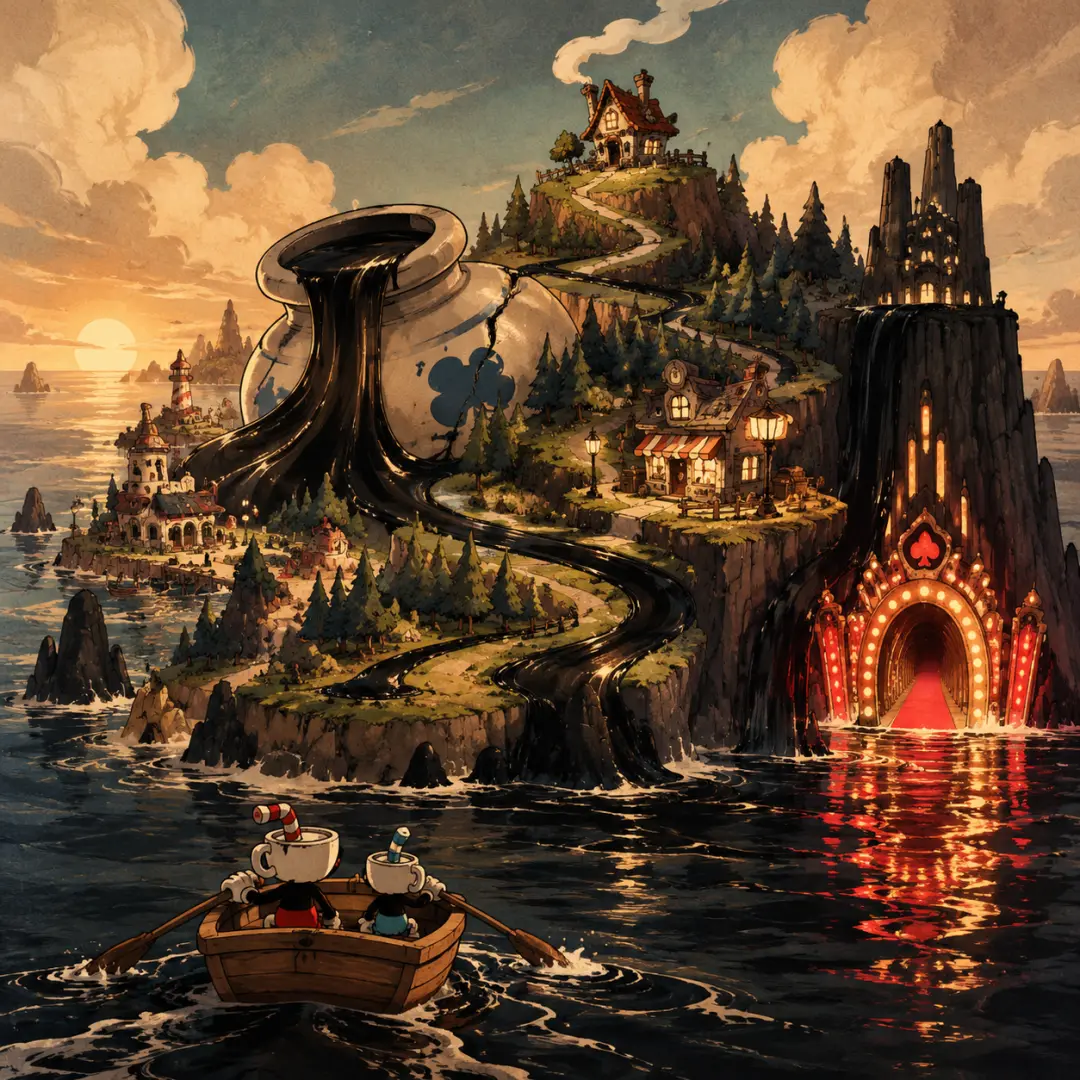
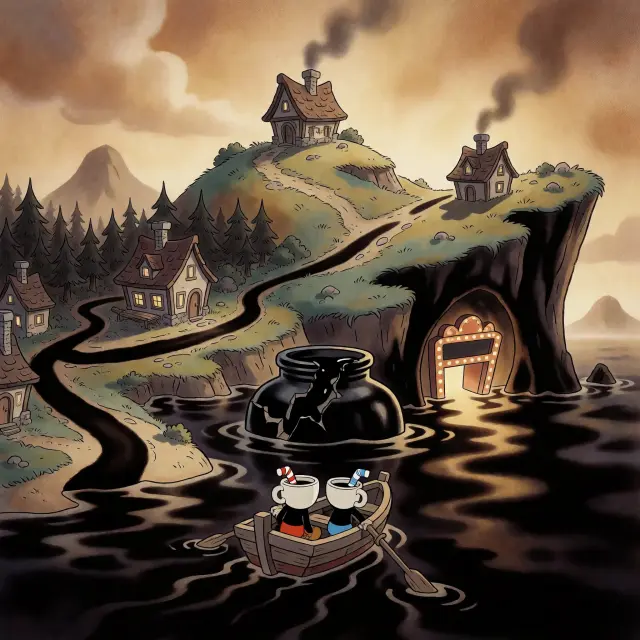
The Inkwell Isles are a chain of cartoon islands drawn in the 1930s and never erased. Rubber-hose towns lean over a churning inky sea, hilltop cottages smoke through crooked chimneys, and every citizen is a line that learned to talk. Long ago a giant ceramic inkwell cracked and spilled the archipelago into being; since then the Devil has run a casino in the hollow beneath the water, buying souls one signature at a time. Debtors are handed a deed, a stretch of land and a standing order to fight anyone the House sends. Two cup-headed brothers signed on a bad night. Now they work the collection route in reverse, beating the Devil's debtors to tear up their own contract before the annual audit closes the ledger.
A world built on a single joke with a knife behind it: everything here is drawn, so everything here can be signed away. The sunshine is painted, the jazz is stamped into the groove, and the paperwork is forever. The Inkwell Isles are a 1930s rubber-hose cartoon dark comedy of 25 atoms — a full cast, five islands, five turning points, four powers and three laws of ink — where the funniest thing in the room is usually the most dangerous.
Nothing in the isles can die, because nothing here was born. A soul can still be owned, a name can still be scratched out, and a contract can still be beaten — but only by the debtor who holds it, in a duel, in front of witnesses. That is the whole engine of the setting: a legal system enforced by fists, cartoons and a house band.
The Cast (6)
Locations (5)
Events (5)
Factions (4)
The Laws of Ink (3)
Inkwell Isle One: The Front Porch of the World
Every story in the isles starts at the cottage. Elder Kettle's house sits on the highest hill of the first island, with a vegetable patch, a leaning fence and a view of the whole chain. The boys leave it in the morning, get into trouble by noon and come back at dusk with something broken. The island teaches the visual grammar of the world: warm cream sky, black-ink paths, a single hot red accent, and a horizon that looks painted because it is.
Inkwell Isle Two: The Carnival That Always Wins
The second island is the world's smile. Striped tents, a ferris wheel, a calliope and rows of games where the prize is always a receipt. The carnival is where the House does its softest recruiting: a debtor who is having fun signs faster than a debtor who is afraid. It is also the best place in the world to stage a chase, because every striped surface and spinning light gives a key visual its rhythm.
Inkwell Isle Three: The City That Keeps the Books
The third island is the most modern and the least innocent. Elevated trains, neon, nightclubs and a boardwalk that ends at the water; a city of agents and middlemen who have never signed a page themselves but know exactly whose name is on it. The city is where the ledger gets its clerks, and where the brothers learn that a man in a clean suit can be more dangerous than a monster in a pit.
Inkwell Isle Four: The Workshop Where the First Page Was Drawn
The fourth island is high, cold and quiet: black rock, pine forest, a mountain road and an observatory nobody maintains. The old ink is thickest here. Somewhere on the ridge is the workshop where the first contract was drawn, and the tools that drew it. The island is the world's origin story and its least funny place — the point where the cartoon stops being a cartoon and becomes a cosmology.
Inkwell Hell: The Casino Beneath the Sea
The casino is the world's capital. A vast Art Deco pit under the water, all green baize, brass rails, stained glass and lamps that never quite go out, with the ledger in a room behind the cashier's cage and the audit chamber behind that. Everyone arrives eventually. The House band plays through every collection, because a debt collected in silence is just a robbery; a debt collected in front of an audience is a show.
The Night at the Tables: The Scene That Starts Everything
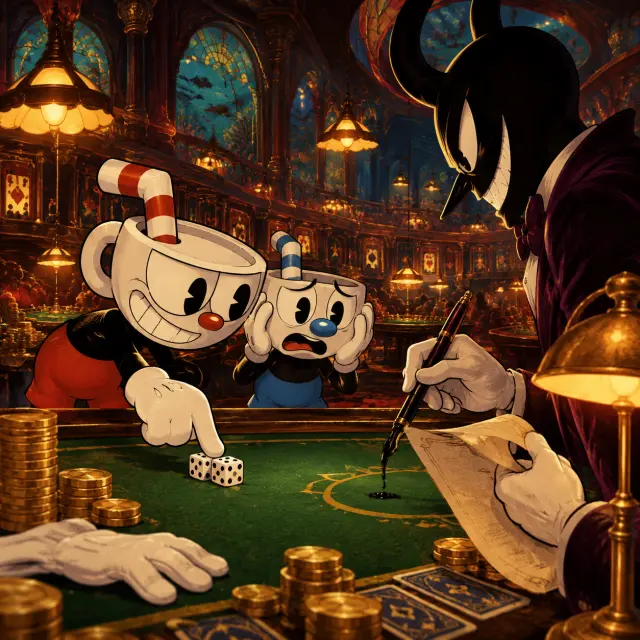
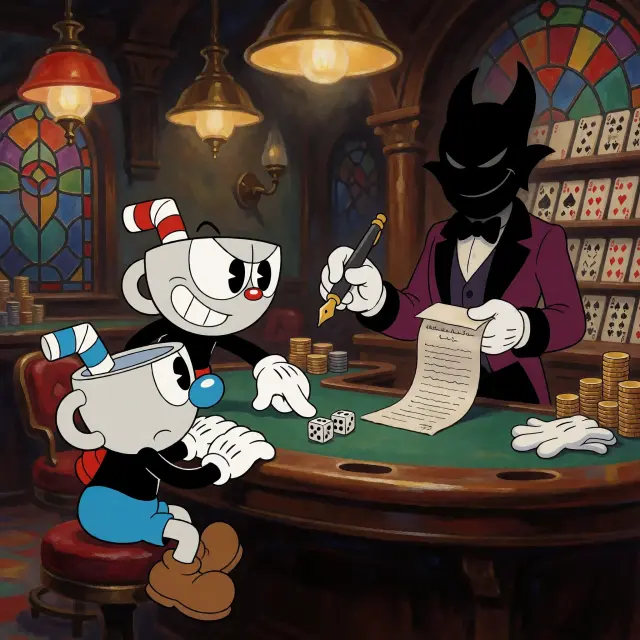
The inciting incident is a gambling scene, but it is written like a contract signing. Cuphead is winning, then he is not; Mugman is counting the exits; the dealer never touches the dice; and the pen is already full. The genius of the scene is that nobody cheats in a way the audience can prove. The House does not need to. It owns the table, the room, the band and the definition of a throw.
The Annual Audit: A Deadline With a House Band
The audit is the world's clock. Once a year the Devil reads every deed aloud, writes down every uncollected name in full, and closes the ledger. It is a deadline, a ceremony and a threat delivered in the same breath. For a story, it is a gift: it gives every episode a countdown, every victory a cost, and every character a reason to be in the casino on the same night.
The Core Conflict: A Ledger That Always Balances
The Devil holds a signed contract on two brothers, and the only way to void it is to beat every debtor the House has ever signed, one duel at a time, before the annual audit closes the ledger. The debtors do not want to fight, the House does not have to fight fair, and the one person who knows the loophole had her own name erased for using it. That is the whole plot engine, and it is strong enough to run for years: every episode is a page, every boss is a signature, and every win tears out a little more of the book.
Works from This World
Four key visuals were generated from the Inkwell Isles — two subjects, two models, one canon. The world pair establishes the map and the palette. The character pair establishes the stakes and the cast. Each one is a published work of this world with its own share URL, so the setting and its images travel together.
Model Comparison: GPT Image 2 vs Krea 2
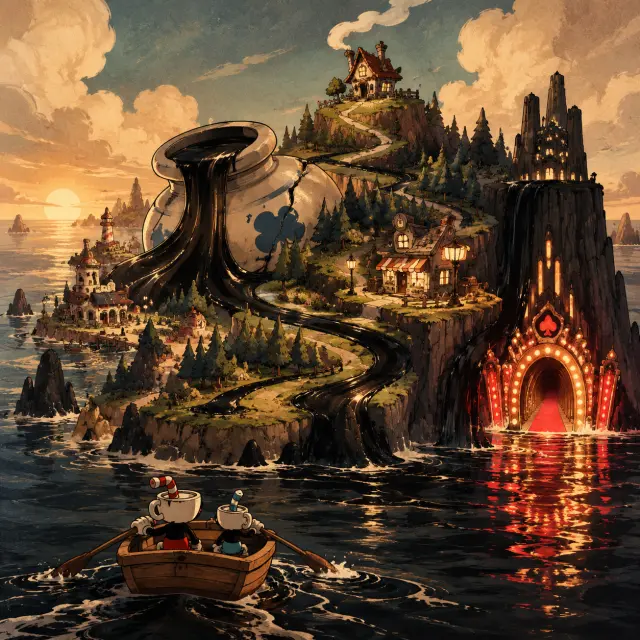
Both models were given the same prompt, word for word. GPT Image 2 builds the world as architecture: a clear depth stack from foreground boat to mid-ground islands to the casino cliff, props used as scale markers, and a level of environmental detail that survives a storefront crop. Krea 2 builds the world as a mood: flatter shapes, warmer light, a poster-like read, and a stronger sense of performance. GPT is slower and more expensive; Krea is fast, cheap and more expressive. The practical answer is to run both and keep the pair.
The World Key Visual, Examined
The world visual has one hard job: explain the setting before anyone reads a word. This one does it with a route. The eye starts at the cracked inkwell in the centre, follows the black-ink spill down into the islands, finds the cottage on the crest, crosses the pine wood to the lit shop, and ends at the casino door under the cliff. Two tiny cup-headed silhouettes row toward it in the foreground. In one image you have the cosmology, the map, the tone and the inciting journey.
The Casino Table, Examined
The character visual is the harder brief, because it has to hold two comedic designs, one menace and one prop that carries the plot. GPT Image 2 stages it as a standoff: Cuphead forward, Mugman braced, the dealer tall and still, the contract and the dripping pen exactly where the eye lands third. Krea 2 stages it as a poster: the same blocking, but warmer, flatter and more theatrical, with the dealer's shadow doing half the work. One is a scene; the other is a title card.
Fork This World
The Inkwell Isles are built to be forked. Change the debtor, change the island, change which page of the ledger is due — the laws of ink still hold, and the visual grammar still carries. You can keep the cup-headed brothers, replace them with your own porcelain protagonist, or set a story in the margin with the Erased. The world is a machine for generating collection routes; all you have to do is pick the next name.
A fork inherits the canon: three laws, four powers and a ledger with room for more names. What it does not inherit is your story. That is the point. The isles are a stage, not a script — the cottage, the carnival, the city, the workshop and the casino are five different genres sharing one coastline.
- World: 25 atoms, all editable.
- Subjects: one world visual and one character/event visual.
- Models: GPT Image 2 for architecture, Krea 2 for mood.
- Output: four public works, each with its own share URL.
Fork the world, open the studio board and generate from the world's own atoms. The world supplies the cast, the map, the events and the laws. The generator supplies the camera, the light and the model. Nothing has to be re-explained between images, because the canon and the image live in the same place.
From Seed to Key Visual
Choose the seed
Fork the Inkwell Isles, or write a one-sentence brief about a 1930s cartoon archipelago where souls are signed away in ink.
Pick the scene
A world visual needs a route; a character visual needs a standoff. The cottage, the carnival, the city, the workshop and the casino all do different jobs.
Write the style contract
Name the medium, the line and the palette. "1930s rubber-hose cartoon, bold fluid black outlines, cream and burnt umber with a single hot red" is the minimum.
Run both models
Use the same prompt on GPT Image 2 and Krea 2. GPT will build the map; Krea will build the mood.
Publish and iterate
Publish both as works of the world, compare them side by side, then generate the next scene from the same canon.
World, Not Work
A single image is a deliverable. A world is a production system. The difference shows up on the second image: with a world, the palette, the props and the architecture are already decided, so a new scene costs a prompt instead of a briefing. The Inkwell Isles are organized around that idea — every atom is a reusable decision, and every work is evidence that the decision holds.
That is also why the four works on this page share more than a style. They share a horizon logic, a color temperature and a vocabulary of props: bendy straws, porcelain cups, green baize, brass lamps, black ink, hot casino red. Generate a fifth image tomorrow and it will belong to the same world without a single reference image.
A canon you can edit
Six characters, five islands, five events, four factions and three laws — all editable atoms, not a fixed bible.
A style that survives
Bold ink outlines, cream and umber, one hot red. The palette is narrow on purpose so every new image reads as the same world.
A plot engine
Every contract has a duel and every year has an audit. The setting generates episodes without needing a new premise.
A comparison, published
The same prompt through two models, both kept as works — so the world documents its own range.
Who This World Is For
Fans of 1930s animation and rubber-hose cartoons who want a setting that takes the style seriously. Game designers who need a coherent cartoon world with a built-in boss structure. Writers and tabletop game masters looking for a campaign frame where every adventure is a contract. Artists who want a palette and a prop language they can generate from. And anyone who has ever looked at a cheerful vintage cartoon and thought: this could be genuinely sinister.
Frequently Asked Questions
- What are the Inkwell Isles? A 1930s rubber-hose cartoon world on Neta Studio: a chain of inked islands where nothing dies, souls can be signed away, and two cup-headed brothers are trying to beat the Devil's ledger.
- How many atoms does the world have? 25 — six characters, five locations, five events, four factions and the laws of ink, all editable.
- Which model made these images? Both. Each subject was rendered twice from the same prompt: GPT Image 2 for detail and architecture, Krea 2 for mood and poster expression.
- Can I fork it? Yes. Fork the world, keep the laws and change the cast, the island or the debt. The canon is designed to survive a rewrite.
- Is this an official Cuphead page? No. It is an original world seed inspired by 1930s rubber-hose cartoons, built and published on Neta Studio.
Start Creating
Fork the Inkwell Isles or start from your own one-sentence cartoon brief. The world ships with 25 atoms and four published key visuals, so the fastest path to a poster is to reuse the canon and change the moment. When it looks right, publish it as a work of the world — and let the next person fork it.
Start Creating
Two models, one inked archipelago, a poster in minutes — rendered, published and remixable.