
It Takes Two — A Co-op Fairytale World Where the Marriage Is the Level Design
A complete co-op fairy-tale world rebuilt as an AI world: 23 atoms — 7 characters, 6 locations, 6 events, 4 factions and 3 laws of the house — plus four published key visuals from a GPT Image 2 vs Krea 2 comparison, and an interactive studio. Two parents, one house, and every door needs both of them.
Worldview
It Takes Two is a co-op fairy tale about a marriage that has already ended on paper. Cody and May have agreed to divorce; their eight-year-old daughter Rose makes two clay dolls of them and cries over them, and the tear wakes the Book of Love. By morning the parents are the dolls, the house is a continent, and every way back to human size runs through a room they stopped looking at. This is that world rebuilt as an AI world on Neta Studio: 7 characters, 6 locations, 6 events, 4 factions and 3 laws of the house — 23 atoms in all — plus four published key visuals generated from it in a GPT Image 2 vs Krea 2 comparison.
The premise is a children's book and a divorce hearing at the same time. Rose's tear does not fix her parents; it shrinks them, and the Book of Love — a living self-help tome with a tiny doctor inside — refuses to reverse the spell until the couple completes its exercises. The house becomes the curriculum: the shed teaches cooperation, the tree teaches alliance, the clock teaches punctuality, the garden teaches memory, the snow globe teaches scale, and the attic asks for the last dance.
Core conflict: two people who have stopped listening are chained to the same puzzle. Cody carries the nails, May carries the hammer; neither can finish a single mechanism alone. The love doctor holds the key and will not open the door until they choose each other again.
Visual style: hand-painted game 3D — modelled silhouettes with painted diffuse texture, visible directional brushwork, controlled warm-cool planes, restrained game light, and a miniature scale that makes every household object a building. The palette is workshop warm against dust blue, with one hard blade of window light per frame.
Characters (7)
Locations (6)
Events (6)
Factions (4)
The Laws of the House
Works from This World
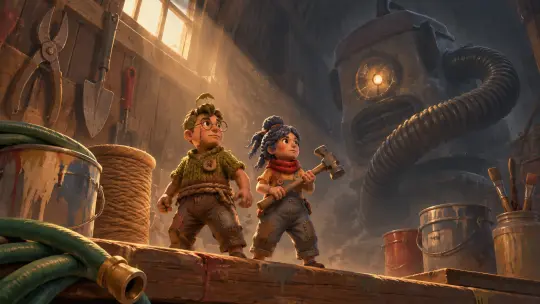
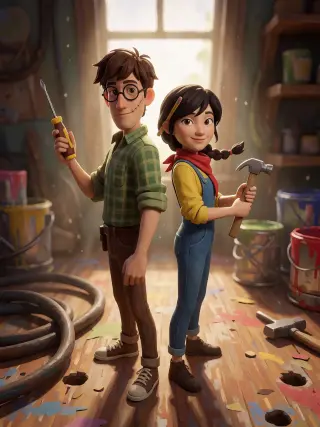
Four works have been published from this world — two briefs, each rendered by two models. The first is the world key visual: the Shed at cathedral scale. The second is the character pair: Cody and May back to back on the workbench. Neither model received a reference image; both received the same prompt, so the difference you see is the model's reading of the brief, not the brief itself.
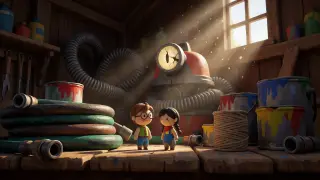
Model Comparison: GPT Image 2 vs Krea 2
GPT Image 2 renders the shed as a lit interior with a history: the hose has weight, the paint cans are dented, the dust is a physical object, and Hoover's headlamp is a real light source. Krea 2 renders the same sentence as a poster: cleaner colour blocks, a toy-bright palette, the vacuum reduced to a cracked clock face, the dolls placed dead centre. Neither is wrong. GPT Image 2 gives you a frame that survives inspection and crop; Krea 2 gives you a frame that reads at thumbnail size in one glance.
The Shed Awakens — GPT Image 2 vs Krea 2
The same sentence, two readings of scale. GPT Image 2 puts the dolls low in the frame and lets the tool wall and the machine tower over them, so the shed feels like a building with a roof you cannot see. Krea 2 pulls back, centres the pair, and turns the same space into a bright diorama where every object is legible at once.
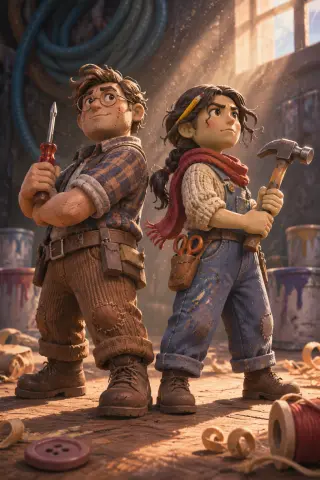
Cody & May — GPT Image 2 vs Krea 2
The character pair makes the split even clearer. GPT Image 2 builds the dolls from material — the flannel weave, the scuffed knees, the seam down Cody's cheek, May's hammer worn at the head. Krea 2 builds them from silhouette and colour — the red scarf, the yellow sleeves, the pencil in the braid — and lights them like an animated feature. If the frame is going on a store page, choose GPT Image 2. If it is going into a feed, choose Krea 2.
What the Comparison Proves
Run the same sentence twice and you learn more about a model than any benchmark. GPT Image 2 follows clauses literally and pays for it in speed. Krea 2 follows the mood and pays for it in specificity. The useful workflow is not to pick a winner — it is to publish both and let the world keep the pair as its reference, so every later render of the Shed has two answers to argue with.
- GPT Image 2 — best for hero frames, store pages, print, and any crop that will be inspected at 100%.
- Krea 2 — best for feeds, thumbnails, mood boards, and fast variation before a final render.
- Both — publish the pair. The comparison is the asset, not the winner.
From Seed to Key Visual
Choose the seed
Fork It Takes Two or write a one-sentence co-op fairy-tale brief about two people who cannot finish anything alone.
Pick the room
The Shed, the Tree, the Cuckoo Clock, the Garden, the Snow Globe, the Attic — each one teaches a different lesson and frames a different poster.
Cast the pair
Name both dolls and give each one prop: the screwdriver, the hammer, the red scarf, the seam on the cheek.
Render both models
Run the identical prompt through GPT Image 2 and Krea 2; the studio publishes both as works with their own share pages.
Compare and iterate
Keep the frame that survives the crop, then re-prompt the room at a larger scale. Every poster becomes a fork point for the next one.
World, Not Work
In Neta Studio, a world is the beginning of everything. A world contains characters, locations, events and factions as editable atoms; every image, game or video is generated from those atoms rather than from a blank prompt box. That is why the Shed in these two key visuals has the same tools on the wall as the Shed described in the location card — the model is reading a canon, not a mood.
A world is not a single image. A world is the source of every image: the place list becomes a background library, the character list becomes a cast sheet, the event list becomes a storyboard, and the faction list becomes the argument the story is built around.
World → Game
Select a storyline from the world cards; the studio writes game logic, generates art and builds a playable scene from the same atoms.
World → Video
Animate a location plate or a character portrait into a short loop — a shed door opening, a cuckoo striking the hour.
World → Assets
Each character generates a cover, each location a background. The world itself becomes an asset library you can reuse.
Why This World Matters
Co-op fairy tales live and die on their rules. It Takes Two's rule is unusually clean: every tool is halved, so the mechanic and the metaphor are the same object. That makes it a strong test for an image model, because the frame must hold two equal subjects and one shared problem — not a hero and a sidekick.
- Two-subject composition — a model that defaults to one hero will fail this world immediately.
- Miniature scale — household objects must read as architecture without losing their object-ness.
- Material honesty — clay, flannel, brass, dust. The world is handmade and should look handled.
- Emotional restraint — the story is a divorce, not a battle. The frame should be warm, not triumphant.
Fork This World
This world is public. You can fork it, inherit all 23 atoms — every character, location, event, faction and law — then rewrite the room you want and render your own pair of key visuals. The two model answers stay attached to the world as reference works, so your version starts with a visual argument already in progress.
Collaborative workflow
Start Creating
Create from This World
Inherit 23 atoms, rewrite the room you want, and tell your own story at doll scale.
Every image on this page is a published work from this world, not a demo render. Open a share page to inspect the full-size frame, or fork the world and generate the next room yourself.