
Metal Gear: The Patriots' Shadow — An AI World Where the Soldier Is the Weapon
A woman is ordered to die in a jungle in 1964. Fifty years later, a machine is still deciding which wars are allowed to happen.
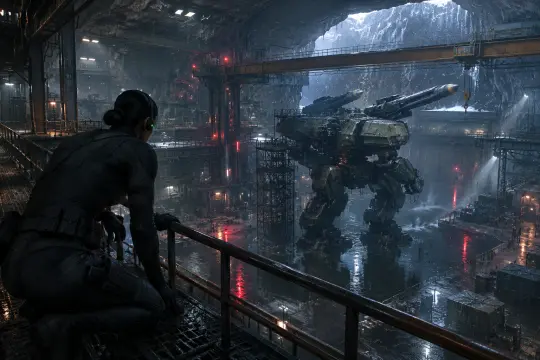
Metal Gear: The Patriots' Shadow — An AI World Where the Soldier Is the Weapon
The most dangerous weapon in this world is not the walking tank. It is the idea that a person can be owned — by a state, by a gene line, by a nanomachine network, by a dead man's will written into software. This world takes the tactical-espionage saga apart and hands you the pieces as editable cards: eight operators, six fortresses, six turning points and four powers, every one of them written to be used in a prompt, a scene or a story tonight.
It is not a synopsis and it is not a wiki. It is a world board: each card has a look, a position and a pressure point, so an image has something to stand on and a scene has someone to push against. Four key visuals are published inside it, generated from two identical prompts on two different models.
Every war in this world is a war over ownership of the soldier — and every system built to win it breaks on a promise one person made to another.
The Premise, Without the Spoilers
Nineteen sixty-four. In a jungle the maps call Tselinoyarsk, a woman is ordered to defect, help a weapons scientist escape, and then die at the hands of her own student so that her government can deny everything. She does it without a word. The man who kills her is given her name, her legacy and a title, and spends the next fifty years learning what the silence cost him.
Everything after grows out of that one order: nuclear-capable walking tanks, cloned sons told different stories about their own genes, offshore fortresses built as homes for soldiers with no country, and finally an artificial intelligence that inherits the grudges of dead men and administers the world's wars as a managed economy. The surface is military thriller — infiltration, interrogation, deterrence, black budgets. Underneath it is a single question asked four different ways: who owns the soldier?
- 8 operators — from The Boss in 1964 to Solid Snake in 2014, each holding one position in the argument
- 6 fortresses — Tselinoyarsk, Outer Heaven, Zanzibar Land, Shadow Moses Island, Big Shell, Mother Base
- 6 turning points — the operations and incidents that reset the board each generation
- 4 powers — FOXHOUND, Outer Heaven, Philanthropy and The Patriots
- 24 editable materials and 4 published key visuals made inside this world
Eight Operators, Eight Positions
Every character here exists to make one argument unavoidable. Open a card in the studio and you get the look, the history and the position — enough to write a prompt that produces a specific person rather than a generic soldier.
Six Fortresses That Each Answer the Same Question
The locations are not backdrops. Each one is an attempt to answer “where do soldiers belong?” — and each one fails in a different way, which is what makes them useful for composition: a frozen bunker, a sun-baked mine, a hexagonal platform over the Atlantic, an oil rig in the Seychelles.
Six Turning Points, 1964 to 2014
The events are written as beats, not plot summary. Each has a pressure point you can build a scene around — a death that must be denied, a clone programme that starts as a contingency, a test that turns out to be the mission itself.
Four Powers, Four Kinds of Loyalty
Factions are how this world distributes blame and affection. Each has a uniform, a method and a lie it tells itself, which is exactly what you need to dress a scene or write a briefing.
What the World Is Really About
The engine is not a fight between heroes and villains. It is a contest between two kinds of inheritance: the one a system hands you — genes, orders, nanomachines, a simulation of a childhood — and the one you choose, which in this world always looks like a promise to one specific person. Every institution here is an attempt to engineer loyalty. Every institution breaks on it.
Two Models, One Brief: GPT Image 2 vs Krea 2
Both pairs of key visuals on this page used identical prompt text. Nothing was reworded between models, nothing was re-rolled for style. The only variables were the model, the aspect ratio its parameters allow, and the seed. That makes the comparison useful rather than decorative.
- GPT Image 2 — depth and materialBuilds the hangar as separate planes: catwalk, flooded bay, rock ceiling. Keeps the crane gantries, the cable trunks, the drum stacks, the strobe reflections and the snow blowing through the torn roof. Best when the image has to explain how a place works.
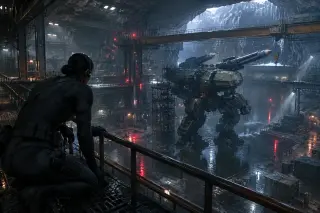
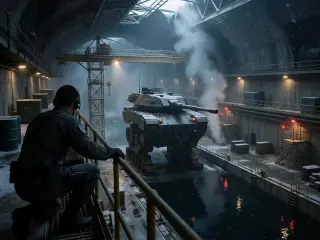
- Krea 2 — shape and speedCompresses the same hangar into a cleaner poster: one walker on a concrete apron, one silhouette on a railing, a colder flatter palette. Roughly one-seventh the cost per image and much faster. Best when the image has to read at card size or carry a title.
- Where they agreeBoth understand a bipedal walker, a catwalk, a headset and a frozen military interior. Both keep the figure small against the machine when the prompt asks for scale. Neither invents a different genre.
- Where they splitGPT Image 2 adds props, water and depth; Krea 2 removes them for clarity. GPT explains, Krea advertises. The choice is not which model is better — it is which job the frame has to do.
How the Hangar Key Visual Was Built
The prompt did not start from a game title. It started from the world’s core claim — one person is small inside a machine built to replace him — and then chose a camera position that could prove it in a single frame.
Pick the argument
One operative, one machine, one room too big for both. That decides camera height and the figure-to-walker ratio before any style words.
Choose the three planes
Foreground catwalk with railing and grating; middle ground flooded service bay; background rock ceiling with a torn panel and snow. Write them in that order.
Name the light sources
Sodium work lamps overhead, red hazard strobes in the water, volumetric searchlights from the gantries. Unnamed light returns generic grey fog.
Fix the figure
Back to camera, crouched, one hand on the rail, codec earpiece glowing. A face turns the image into a portrait and loses the room.
Render both models
GPT Image 2 at 1536×1024 and high quality for the hero; Krea 2 at 1024×768 on the same text for the poster cut. Compare before rewriting anything.
How the Corridor Key Visual Was Built
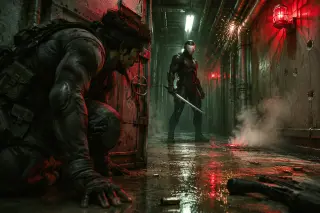
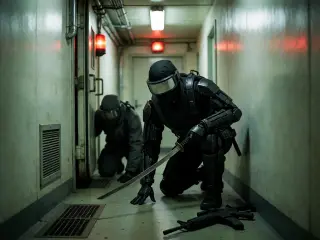
The second prompt is harder because it contains two people, a prop, a wound and a single corridor — four things that can all collapse into a blur at once. The trick is to give each body a fixed relationship to the architecture.
Set the corridor
Narrow service corridor of a nuclear disposal facility, one-point perspective, blast door on the left, wet steel floor, a floor grate venting steam.
Place the two bodies
Operative kneeling behind the open blast door in the left foreground, hand flat on the floor; cyborg framed dead centre, katana held low, cracked white visor.
Add the evidence
Sparks from a severed conduit, fresh bullet impacts in the wall, a discarded rifle on the floor. These props tell you a fight already happened off-frame.
Colour-code the alarm
Crimson rotating beacon as the key, cold fluorescent green as ambient, so the red reads as a state of emergency rather than decoration.
Break the symmetry
Handheld documentary framing and shallow focus on the visor. Perfect symmetry turns a standoff into a poster and kills the tension.
Where the Two Models Actually Disagree
On the hangar, GPT Image 2 produced a place with weather: water in the bay, snow through the roof, reflections under the walker, a second and third light source. Krea 2 produced a place with a composition: a walker centred on a clean apron, the operative as a small dark shape on a railing, and a palette cold enough to print a title on. If the page needs to explain a hangar, GPT wins. If the page needs a thumbnail that survives a 120-pixel crop, Krea wins.
On the corridor, the gap is bigger. GPT Image 2 kept the two roles separate — one man pinned behind cover, one machine standing in the open — and used the rifle, the shell casings and the steam to imply time passing. Krea 2 rendered a beautiful, legible standoff, then merged the two figures into one armoured silhouette, which erases the whole point of the scene: a human facing something that used to be human.
The practical rule: use GPT Image 2 when the viewer has to understand what is happening, who is winning and what it costs. Use Krea 2 when the viewer only needs to feel the genre in half a second — a poster, a card, a title frame — and accept that props and secondary bodies may simplify.
Five Story Seeds You Can Play Tonight
These are not scenes from the games. They are situations this world’s rules produce the moment you put two of its cards together.
How to Start From This World
You do not have to rebuild a hangar to stand in it. The world is open, the cards are editable, and the four published works already carry their prompts — which means you can fork the exact brief instead of guessing at it.
Open the studio
Read the eight operator cards, then pick the one whose position you want to argue with. That choice sets the palette more than any style keyword.
Pick one fortress
Mother Base at dusk, Shadow Moses under floodlights, Outer Heaven at noon. The location decides the light rig, and the light rig decides whether the frame feels like a thriller or a poster.
Write a six-clause prompt
Rendering system, composition, place, subject, one wrong-physics detail, negative clause. Keep the negative clause — it is what stops the model drifting into illustration.
Generate on both models
Same text, GPT Image 2 and Krea 2. Keep the one that answers the brief, not the one that looks most expensive.
Publish it into the world
A published work keeps the prompt, the model and the world together, so the next person can fork the brief rather than reverse-engineer the picture.
Questions People Ask Before Starting
Do I need to know the games? No. The world is written to be entered cold: every card explains the position it holds, and the timeline reads as six pressure points rather than a continuity quiz.
Is this a copy of the games?
No. It is a fan-built setting with its own editable materials. Characters, places and events are world cards written for generation and play, not canonical text, and the four images on this page were made inside this world rather than taken from it.
Which model should I use first?
GPT Image 2 if you need a room, a costume or a standoff explained. Krea 2 if you need a poster, a card or a title frame that reads at thumbnail size. The two comparisons on this page are the honest version of that advice.
Can I use the images commercially?
The images are generated assets published inside this world, so treat them the way you would treat any AI-generated asset you produced here: check the platform terms, keep the prompt with the file, and credit the world if you build on it.
Why are there only four works?
Because this page is a comparison, not a gallery. Two prompts, two models, four frames — enough to show a real difference in how each model handles scale, props and two bodies in a corridor.
Start From the World as It Stands
The hangar lights are on, the corridor beacon is turning, and the four published works are already loadable with their prompts. Take the brief you like, change one card, and see what the machine does with it.
Enter the Patriots’ shadow
A world of eight operators, six fortresses and one question that never stops being asked. Start a scene — or open the studio and read the cards first.
Metal Gear is an independent, fan-built world in Neta Studio and is not affiliated with Konami or the rights holders of the series. Every character, place, event and faction here is an editable world material rather than canonical text. The four key visuals on this page were generated inside this world with GPT Image 2 and Krea 2 from two identical prompts. Open the studio to read every card.