
Metroid — The Hunter, the Machine and the Last Larva
The Metroid canon rebuilt as an explorable AI world: eight characters, six locations, six events and four factions — plus four published key visuals from a GPT Image 2 vs Krea 2 comparison on identical briefs. A bounty hunter raised by birds, a brain in a jar that runs a planet, and a lock everyone mistakes for a gun.
Metroid: A Galaxy Built Around One Locked Door
The Chozo did not build the Metroids to win a war. They built them to hold a door shut. A gelatinous parasite called the X can absorb any living thing and wear its shape — face, voice, memory, combat skill — and the only predator that reliably eats an X is a Metroid. So the Chozo bred a hunter of the hunter, seeded SR-388 with it, and hoped the lock would hold long enough for someone else to find the key.
Then the Chozo vanished, and everyone with a fleet found the door. This world is what happens next, written as a working kit: twenty-six atoms, four published key visuals, and enough structure that any two cards can be put in a room and produce a scene.
A bounty hunter raised by birds. A brain in a jar that runs a planet. A larva the size of a gunship that chose a mother. The Metroid canon is a locked-room mystery where the detective is also the weapon.
Everything on this page belongs to one world: the characters, the locations, the timeline, the four factions, and the four renders that were generated inside it. Two briefs were sent to two models with no rewrites in between, so the pair of images below is a real comparison rather than a curated highlight reel.
The Worldview: A Lock, Not a Weapon
Every faction agrees on one fact and disagrees about everything it implies: the Metroids were engineered. The Galactic Federation calls them a bioweapon and files the paperwork. The Space Pirates call them a power source and steal the shipping manifests. Mother Brain calls them a garrison. Raven Beak calls them a bloodline. Only the Chozo records — and Samus, who was raised on them — say what the Metroids actually were: a containment system, built by people who had already watched a civilisation get eaten from the inside.
That single reframe turns the canon from a monster-of-the-week shooter into a political story. If the Metroids are a lock, then every attempt to weaponise them is an attempt to remove a lock from a door that is still holding something back. The horror is not the creature. The horror is how quickly a room full of adults decides the lock is worth more as a gun.
Every power in the galaxy wants the Metroid. Only one remembers why it exists.
The Timeline: Six Events That Break the Galaxy
Six events are enough. Each one is a decision with a body count, and each one changes what the next generation believes is normal. Read them in order and the canon becomes a chain of custody: the Chozo lose control of their own defence system, the pirates inherit it, the Federation tries to copy it, a parasite escapes the copy, and one hunter keeps arriving late enough to bury what is left.
Six Places That Hold the Story
The map is vertical and mean. A quarantine planet at the bottom of the food chain, a fortress world already destroyed twice, a cathedral built to house a computer, a buried colony with a crater nobody can seal, a floating city maintained by machines that outlived their makers, and a research station that simulates environments the Federation does not own. Every location is an argument about who gets to run an ecosystem.
The Cast: Hunters, Machines and the Last Larva
Eight characters carry the world, and each one is written as a position in an argument rather than a power level. Samus is the inheritance. Adam is the cost of command. Mother Brain is order without consent. Ridley is appetite with a fleet. Raven Beak is the past refusing to die. Kraid is force without strategy. Dark Samus is a copy with no original left. The Baby Metroid is the only character in the canon who chooses someone freely — and the canon kills it for that.
Four Powers, Four Definitions of Order
The politics work because nobody in the room is lying about what they want. The Federation wants a monopoly on force and calls it law. The pirates want the market and call it survival. The Chozo wanted stewardship and left a library of machines that cannot tell the difference between a student and an intruder. The X want to be everything, and they are honest about it. Put any two of those in a corridor and the scene needs no villain.
Tourian: The Room the Whole Canon Points At
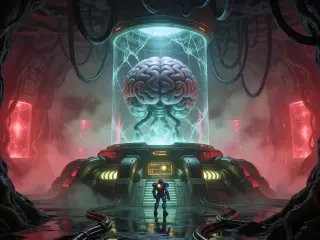
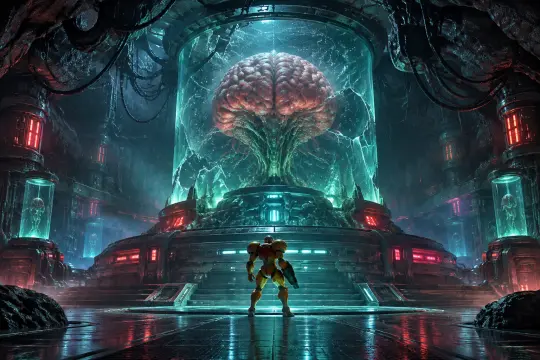
Every storyline in Metroid eventually walks down the same staircase. Tourian is not a final level so much as a thesis: a cathedral built by a species that believed in containment, converted into a throne room by the thing they built to protect them, guarded by the creatures they built to protect everyone else. The architecture is honest. The vats are labelled. The barriers are made of a material that only opens for the right inheritance, and the thing behind the glass has been waiting long enough to be polite about it.
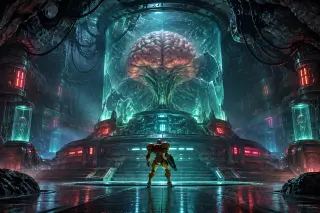
That is why Tourian is the best single frame to test a model on. It needs scale, symmetry, wet stone, bioluminescence, a metal dais and a human figure small enough to make the room feel like a verdict. If the room reads as a boss arena without any text, the world holds. If it reads as a sci-fi corridor, the prompt has lost the politics.
“The Chozo built a guardian and got a government. The pirates built a religion and got a machine. Samus built a life out of the wreckage and got a job.”
The Look: Chozo Stone Against Pirate Steel
The visual language is a collision of two material cultures. Chozo work is bone-white masonry, brass, carved relief and warm amber light — patient, symmetrical, built to last ten thousand years. Pirate work is grafted steel, exposed cabling, magenta alert strips and welding scars — fast, scavenged, held together by threat. Samus sits between them in orange and red, the only object in the frame that was made with care and then repaired in the field.
Keep the palette tight and the model will keep the genre: deep teal stone, bone white, oxidised brass, alarm magenta and one warm orange subject. Add a sixth saturated colour and the frame slides toward generic sci-fi illustration. Add fog and a wet floor and the same frame starts to look like weather, which is what makes these rooms feel abandoned rather than staged.
- Two materials, one frame. Carved stone for the civilisation that left, welded steel for the one that moved in. Never blend them into generic sci-fi paneling.
- One warm subject. Orange-and-red armour is the only saturated warm note; everything else is teal, bone and magenta.
- Wet stone, not chrome. Reflections should come from water on the floor, not from polished spaceship corridors.
- Scale through a small figure. The room is the character. Put a human-sized silhouette at the bottom of the frame and let the architecture win.
- No text. Every label, warning sign and HUD element is a failure to render, not a detail to add.
Model Comparison: Structure Against Atmosphere
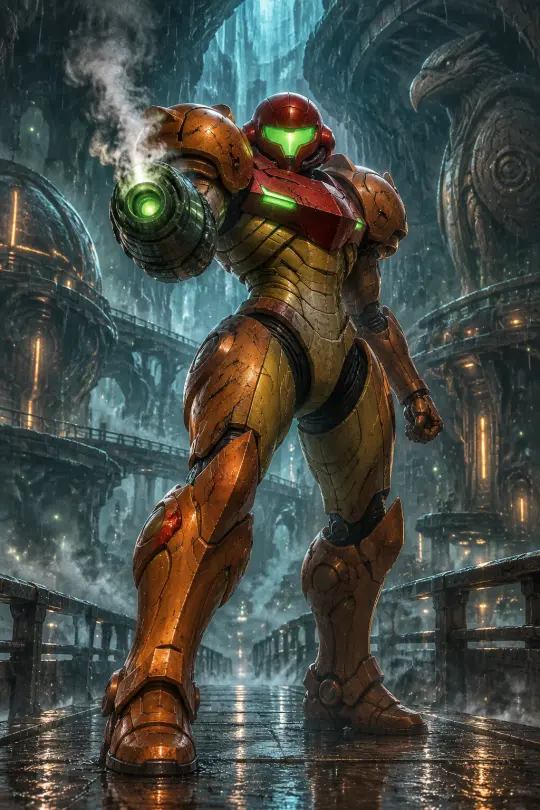
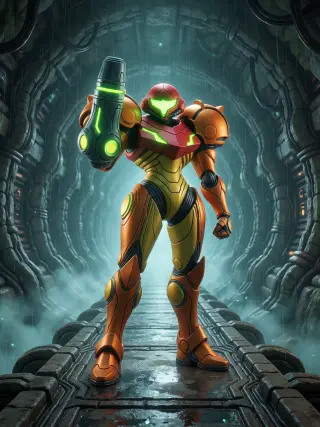
Both models were briefed from the same world atoms and the same two scene briefs, with no rewrites in between. GPT Image 2 resolves the world as a place: armour seams, steam from a venting cannon, cracks in a containment cylinder, cables with a physical route from ceiling to floor. Krea 2 resolves it as a mood: compressed values, heavier rim light, a poster silhouette and a stage-like symmetry that makes the room feel designed for a confrontation.
Neither result is the correct answer, and that is the point of publishing both. GPT Image 2 is the better tool for a world bible, because a reader can believe the room continues past the frame. Krea 2 is the better tool for a cover, because it decides what the frame means before the viewer has time to ask. A world page that shows only one of them is an advertisement; a world page that shows both is a working document.
The comparison also exposes a useful asymmetry. GPT Image 2 will happily render twelve small details and let three of them be wrong; Krea 2 will render four shapes and make all four correct. If your prompt has a specific object that must exist — a cracked capsule, a zebetite barrier, an arm cannon with a visible barrel — GPT Image 2 is more likely to build it. If your prompt needs a feeling that survives a thumbnail, Krea 2 gets there in one pass.
The Prompts Behind These Frames
Character brief. Metroid character key visual, stylized semi-realistic 3D game art: Samus Aran in her orange-and-red Varia power suit standing on a rain-slick Chozo way-station catwalk, green visor glowing, arm cannon raised and venting steam, thick segmented shoulder plating with visible battle scars, a cavernous ribbed alien corridor of stone and machinery behind her, cold teal backlight against warm orange armour, volumetric mist and drifting spores, cinematic vertical character poster, dramatic rim light, no text, no watermark.
Location brief. Metroid location key visual, stylized semi-realistic 3D game art: the Tourian control chamber deep beneath the planet Zebes, a colossal organic brain-computer suspended in a cracked glass cylinder above a circular dais ringed with pulsing conduits, a lone armoured bounty hunter standing small at the foot of the platform, blue-green bioluminescence against red alert light, cables hanging like roots from a wet basalt ceiling, shallow reflective floor, cinematic wide shot, volumetric haze, no text, no watermark.
Both prompts follow the same six clauses: medium and genre; subject and costume; place and scale object; light and palette; composition and lens; and a negative clause that removes text and watermarks. That order is what makes the comparison honest. If one brief had been written for GPT Image 2 and the other for Krea 2, the pair would measure the prompts instead of the models.
The negative clause is doing more work than it looks like. “No text, no watermark” keeps the frame usable as a key visual. It also stops the model from inventing Federation stencils, pirate signage or a HUD, all of which read as AI artefacts at thumbnail size and force a re-render. Write the negatives once, keep them identical across the set, and the set starts to look authored.
Why Metroid Is a Hard, Useful Test for Image Models
Most sci-fi prompts ask a model to invent a spaceship. Metroid asks it to hold two design languages in one frame and keep them legible: a vanished civilisation's carved stone and an occupying army's welded steel, with a single warm subject between them. That is a much better stress test than a generic cyberpunk street, because failure is obvious. If the stone turns into paneling, the politics disappear.
The canon also supplies hard, specific nouns that models can actually draw — a glass capsule, a ringed dais, a segmented shoulder pauldron, an arm cannon, a zebetite barrier, a floating brass city. Specific nouns beat adjectives. A prompt that says “ancient alien ruins” gets concept art; a prompt that says “a cracked glass cylinder above a circular dais ringed with conduits” gets a room.
Two material cultures
Carved Chozo stone and welded Pirate steel in the same frame. The collision is the genre; a single unified look is the failure mode.
One warm subject
Orange-and-red armour is the only warm note in a cold room. Take it out and the image becomes a landscape instead of a story.
Scale as argument
A human-sized figure at the foot of a machine the size of a building is the canon's whole thesis in one composition.
From Key Visual to Playable Scene
A world is a kit, not a bible. The same twenty-six atoms support a survival-horror run through a station that is too clean, a boss-rush down a cathedral staircase, a management game about keeping a floating city's turbines running, or a quiet story about a hunter who keeps arriving one room too late. The atoms do not dictate the genre; they supply the pressure.
Survival horror: BSL
You are a federation researcher on a station with a false sun. The X have replaced three colleagues. The only weapon that works is a larva in a containment jar that you have to feed.
Boss rush: Tourian
Eight rooms, eight inherited mistakes. Each fight is a machine the Chozo built to protect something, and the only way down is through the thing it was protecting.
Visual novel: The Last Egg
Play the week between SR-388 and Ceres Station: a hunter, a hatchling and a government that has already written the invoice for both.
Management: SkyTown
Run a Chozo city whose maintenance drones outlived their makers. Every district you restore wakes a system that was sealed for a reason.
Who Should Build in This World
Publishing, Forking and Remixing
This world is public and forkable. Open it in the studio, change a character, add a location, render a new frame and publish it as a work attached to the same world. Every published frame keeps its prompt and its model, which means the next person can reproduce it, compare it against a different model, or fork the world and take the argument somewhere else.
Read the atoms → choose a consequence → render two models on one brief → publish both → compare → fork or re-prompt
That loop produced the four frames on this page in two passes. The first pass established a character at human scale: a hunter, a corridor, a raised cannon. The second established a room at institutional scale: a machine, a dais, a very small figure. Both passes used identical briefs on both models, which is why the page can show a comparison instead of a mood board.
Frequently Asked Questions
Is this an official Metroid product? +
No. This is a fan-built world assembled from publicly known Metroid canon and rendered with AI models. It is not affiliated with or endorsed by Nintendo.
What is actually in the world? +
Twenty-six atoms: eight characters, six locations, six events and four factions, plus four published key visuals generated inside the world with GPT Image 2 and Krea 2.
Can I use the images commercially? +
The renders are published to demonstrate the workflow. Metroid and its characters are Nintendo's intellectual property, so treat the images as fan work, not licensed assets.
Why compare two models on one page? +
Because a single render hides the decision. Two models on one brief show what was gained and what was sacrificed, which is more useful than a highlight reel.
How do I start my own version? +
Fork the world, keep the lock-not-weapon rule, and change one variable: the planet, the faction in charge or the thing the Metroids are containing.
Enter the World
Inherit a suit that was never finished, a machine that runs a planet and a larva that chose the wrong mother — then tell your own story inside the ruins.