
Mob Psycho 100 — An AI Anime World About the Feeling Behind the Power
Seasoning City rebuilt as an editable AI world: seven espers, six locations, six turning points, four organisations and five rules, plus four published key visuals from a GPT Image 2 vs Krea 2 comparison. A boy who wants to be ordinary, a con man who sells him a story, and a meter that never stops counting.
Mob Psycho 100 — The World in One Sentence
A city where psychic power is real but officially impossible, where spirits haunt parking lots and cram-school stairwells, and where the strongest esper alive is a fourteen-year-old boy who would rather join a muscle club than use it. Mob Psycho 100 is a comedy about immense power and small ambitions, and the joke is never that Mob is weak. The joke is that everyone else has decided what his power is for.
A boy who can bend a building with a thought wants a body strong enough to do one pull-up. A con man with no powers builds a business on that boy’s silence. And somewhere behind Mob’s closed eyes, a self with no manners is waiting to be introduced. This is a world where the most dangerous thing in the room is a feeling nobody said out loud.
The World in One Frame
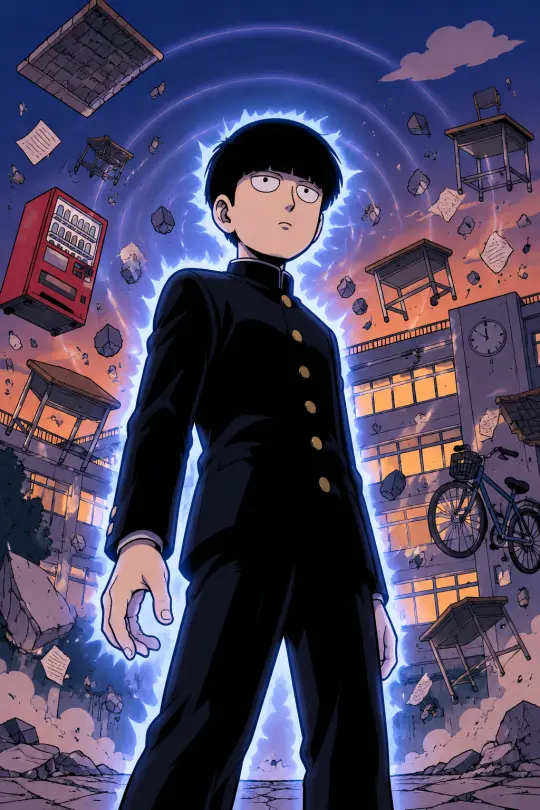
The cover is not a battle. Nothing in it is being punched, and no one is shouting. It is a schoolyard after the last bell, with the ordinary furniture of a Japanese public middle school — desks, roof tiles, a vending machine, a bicycle — lifted a metre off the ground and held there by a boy standing very still. That stillness is the entire thesis. Mob does not look powerful. He looks like he is waiting for the feeling to pass.
Everything the world needs is arranged around that stillness: the school that measures him by effort rather than power, the city that would rather not notice him, and the meter behind his eyes that is always counting. The frame is bright, flat and almost cheerful. The horror is entirely in the composition.
What Seasoning City Actually Runs On
The city runs on three currencies: ordinariness, attention and silence. Ordinariness is the social contract — you go to school, you join a club, you do not mention the thing in the parking lot. Attention is what Reigen sells, because attention is cheaper to manufacture than power. Silence is what Mob pays with, because every feeling he swallows is credit against a bill that will eventually come due.
That is why the world works as satire and as horror at the same time. A society that refuses to believe in psychic power does not become safe. It becomes a place where espers learn early that being seen is dangerous, where cults can sell belonging in bulk, and where a boy with enough power to end a district is praised for being modest.
“The most powerful esper in the city is not hiding. He is doing his homework. That is the joke, and it is also the threat.” — world note
Cast: Seven People and One Very Bad Business Model
Every character is defined by what they do with power they did not choose. One refuses it, one sells it, one worships it, one inherits it, one loses it, one was ruined by it, and one wants to replace the entire social order with it. The cast is a set of arguments about the same question: what is power for?
Six Places That Should Not Coexist
The locations are built as pressure vessels. Each one asks a different production question: where does the city perform normality, where does it hide the children it ruined, where does the small resistance pay rent, and where does a cult put a god?
The Timeline: Six Days That Changed the Meter
The events are ordered by escalation, not chronology. Each one raises the cost of being seen: a childhood accident, a part-time job, a schoolyard duel, a raid, a cult, and finally the night the meter breaks. Read in sequence, they describe a boy learning that the thing he is most afraid of is also the thing everyone wants from him.
The Four Organisations That Want to Define Him
The factions are not good and evil. They are four different answers to the same question, and each one is attractive for a reason. That is what makes the world usable for stories: the pressure on Mob is not a villain, it is a set of plausible offers.
The Five Rules of the World
The rules are the physics of the setting, but they are also the emotional physics. Power grows with training, yes, but it also grows with everything the character refuses to say. Once you accept that, the world becomes easy to write: every scene can be about a feeling looking for an exit.
The 100% Meter Is the Best Rule in the World
Most power systems measure what a character can do. This one measures what a character will not say. That single change turns every fight into a character scene and every character scene into foreshadowing. When the meter climbs, the audience is not waiting for a technique. They are waiting for a confession.
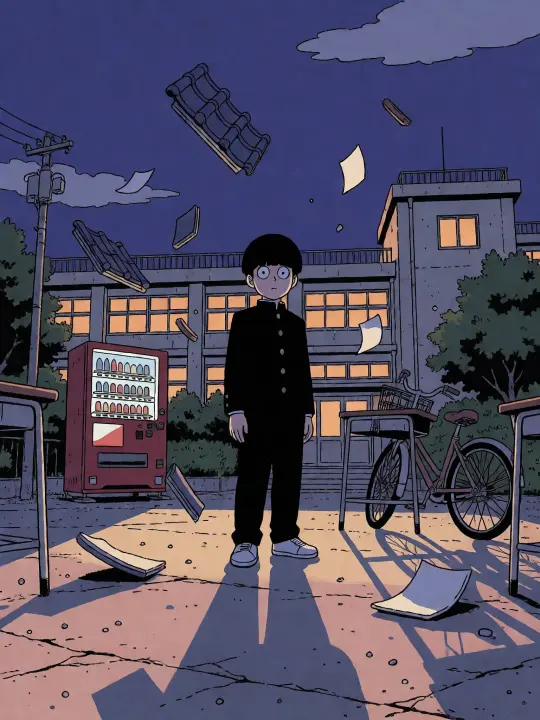
The rule also solves the adaptation problem. A world built on this meter can generate key visuals that do not need a fight choreography to be dramatic. A boy standing in a courtyard is enough, provided the objects around him have started to disobey gravity.
Design note. When prompting this world, put the feeling in the object list, not in the word “emotion”. A floating desk, a vending machine three centimetres off the ground, a bicycle wheel turning without a rider: these are legible. “Overwhelming psychic aura” is not.
Why It Works as an Editable World
A good world is not a plot summary. It is a set of objects and rules that can generate new plots. Mob Psycho 100 is unusually well suited to that because its central mechanic is internal, its supporting cast is a set of competing institutions, and its city is deliberately ordinary. You can drop a new esper into any ward and the world will explain them.
The meter
Any scene can start with a number. What is Mob at today? What did he swallow to get there? The answer is a story.
The office
Any case can start with a client. A haunted flat, a cursed object, a parking lot with a grudge. The office is a plot engine with rent.
The city
Any location can be ordinary until it is not. A train station, a cram school, a rooftop. The world supplies the contrast for free.
The factions
Any antagonist can be sincere. Claw, the cult and the office all offer Mob a version of belonging. The conflict writes itself.
That is also why the world benefits from a fixed visual language. The atoms give you the nouns; the style gives you the grammar. Without the grammar, every new frame looks like a different adaptation of the same show.
The Visual Style: Bold Line Comic
This world is set to a bold-line comic style: very thick, stable outer contours, simpler interior lines, flat high-readability local colour, a few discrete value steps and compact hard-edged shadow. Clean matte fills, very little texture, no painterly rendering. The point is not to imitate a screenshot. The point is to make every frame legible as a graphic object at thumbnail size.
That choice matters for SEO and for the world itself. A flat, high-contrast frame survives cropping, compression and a small card on a phone. It also keeps Mob’s deadpan face readable, which is the entire emotional engine of the property. A photoreal Mob would be a different, much worse idea.
Style clauses that do the work: bold black contour lines; flat cel-shaded colour blocks; two hard value steps; minimal texture; strong graphic silhouette; preserve age, body type and facial features; avoid photorealism, PBR, heavy paint and fine anime lines. Add “no text, no logo, no watermark” to every brief.
Model Comparison: Same Brief, Two Answers
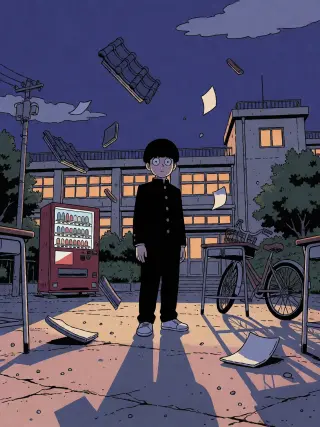
The four published works were generated as a controlled comparison. The same two prompts went to GPT Image 2 and Krea 2 at matched aspect ratios. Nothing about the brief changed between models, which is the only way to learn what each model is actually good at.


Prompt Anatomy for This World
The prompts that produced these works share six clauses. They are boring on purpose: a fixed order is what makes two models comparable, and what keeps the world consistent when a different person writes the next brief.
Medium and style
Anime key visual in a bold-line comic style. Lock the rendering system before you describe anything else.
Subject and wardrobe
Name the character, age, hair, eyes and the black gakuran with its high collar and gold buttons. Wardrobe is identity in this world.
Place and time
A cracked concrete schoolyard at dusk, or a cramped second-floor office at night. Name the city texture, not just the room.
The impossible event
Objects lifted in a slow radial explosion, or a green spirit floating above a worn sofa. One impossible thing, stated as a fact.
Light and palette
Cold blue-white aura against orange windows and deep indigo; or fluorescent beige, teal upholstery and neon through glass.
Negative clause
No text, no logo, no watermark. Add no photorealism when the style is flat cel.
The most common failure is not a bad model. It is a brief that asks for a mood instead of an event. “Mob looks powerful” produces a generic anime boy with glowing eyes. “A vending machine is floating three centimetres above a schoolyard and Mob is standing under it” produces a scene.
Seasoning City as a Production Bible
The world has twenty-eight atoms and every one of them is a usable prompt seed. A character card gives you face, wardrobe and want. A location card gives you architecture, props and light. An event card gives you a before and an after. A faction card gives you a uniform and a reason to fight. A rule card gives you the physics that make the frame impossible in the right way.
That is the practical argument for building the world first and the images second. If you generate from a vibe, you get one good frame and no way to make the next one match. If you generate from atoms, the tenth frame still belongs to the same city — and a reader can feel that even when they cannot name it.
What to Build Next
The obvious next frames are the ones the comparison has not answered yet. The Divine Tree at street level, with masked pilgrims and a broccoli crown cutting the skyline. The Seventh Division base, all chain-link and numbered uniforms. The rooftop lunch scene, which is the quietest frame in the world and probably the hardest to make interesting. A Reigen-only frame, no powers, just a man selling confidence in a room that is losing an argument with its ceiling.
Each of those is a test of the same question: can the world stay legible when the aura is switched off? If it can, you have a setting. If it cannot, you have a wallpaper. The four published works are the baseline; the next four should prove the range.
The world, its twenty-eight atoms and its four published key visuals live on Neta Studio. Fork it, rewrite a character, add a location, or generate the next frame. If you only look at one thing, look at the schoolyard: a boy standing still while the furniture floats is the whole property in a single gesture.
Create from This World
A meter that counts feelings, a con man with a rent problem and a city that refuses to notice — tell your own story inside Seasoning City.