OMORI: Headspace and Faraway Town — The Dream, the Door and What Waits Under It
A playable OMORI world built from 25 atoms — 8 characters, 6 places, 5 turning points, 3 factions and 3 rules of dream logic — with four published key visuals made in a GPT Image 2 versus Krea 2 comparison.
OMORI is a game about a boy who has not left his house in four years, and about the bright handmade country he goes to instead. This is that country rebuilt as a playable world: White Space, Headspace, Faraway Town and the dark room underneath, with every person, place, turning point and rule of dream logic written down as an editable object.
The world is built from 25 atoms — 8 characters, 6 locations, 5 events, 3 factions and 3 rules of dream logic — plus four published key visuals generated inside it in a GPT Image 2 versus Krea 2 comparison. The dream and the real town share one cast, one style contract and one prompt. Change an atom and the roleplay, the images and this page all move with it.
Two Worlds, One Boy
Headspace is a country of crayon-green forests, a candy-pink castle, a casino on the water and a picnic blanket that is always waiting. It is warm, funny and generous, and it is also a lid. Faraway Town is the real place underneath: porches, a church, a graveyard, a plaza, and a house with the curtains drawn. The whole world is the distance between those two maps.
| Quick facts | |
|---|---|
| World | OMORI — Headspace and Faraway Town |
| Atoms | 25 across five categories |
| Characters | Omori, Sunny, Aubrey, Basil, Hero, Kel, Mari, Sweetheart |
| Places | White Space, Vast Forest, Sweetheart's Castle, The Last Resort, Faraway Town, Black Space |
| Turning points | Kel Knocks, The Recital, The Four Quiet Years, The Night on the Stairs, The Last Night |
| Rules | Something, the Emotion Triangle, the Photo Album |
| Published works | 4 key visuals · 2 prompts · GPT Image 2 and Krea 2 |
| Style | Crayon and transparent watercolor, reserved paper white |
| Play | Open the world, pick an atom, start a scene |
Why OMORI Works as a World to Play In
Most fan worlds hand you a map and a villain. OMORI hands you a coping mechanism with weather. The dream is not decoration: it is the thing the protagonist is doing instead of grieving, and every cheerful location is evidence of how much he does not want to leave it. That makes the setting unusually good for roleplay, because the scenery is already an argument.
The Places, in the Order You Would Walk Them
- White Space A blank white room with a black light bulb, a laptop, a sketchbook and a door. Omori rests here between adventures. Nothing grows, nothing decays, and the silence is the point.
- Vast Forest Headspace's bright patchwork woodland: crayon-green trees, a playground, a train station and a picnic blanket that is always waiting. The friendliest place in the world, which is why the eye-scribble at the treeline matters.
- Sweetheart's Castle A candy-pink fortress of mirrors, ballrooms and dungeons, ruled by a princess who has never been told no. The dream's satire of authority, played entirely straight by everyone inside it.
- The Last Resort A neon casino city on the water, run by Mr. Jawsum and staffed by sharks in suits who are always happy to extend you credit. The funniest location and the loneliest one.
- Faraway Town The real world: porches, a church, a graveyard, a plaza and a house with the curtains drawn. Small enough that everyone knows what happened, polite enough that nobody says it.
- Black Space The dark country under the dream — a room of broken furniture, wrong memories and a truth that keeps trying to be seen. Not a dungeon. A basement with no floor.
Five Turning Points, One Summer
The Recital
The duet Mari and Sunny practised for months — the performance that was supposed to be his first real one, and never happened. Everything after it is an aftermath.
The Night on the Stairs
The fall that ended Mari's life, and the panicked lie two children told to survive the morning after. The world does not show it as a monster; it shows it as a staircase.
The Four Quiet Years
The years in which a group of children became five strangers living within walking distance of one another. No single event. Just a door that stayed closed.
Kel Knocks
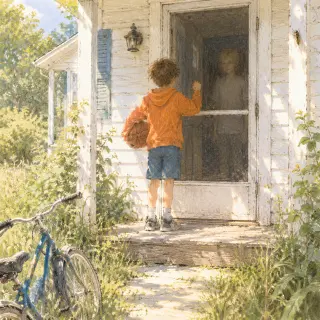
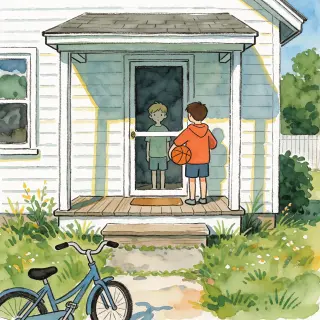
Three days before the move, Kel bangs on Sunny's door with a basketball and a plan. The smallest event in the list and the one that starts the game.
The Last Night
The night the dream cracks open, the truth surfaces, and Sunny must choose whether to wake. The ending is not a boss fight; it is a decision to be known.
The Rules of the Dream
What Something Is, and What It Is Not
Something is not a monster with a motive. It is the outline of a fact that has been refused. That distinction changes how you run it: it never negotiates, it never chases on a grid, and it cannot be killed by a good roll. It gets closer when a character lies, and it recedes when someone tells the truth in front of a witness.
Played that way, the dream logic becomes a mechanic the table can feel. Keep a small truth track — three boxes, no numbers — and tick one whenever a character says the real thing out loud. When the third box fills, the dream lets go of a location: the picnic blanket folds, the castle loses a wall, the casino lights go out one row at a time. Nothing is explained. The world simply stops pretending.
The Same Two Prompts on Two Models
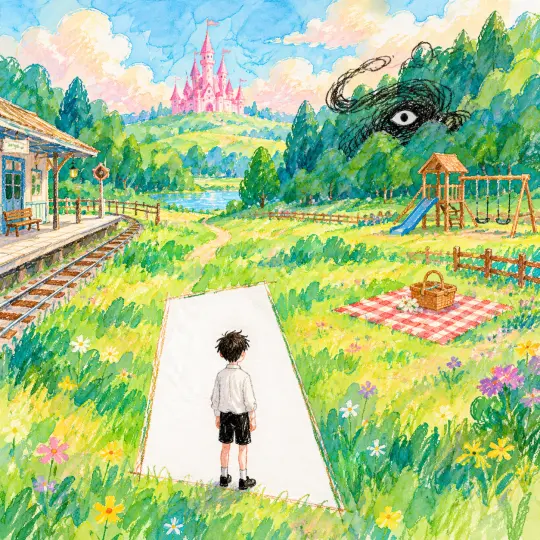
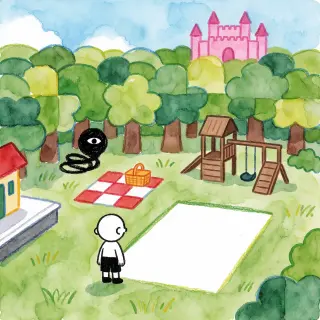
All four images on this page were generated from two prompts and two models at 1024×1024. No reference images, no post-processing, no retouching. The first prompt asks for Headspace as a single wide view with one impossible white rectangle in the grass. The second asks for the porch in Faraway Town on the afternoon Kel knocks. The comparison is the content: same words, two different ideas of what a handmade world looks like.
| What changes | GPT Image 2 | Krea 2 |
|---|---|---|
| Read at a glance | Detail-first; rewards looking | Shape-first; reads at thumbnail |
| Omori | A painted boy with a specific posture | A white oval with two black dots |
| Something | A fine ink tangle in the trees | One bold eye and a thick coil |
| Castle | Pink towers with roof texture | A blocky pink silhouette |
| Light | Soft, directional, watercolour bloom | Even, decorative, almost shadowless |
| Best use | Hero image, world landing page | Poster, icon, social card, fast iteration |
Why the Comparison Is Worth Publishing
- One variable — same prompt, same size, same day. Any difference you see belongs to the model, not to the brief.
- Two useful answers — one image for atmosphere, one for legibility. Neither is the "correct" OMORI.
- A style contract — crayon line, watercolour wash, reserved white, no realistic shading. Written once and reused on both.
- Honest limits — both models invent details. The captions say which details came from the prompt and which were invented.
How to Play This World in Five Moves
Open the world
Start from OMORI — Headspace and Faraway Town on Neta Studio. All 25 atoms are listed and editable; nothing is locked.
Pick one pressure
The move is in three days. Kel is at the door. Basil has not answered a message. Aubrey is waiting at the plaza. One pressure is enough for a session.
Choose three atoms
One character, one place, one rule. Resist the whole cast. OMORI is strongest when two people are talking and a third thing is listening.
Say what the dream costs
Before the first scene, decide which location disappears if the party tells the truth. That is the clock, and it is not measured in turns.
Let the small thing be the hook
A basketball, a cut photograph, a recital program, a door left unlocked. In this world the props are the plot.
A knock → a refusal → a memory that does not fit → the dream compensates → Something appears → a friend asks a direct question → the truth is said or withheld → a place folds away → someone chooses to stay or wake.
Who This World Is For
- OMORI fans who want to play the gaps The four quiet years, the recital that never happened, the conversations the game cuts away from. The world is built exactly in those gaps.
- Game masters running quiet horror No gore, no chase music, no stat blocks. A small town, a kind dream and a rule that punishes lying. The dread comes from the room.
- Roleplayers who like emotional stakes Every scene has a cost that is not hit points. The Emotion Triangle gives arguments a shape, and the truth track gives them a consequence.
- Artists studying model behaviour Two prompts, two models, four published images, the exact prompts in full. A clean comparison with no retouching.
The Prompt Behind the World Key Visual
The prompt does three jobs at once: it lists the geography, it fixes the style contract, and it plants one impossible object. The geography is the train station at the left edge, the picnic blanket, the playground, the pink castle on the hill. The style is crayon and transparent watercolour with reserved paper white. The impossible object is a blank rectangle of paper cut into the meadow, with a boy standing at its edge.
Hand-drawn crayon and transparent watercolor illustration, square composition. A single wide view of Headspace: a bright handmade country of patchwork crayon-green forest, a red-and-white picnic blanket with a wicker basket, a small wooden playground, a candy-pink castle far on the horizon, and a little train station platform at the left edge. In the foreground a pale, expressionless boy in black-and-white clothes stands with his back to the viewer at the edge of a blank white rectangle of paper that cuts unnaturally into the meadow, like a doorway into an empty room. A black scribble with a single white eye coils at the treeline behind him. Waxy broken crayon outlines, reserved white paper, transparent overlapping watercolor washes, pastel brights, soft diffuse light, no realistic shading, no text, no letters, no logo, no watermark.
The white rectangle is doing the heavy lifting. It is not a portal effect, a glow or a screen; it is paper. That single decision tells both models to render the dream as a drawing that knows it is a drawing, which is exactly the tone of the source material.
Canon, Blank Space and the Parts We Invented
This is a fan-built world, and it is honest about the seam. The 25 atoms follow the game: White Space, Vast Forest, Sweetheart's Castle, The Last Resort, Faraway Town and Black Space; Kel Knocks, The Recital, The Four Quiet Years, The Night on the Stairs and The Last Night; Something, the Emotion Triangle and the Photo Album. The images add details the game never fixes: the exact colour of the station roof, how many swings are in the playground, whether the castle has a flag. Those are inventions, and they are labelled as such in every caption.
Questions People Ask Before Playing
Do I need to have finished OMORI to play? +
No. The world page states the premise and the five turning points plainly. If you know nothing, play Sunny as a boy who does not explain himself; the table will learn the rest at the same pace he does.
Is this a horror world or a sad world? +
Both, in that order. The horror is quiet and mostly off-screen; the sadness is domestic and very much on-screen. There is no gore and no jump-scare machinery in the atoms.
How many players does it need? +
Two is enough: one plays Sunny or Omori, one runs the world. Three to five lets you spread the friend group, but the best scenes are two-handers with a third presence listening.
Can I change the canon? +
Yes. Every atom is editable. If you want Mari alive, the recital to have happened, or the castle to be a real place with real citizens, change it and the images and prompts follow.
Why are there two images of every scene? +
Because the world was published with a model comparison. GPT Image 2 and Krea 2 answered the same prompt at the same size. Keeping both makes the style contract visible instead of implied.
Where do I actually play? +
Open the world on Neta Studio and start a scene from the studio. The CTA at the bottom of this page goes to the same place; the images are references, not a substitute for the room.
What to Read Next
- OMORI AI roleplay A use-case page on running the two worlds at a table: scene frames, the truth track, and how to play a character who will not speak.
- GPT Image 2 OMORI world generator The tool page: parameters, the three-pass prompt, the full comparison table and the failure modes worth knowing.
- How to use GPT Image 2 for OMORI world art The step-by-step guide, from reading the world to checking the frame at thumbnail size.
Open the door, or knock on it
Start in White Space, walk out into Vast Forest, and let the picnic last one scene too long. The world, the cast and the style contract are already loaded; you only have to decide who speaks first.
Four published key visuals, two models, one world
Every image on this page was generated from the same 25 atoms — the prompts are published in full.
OMORI — Headspace and Faraway Town is a fan-built world on Neta Studio. OMORI and its characters belong to OMOCAT. The four key visuals were generated for this world with GPT Image 2 and Krea 2 at 1024×1024, without reference images or post-processing. Prompts, captions and comparison notes are published so the process can be checked.