Silent Hill — AI Horror World Generator: Fog World, Otherworld and Pyramid Head Key Visuals
A complete survival-horror world built in Neta Studio: 28 atoms — 4 laws, 8 characters, 6 locations, 6 events, 4 factions — plus four published key visuals from a GPT Image 2 vs Krea 2 comparison. The fog never lifts, and the town will not let you leave until you name what you did.
The Town That Remembers You
Silent Hill is a lakeside resort town on the shore of Toluca Lake, wrapped in a fog that never lifts. It was founded as sacred ground, grew into a strip of diners, motels and a church on the hill, and kept something older underneath: the Order, a cult that believes a god sleeps beneath the streets and that suffering is the only language it hears. In 1976 a woman burned her own daughter to force that god into the world. The fire did not kill the girl, and the town has been split ever since between the polite fog world it shows visitors and the rust-and-blood Otherworld it shows when it wants the truth.
A complete survival-horror world built in Neta Studio: 4 laws, 8 characters, 6 locations, 6 events and 4 factions, plus four published key visuals from a GPT Image 2 vs Krea 2 comparison. The town gives every visitor the punishment they believe they deserve, and will not let them leave until they name the thing they did.
Visual style: semi-realistic painterly horror — fog-grey mid-tones, oxidised green tile, rust and one warm amber lamp — rendered with GPT Image 2 and Krea 2.
The Fog World and the Otherworld
Two versions of the same town run on top of each other. The Fog World is the polite face: empty streets, grey daylight, ash falling like snow, a fog thick enough to swallow sound, distance and the road you came in on. The Otherworld is what the town shows when it wants an answer — wet rust, chain-link, blood, rooms that remember a worse version of themselves. The transition is not a special effect. It is the town deciding you are ready to be honest.
The Laws of the Town (4)
Every Silent Hill story obeys the same four rules. They are not lore decoration — they are the engine that turns a visitor into a plot.
Characters (8)
The cast is a list of people the town is using, and people who think they are using it. Each one carries a secret the fog is built to pull out of them.
Locations (6)
Six rooms in the fog where the town stores its history and shows it to you at a price. Each location has a landmark, a sound, and one detail that should not be there.
Events (6)
The town remembers in a fixed order, and it expects you to keep up. These are the six nights that shaped the fog.
Factions (4)
The Order is not one church. It is a family of appetites wearing the same symbol, and the difference between them is what they are willing to do to a child.
Works from This World
Four works have been generated from this world: two subjects, each rendered by two models with the same prompt. Everything below is a real published output — the same atoms, the same palette, two different ideas of what dread looks like.
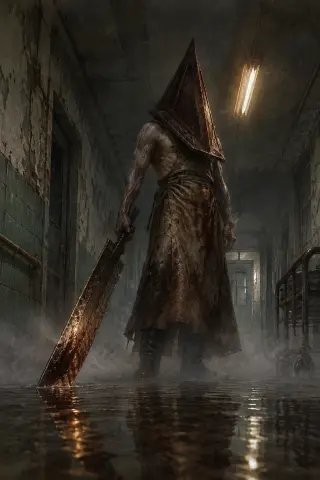
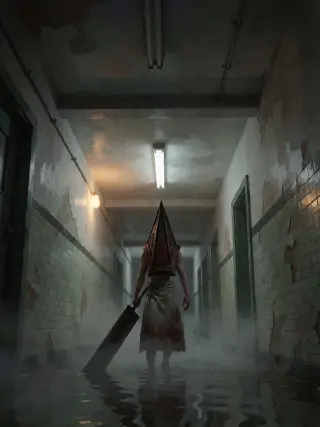
Model Comparison: GPT Image 2 vs Krea 2
The experiment is simple: write one prompt, run it through both models, publish both results. GPT Image 2 is detail-first — it resolves rust, wet reflection, tile grout and the weight of a blade, and it holds up at poster size. Krea 2 is atmosphere-first — looser brushwork, softer light, more air in the frame, and a faster render. Neither is the "right" answer; the comparison is the product.
Subject One: The Executioner in the Flooded Ward
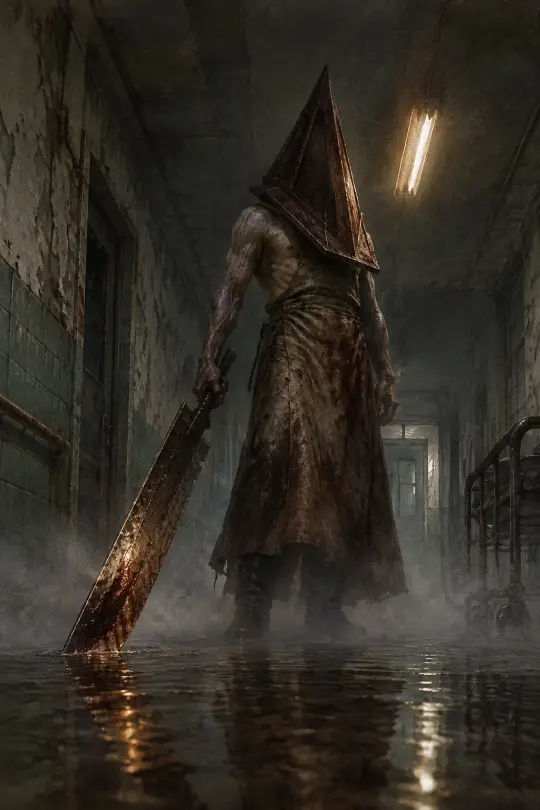
Pyramid Head is the town's most efficient idea: a punishment with no face and unlimited patience. The prompt placed him at the end of a flooded institutional corridor, greatsword dragging in standing water, one fluorescent tube burning above him, fog crawling along the floor. GPT Image 2 turned it into a poster — the helm scraped and stained, the apron heavy with old work, the reflection carrying the composition. Krea 2 pulled the camera back and let the corridor do the threatening: the same figure, much smaller, the architecture pressing in.
Subject Two: Brookhaven, Reception After the Shift
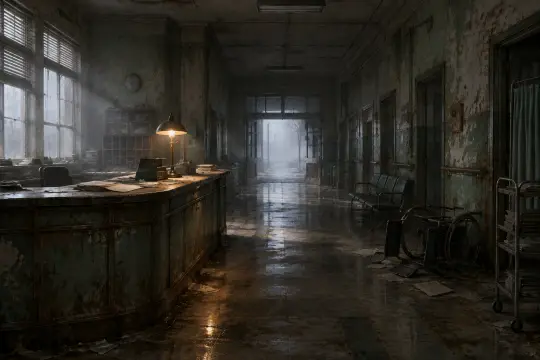
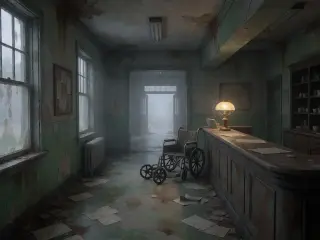
The second brief is quieter and harder: no monster, no blood, just a county hospital reception that has been empty for years. The details do the work — the brass desk lamp still lit, charts fanned across the counter, an overturned wheelchair, green paint peeling off damp plaster, and a doorway at the far end filled with fog instead of a street. GPT Image 2 builds it like a stage set with controlled negative space. Krea 2 answers with daylight: tall windows, a wider tonal range, paper scattered across the floor, the same room made sadder by being brighter.
Why the Town Still Works
Silent Hill is not scary because of its monsters. It is scary because it is organised: a rule set, a cast with secrets, a map with a bad room in it, and a single promise that the town will make you look at the thing you have been carrying. That structure is what makes it a good world to build on — every atom is a hook, and every hook can become a key visual, a scene, or a game.
- A rule that generates plot — the town only calls people who are guilty of something they have not named.
- A visual language you can repeat — fog-grey, oxidised green, rust, one amber light. It reads at thumbnail size.
- A cast built for confrontation — every character is a secret with a face, which is exactly what a scene needs.
- A map with memory — six locations, each with a landmark and one detail that should not be there.
- A ready comparison set — four published works, two models, one world, so you can pick a direction before you spend a session.
Fork This World
This world is public. You can fork it and inherit all 28 atoms — every law, character, location, event and faction — then rewrite what you want. Keep the fog and drop the cult. Keep Brookhaven and move it to another town. The works you generate stay attached to your fork, so the comparison set grows with you.
Fork world → Edit atom cards → Generate key visuals, scenes or a game → Publish → Others can fork your version
From Seed to Key Visual
The pipeline is deliberately short. A world seed gives the canon; a single prompt gives the frame; a two-model run gives you a direction.
Choose the seed
Fork Silent Hill or write a one-sentence horror brief about a town that remembers.
Pick the room
Brookhaven reception, a flooded ward, the Lakeview lobby, or the road into Old Silent Hill.
Cast the subject
A faceless executioner, an empty wheelchair, a nurse who has not been told the shift ended.
Render both models
Run the same prompt through GPT Image 2 and Krea 2; both outputs publish as works of this world.
Iterate
Compare, re-prompt, or fork the world and start again — every poster is a fork point.
World, Not Work
In Neta Studio, a world is the beginning of everything. A world contains the characters, locations, events and laws that every image, scene and game inherits. That is the difference between generating a spooky picture and building a place that can keep producing them.
The same fog that fills the Brookhaven doorway is the fog in the corridor behind Pyramid Head. The same rule that calls a guilty visitor explains why the wheelchair is overturned. When the atoms are shared, the images stop being decoration and start being evidence.
World → Game
Select a storyline from the world cards; the studio turns the same atoms into a playable scene with dialogue, choices and endings.
World → Video
Animate a key visual into a short fog-world sequence — a corridor reveal, a light failing, a door opening onto rust.
World → Assets
Each character generates a poster, each location a background. The world itself becomes an asset library.
Start Creating
Fork the Silent Hill world or start from your own one-sentence horror brief. The world ships with its laws, its cast, its map and four published key visuals — your next frame is one prompt away.
Create from This World
Inherit 28 atoms, rewrite what you want, and tell your own story in the fog.