
Subnautica: 4546B — An AI Ocean World About Drowning, Curing a Plague, and Choosing to Leave
Planet 4546B rebuilt as an editable AI world: seven survivors, six biomes, six turning points, four factions and four published key visuals from a GPT Image 2 vs Krea 2 comparison. A janitor who has to become the only person who can leave, a leviathan who has been a prisoner for a thousand years, and an ocean that keeps its own records.
Subnautica: 4546B — The Ocean That Keeps Its Own Records
Planet 4546B has no continents and no mercy. It is a drowned laboratory the size of a world: sunlit reefs at the top, a fossil river in the middle, a lava sea at the bottom, and somewhere under all of it a machine older than every human on the surface still deciding whether to let anyone leave. The Aurora lies broken across the shallows like a promise somebody broke on purpose. The lifepods are scattered. The radio has gone quiet in the way that means someone stopped answering.
This is the world Neta Studio rebuilt as an editable AI setting — not a summary of a game, but a working collection of people, biomes, loyalties and turning points that can be forked, rewritten and illustrated. Twenty-six atoms, four published frames, one ocean that does not care whether you understand it.
The quarantine was never a wall around the plague. It was a wall around the only cure — and every route off the planet runs through something older than the people trying to leave it.
The World in One Frame
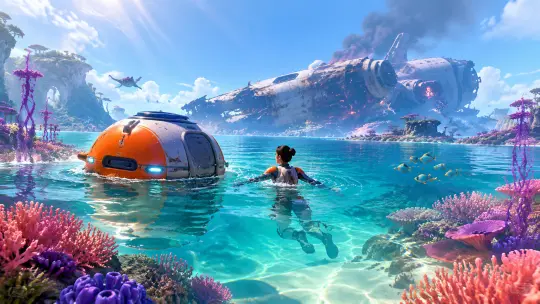
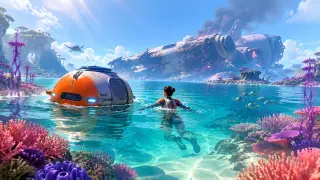
The cover does not show a monster. It shows the first morning. An orange lifepod rides a shallow turquoise lagoon, half-flooded and entirely insufficient. A diver in a white-and-orange wetsuit stands chest-deep in water she can see through, surrounded by pink coral and purple creepvine, the surface close enough to touch. Behind her, the Aurora lies torn open across the reef, still trailing smoke into a pale sky.
That is the design argument in a single image: the planet is beautiful, the disaster is already over, and the person in the middle of it is not equipped. Subnautica is not a power fantasy about conquering an ocean. It is a story about learning to breathe in a place that has been doing fine without you for a thousand years. The frame is bright, the water is clear, and the wreck on the horizon is the only thing that says the clock is running.
What 4546B Actually Is
4546B is an ocean planet with a vertical map. The Safe Shallows teach you to build; the kelp forests teach you to hide; the Grand Reef teaches you that the floor can end; the Lost River teaches you that the map has a second map underneath it; the lava zone teaches you that the planet has a basement, and the basement has a prisoner. Depth is not scenery here. It is the difficulty curve, the narrative structure and the cost of every upgrade.
Above it all sits the Quarantine Enforcement Platform, a Precursor weapon that shoots anything trying to land or leave. It is why the Aurora fell. It is why the Sunbeam broke up mid-transmission. It is why the only way out of 4546B is not up but down — through alien machinery, dead colonists' logs and a telepathic leviathan who has been waiting a very long time for someone with hands.
The Argument at the Center
Subnautica is built on a single argument between two kinds of survival. Alterra believes the planet is an asset and a survivor is a line item; escape is a transaction, and the correct move is to leave before the invoice arrives. The Precursors believed the same thing at a larger scale, sealed a world to contain a microbe, and left a machine to enforce a decision nobody was left to explain.
The castaways are the counter-argument. Marguerit survives by refusing every plan that involves waiting. Paul Torgal survives by negotiating with something that will not negotiate. Bart survives by paying attention to beauty long enough to document it. Ryley survives by fixing things. And the Sea Emperor survives by asking, for the first time in a thousand years, for help. The planet does not need a hero. It needs someone willing to go down instead of up.
Every route off 4546B runs through something older than the people trying to leave it — and the oldest thing in the water is the one asking for a favour.
Seven People in a Drowned Laboratory
The world ships with seven character atoms. They are written as pressures rather than biographies: what each person wants, what they will not give up, and where the ocean has made those two things incompatible. Fork the world and you can add an eighth, rewrite a loyalty, or move a character to a depth they were never meant to survive.
Six Biomes, One Vertical Map
Six locations, each with a different relationship to pressure. The shallows are a nursery. The wreck is a tomb with a toolbox in it. The reef is a cliff disguised as a garden. The lost river is a corridor between two kinds of fear. The containment facility is a courtroom. Sector Zero is the same story told in ice. Prompt any of them and the place does half the work, because a location with a point of view is worth more than a hundred adjectives.
Six Turning Points in the Timeline
The timeline is a chain of decisions made by people who are no longer available to explain them. A ship falls. A salvage crew disappears. A quarantine is built. A rescue is silenced. A nursery hatches. A rocket leaves. Every event is an atom you can pull, reorder or refuse — the setting is strong enough to survive the change.
Four Powers With Four Different Plans
Four factions, four incompatible answers to the same question. Alterra wants the planet audited. The Degasi survivors wanted three different things and got one ocean. The Precursors wanted containment and got a thousand-year babysitting job. The Sea Emperor's brood wants nothing except the chance to be a species again. None of them are villains in the conventional sense; all of them are expensive to disagree with.
Three Rules the Ocean Enforces
The world runs on three hard rules. They are not lore trivia; they are the physics of the plot. A cure that can only be grown. A power source that outlives its owners. A plague that changes behaviour before it kills. Change any one of them and 4546B becomes a different story.
The Visual Grammar: Stylized Semi-Real 3D
The look is stylized semi-real 3D game art: clear CG form and continuous volume, non-photographic materials, geometry-driven edges and controlled local color. Vibrant teal and cyan water, volumetric god rays, bioluminescent bloom, saturated coral pinks against deep ocean blue, cinematic depth haze and caustics on white sand.
That combination is doing narrative work. Bright water keeps the shallows readable and hospitable; the same renderer turns terrifying at depth because the palette narrows to blue-black and the only saturated color left is something alive. The style is not a filter on top of the world. It is the world's way of telling you how far from the surface you are.
How the Key Visuals Were Made: GPT Image 2 vs Krea 2
Both frames in each pair came from the same prompt, run once through GPT Image 2 and once through Krea 2. The brief was deliberately physical: a place, a body, a scale, a light source and one fact about what had just happened. No model names, no camera-brand language, no mood-board adjectives. The comparison is therefore about the models, not about two different asks.
GPT Image 2: The Cinematic Answer
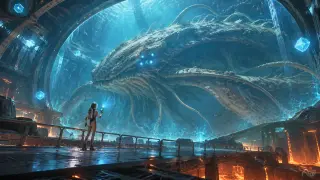
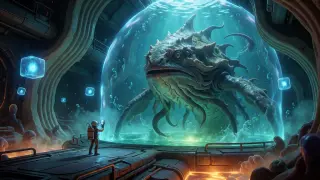
GPT Image 2 reads the brief as a film still. It keeps the horizon, gives the lifepod real weight in the water, puts the diver at the correct scale and lets the Aurora dominate the background without swallowing the foreground. In the containment frame it produces depth you can feel: ribbed arches receding, ion cubes floating at different distances, lava light bleeding through seams in the floor, and a leviathan whose body disappears into the vault instead of ending at the frame.
Its weakness is the same as its strength. It wants to render everything, so incidental detail can become noise. Underwater, that shows up as too many particles, too many fish, and caustics drawn on surfaces that should be matte. The fix is not a shorter prompt; it is a more selective one. Name the three things that matter and explicitly remove the rest.
Krea 2: The Graphic Answer
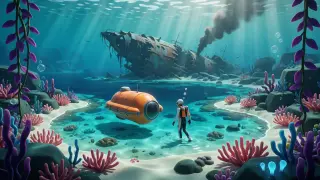
Krea 2 reads the same brief as a poster. It moves the camera, simplifies the geometry and composes for the thumbnail: a rounded submersible instead of a lifepod, a diver standing on white sand instead of wading, coral arranged like a frame, the wreck reduced to a silhouette behind sunbeams. In the containment frame it turns the vault into a stage and the ion shield into a clean glass dome, which is less accurate and considerably more legible.
Use Krea 2 to explore. Ten variations cost less than one GPT Image 2 frame, and the model will happily give you a composition you would never have specified. Then take the winning composition back to GPT Image 2 and ask for the detailed version. That two-stage workflow is the most reliable way to get both speed and finish.
The Prompt, Clause by Clause
This is the structure that produced both pairs. It works because each clause answers a question the model would otherwise answer for you, and none of them tell the model how to feel.
Clause one: lock the medium
Stylized semi-real 3D game key visual, 16:9, clean geometry with semi-realistic material detail. Without this, the model defaults to a photograph with a game-trailer grade.
Clause two: build the water column
Name the surface relationship: shallow turquoise lagoon, volumetric god rays, caustics on white sand, deep ocean blue beyond the reef shelf. Depth is a material condition, not an adjective.
Clause three: put one body in frame
A lone diver in a white-and-orange wetsuit, chest-deep, or a tiny figure on a walkway with a scanner raised. One human body gives the ocean a scale.
Clause four: state the event as a fact
“Dawn in the Safe Shallows, the Aurora still burning on the reef.” “A leviathan behind an ion shield, a diver at the rail.” A fact gives the model something to stage; “epic underwater scene” gives it a mood board.
Clause five: name colors, not lenses
Saturated teal and cyan, coral pink accents, pale sky, lava amber through the floor. Color names survive translation into light; lens names mostly produce filters.
Clause six: ban text and interface
No text, no logos, no interface elements. Underwater scenes tempt models to add HUD frames, depth readouts and warning labels, all of which date the image instantly.
What the Comparison Teaches
The interesting difference is not quality. Both models can make a beautiful underwater frame. The difference is what each one thinks the image is for. GPT Image 2 thinks it is a still from a film and builds a world with edges you can imagine walking into. Krea 2 thinks it is a poster and builds a shape you can read from across a room.
That makes them a workflow rather than a rivalry. Use Krea 2 for volume, GPT Image 2 for the final frame, and keep the same prompt so the comparison stays honest. The published pairs on this page are the evidence: same words, two intelligences, one ocean.
Depth as a Difficulty Curve
Most worlds use distance to pace a story. 4546B uses pressure. The shallows are safe because you can surface; the reef is dangerous because you cannot; the lost river is a commitment because turning back costs more air than continuing. Every biome is a different answer to the question “how far from help am I?”
That is also why the world forks so well. Move the Safe Shallows deeper and the tutorial becomes a horror opening. Raise the containment facility and the ending becomes a discovery instead of a descent. The vertical map is a dial, and the dial changes the genre.
A World You Can Fork
Subnautica: 4546B is public. Every atom can be opened, rewritten, duplicated or removed; every published frame carries its prompt and model, so you can see exactly what produced it and run the same brief yourself. Start from the world as it stands, or fork it and change one thing: let the Sunbeam survive the platform, let Marguerit reach the containment facility first, let the Sea Emperor's eggs hatch without a human in the room.
The published frames are proof, not product. They show that a world with a clear visual grammar can produce a coherent image set across two very different models, and that a single frame can carry a story's central argument without a caption. The rest is yours to write.
Enter 4546B
Twenty-six atoms, four published frames, one ocean with no horizon. Build your own version of the planet — or start from the world as it stands.