Terraria: The Corruption Below — A 16-Bit Sandbox RPG World Where the Blight Spreads Every Night
A complete sandbox RPG world generated by AI: 22 atoms — 7 characters, 6 locations, 5 events, 4 factions — plus published 16-bit pixel key visuals from a GPT Image 2 vs Krea 2 comparison, and an interactive studio. Haven Hollow is the last lit town on the surface, the Ebon Rot is eating the western hills, and every layer below hides a boss that feeds the blight — dig, build, fight, and decide how much of the world you are willing to lose.
Worldview
Terraria: The Corruption Below is a world of earth, stone, and sky, where the surface is a patchwork of forest, desert, snow, and jungle and every layer beneath hides something hungry. The Corruption and the Crimson are two living blights that spread through the stone like roots and bleed into the land above. The Eye of Cthulhu, the Wall of Flesh, and the Moon Lord rise to test anyone strong enough to challenge them. Haven Hollow, a small town founded by stubborn settlers, sits at the edge of the Ebon Rot and trades with the adventurers who go below. This is that world rebuilt as an AI world on Neta Studio: 7 characters, 6 locations, 5 events, and 4 factions — plus four published 16-bit pixel key visuals generated from it in a GPT Image 2 vs Krea 2 comparison.
A cycle of digging, building, and fighting: each deeper layer yields rarer materials and more dangerous hosts, and each boss death unlocks new ways to hold back the rot. The surface is a fragile green line; below it are cave systems, a sealed blue-brick dungeon, a bioluminescent jungle, a boiling sea of lava, and four violet pillars humming in the sky. Every atom of this world was generated by AI: characters with secrets, locations with landmarks and lore, events that changed the map, and the hard rules that govern a world where the night itself is an enemy.
Visual style: authentic hand-placed 16-bit-style pixel art — a limited 24-color palette, three-step pixel shadows and selective dithering, crisp nearest-neighbor square pixels — rendered with GPT Image 2 and Krea 2.
Characters (7)
Locations (6)
Events (5)
Factions (4)
The Rules of This World
The Surface Town: Haven Hollow
Haven Hollow is the emotional center of the world and the reason the fight matters. It is not a capital or a fortress — it is a row of wooden cabins, a stone well, tilled farms, a palisade, and a bell that rings only at night. The Guide keeps the ledger, the Merchant keeps the prices, the Nurse keeps everyone alive, and the Demolitionist keeps the western wall standing. Beyond the fence, the Ebon Rot begins: black stone, purple thorns, and the slow arithmetic of a border that moves a few feet every week.
The Ebon Rot: An Enemy With a Map
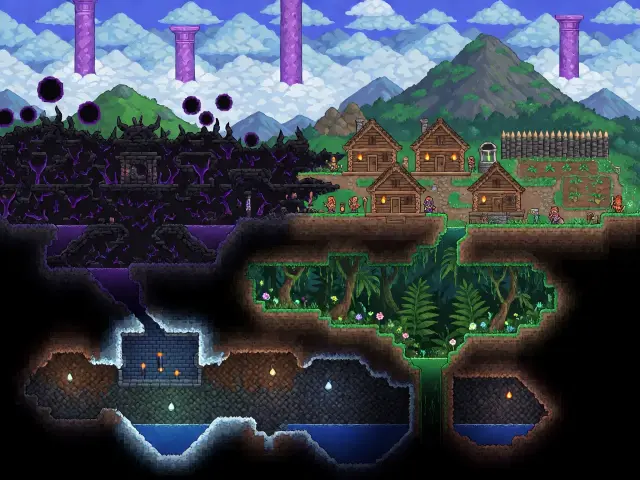
Most RPG worlds have a villain with a plan. The Corruption Below has a villain with a growth rate. The Ebon Rot is drawn as a landscape first — a blighted forest of black trunks, purple veins, and floating shadow orbs that spill over the hills to the west of town. It does not chase the player; it takes ground. That makes every key visual a map of a decision: how much green is left, how close the thorns are to the cabins, and whether the lanterns still reach the fence.
The Vertical World: Six Layers Down
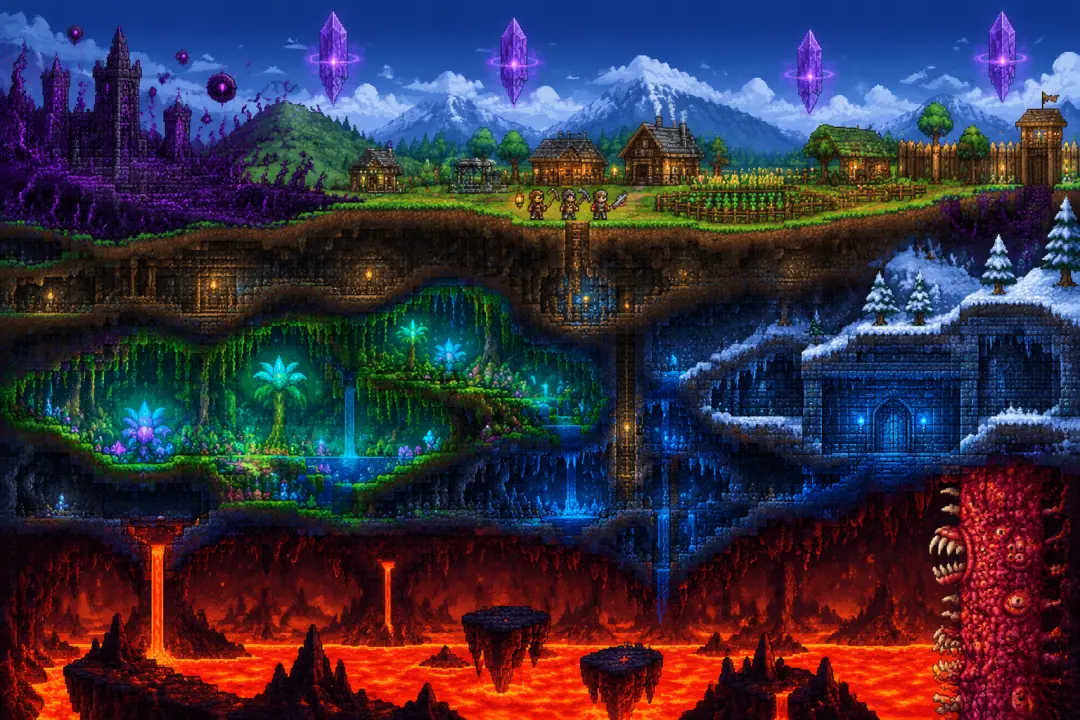
The world is built as a stack, and the stack is the story. Surface: forest, farms, and a town that needs defending. Layer one: brown earth, copper, and the first caves. Layer two: grey stone, iron, and the sealed dungeon under the snow. Layer three: the Verdant Deep, a jungle cavern of glowing ferns and clean water. Layer four: the Ashen Underworld, lava, obsidian, and the Wall of Flesh. Above it all: the Celestial Spire, four violet pillars that turn the sky into a countdown. A single cutaway can hold all six, which is exactly what the world key visual does.
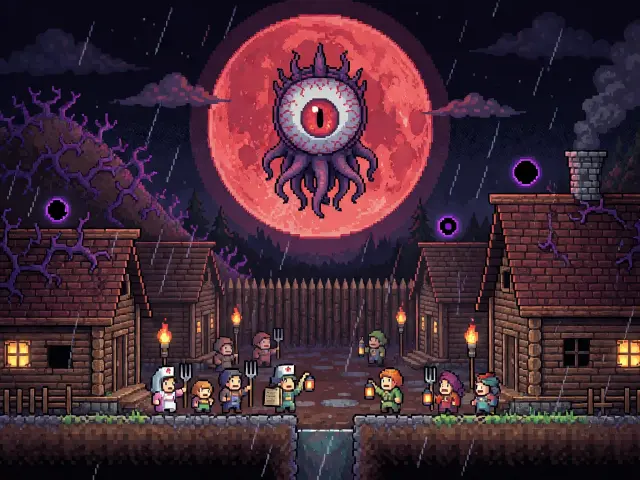
The First Blood Moon
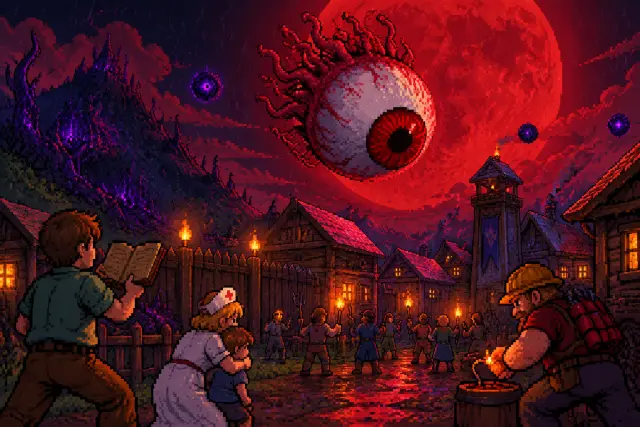
The First Blood Moon is the world’s turn from building to surviving. The moon turns red, the Eye of Cthulhu descends, and the town’s lanterns become a target. The Guide reads from the ledger, the Nurse pulls a child behind her, the Demolitionist lights a fuse, and the townsfolk line the palisade with torches and pitchforks. It is a defense scene, not a duel: the horror is the size of the thing above the roofs, and the courage is a row of ordinary people who refuse to put the torches out.
Events That Shape the Map
The five events are not lore decoration; each one changes what the world can do. The Seeding explains why the rot exists. The Founding explains why anyone stayed. The First Blood Moon explains why the town has a palisade and a bell. The Wall of Flesh explains why the deep is sealed. The Lunar Pillars explain why the sky is the final door. Read in order, they turn a sandbox into a countdown: the world was seeded, settled, attacked, sealed, and is now being opened from above.
Factions and Their Agendas
Four forces pull the world in different directions, and none of them will wait for the others. The Townsfolk Accord wants to hold the surface and keep the ledger honest. The Goblin Army wants the walls down and the surface taken. The Lunatic Cult wants the pillars up and the Moon Lord awake. The Blight wants nothing at all — it simply grows. That asymmetry is the engine of the sandbox: three factions can be negotiated with, traded with, or fought; the fourth can only be contained.
Works from This World
Four works have been generated from this world — a two-subject, two-model key-visual comparison on Neta Studio. The same briefs were run through GPT Image 2 and Krea 2: the world key visual as a single vertical cutaway, from Haven Hollow’s torch-lit cabins and farmland through the Ebon Rot, the Verdant Deep, the sealed dungeon and the Ashen Underworld, with four lunar pillars in the sky; and the event key visual of the First Blood Moon, the Eye of Cthulhu descending over the town while the Guide, the Nurse and the Demolitionist hold the street. Every render is a shareable work of the world, ready to fork, remix, and build on.
Model Comparison: GPT Image 2 vs Krea 2
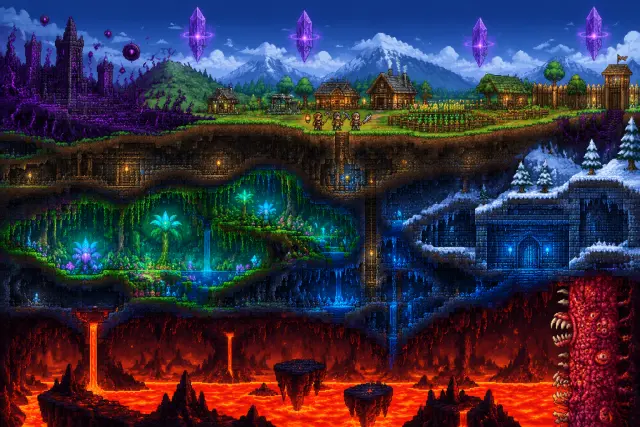
The same prompt, two models, two different kinds of poster. GPT Image 2 leans detail-first: it stacks every layer of the cutaway, separates the value planes, keeps the landmarks legible, and produces a panorama that survives a banner crop. Krea 2 leans map-first: cleaner pixel clusters, a flatter cross-section, a readable whole-world image that sells the scale of a hidden world in one glance. Together they cover both directions of 16-bit pixel art — precision when you need a cover, clarity when you need a map.
The First Blood Moon, Examined
The event pair points the same brief at the world’s turning point. GPT Image 2 stages the defense detail-first: the Eye’s veined sclera and red iris, the tendrils against the moon, the Guide’s open ledger, the Nurse’s arm around a child, the Demolitionist’s fuse, the torches behind the fence. Krea 2 renders the same night story-first: a symmetrical, almost folk-tale frame, the Eye centered inside the crimson moon, rain over the roofs, and the townsfolk arranged along the palisade like a chorus. Two models, one canon, two very different covers.
The World Key Visual, Examined
The world key visual has one job: sell a whole setting in a single frame. Here it is the entire vertical world at once — the wooden town and its farms on the surface, the black wall of the Ebon Rot to the west, the green glow of the Verdant Deep, the snowbound blue-brick dungeon, the lava sea of the Underworld, and the four violet pillars overhead. GPT Image 2 keeps every layer distinct and every landmark readable; Krea 2 trades some density for a clean tile-map sweep. Both are cover-ready, and both stay on-canon because the world seed supplies the style, the palette, and the factions.
Fork This World
This world is public. You can fork it — inherit all 22 atoms, every character secret, every location, and the published key visuals — then rewrite what you want. Save the Guide, bargain with the Goblin Tinkerer, let the Dryad burn the western hills, or side with the cult and see what comes down. The Corruption Below is built to be rewritten: the rot does not care which ending you choose.
Choose a path and see where it takes you. Fortify Haven Hollow, take the fight into the Ebon Rot, or follow the Lunatic Cultist up to the pillars — the world keeps the consequences either way.
Fork world → Edit atom cards → Generate new key visuals/games/videos → Publish → Others can Fork your version
From Seed to Key Visual
Choose the seed
Fork Terraria: The Corruption Below or write a one-sentence sandbox RPG brief about a town at the edge of a spreading blight.
Pick the scene
Pick the moment — Haven Hollow at dusk, the Ebon Rot at the treeline, the Verdant Deep, the lava sea, or the blood moon over the roofs.
Cast the subject
Name the character and the beat — the Guide with his ledger, the Nurse shielding a child, the Demolitionist with a fuse, a hero at the palisade.
Render both models
Run the same prompt through GPT Image 2 and Krea 2; the studio publishes both as works of the world.
Iterate
Compare, re-prompt, or fork the world and start again — every poster is a fork point.
World, Not Work
In Neta Studio, a world is the beginning of everything. A world contains the characters, locations, events, and factions that make a setting coherent — and every key visual, game, or video you generate from it stays attached to that world as a work.
A world is not a single image. A world is the source of every image: the same black stone and purple thorns, the same torch-lit cabins, the same 24-color palette appear across every render, so the poster, the character card, and the next scene all look like they came from the same place — because they did.
World → Game
Select a storyline from world cards; AI auto-writes game logic, generates art, and builds a playable experience from the same atoms.
World → Video
Generate dynamic videos from world characters and scenes — a blood moon over the palisade, a descent into the Underworld, a walk through the Verdant Deep.
World → Assets
Each character generates a cover, each location generates a background. The world itself is an asset library.
Who This World Is For
Sandbox RPG players who want a world with a clock on it. Game masters who need a town, a dungeon, and a reason to go down. Pixel artists who want a canon-consistent palette and a set of published covers to build from. Writers who like their fantasy dirty, practical, and lit by lanterns. Anyone who has ever dug one block too deep and heard something move.
Frequently Asked Questions
- Is this the official Terraria? No — it is an AI-generated, fan-style world inspired by Terraria’s sandbox premise, rebuilt as an original Neta Studio world with its own town, factions, and story beats.
- What can I do with it? Fork it, edit its atoms, generate key visuals, build a playable scenario, or use it as a setting for your own table.
- Which models made the art? GPT Image 2 and Krea 2, from the same prompts, published as four works of this world.
- Do I need to know the game? No. The world carries its own rules: the Blight spreads, bosses gate the depths, and Haven Hollow is the last lit town.
- Can I remix the works? Yes — public works of a public world are forkable and remixable on Neta Studio.
Start Creating
Fork Terraria: The Corruption Below or start from your own one-sentence sandbox RPG brief. The world ships with its 22 atoms, its 16-bit visual style, and four published key visuals — your next cover, game, or night raid is one prompt away.
Create from This World
Inherit 22 atoms, rewrite what you want, tell your own story in a world where the rot spreads every night and the lanterns are the last line.