
The Ashen Crown — A Tactical Dark Fantasy World Where the Fire Is a Debt
A complete tactical dark fantasy world rebuilt as an AI world: nine houses, eight lives at the hinge, five locations, five events and four factions — plus four published key visuals from a GPT Image 2 vs Krea 2 comparison, and an interactive studio. Every kindling is paid for in years.
Worldview
Caldrath is a continent held together by a lie. Nine hundred years ago Queen Serath the Ember broke her crown into nine living flames, gave one to each of the nine great houses, and sealed the fire god Vharun beneath the drowned city of Vael. The Church of the Nine Hearth teaches that the flames are a divine gift, and that the marks they leave on noble blood are proof of the right to rule. In truth the embers are the keys to a cage, and every kindling of a relic draws on the prisoner inside it.
In the year A.S. 912 the First Flame is failing, the ninth house is extinct, and a Greyharbor mercenary carries a tenth mark that no decree permits. The war for the crown begins in the ash of the last truce.
The Bargain at the Centre
Every story in this world is a variation on one sentence: the fire takes years and the dark steps back one winter. A kindling draws on Vharun, and the bearer pays in grey veins, ash in the hair, a cough that smells of soot. Burn too deep and you become ash-touched — warm, hollow, and hungry for open flame. The nobility calls this devotion. The Legion calls it a receipt.
That single exchange is the engine of the setting. A marked character can wake a relic for a few heartbeats, or fully for a battle, or — rarely, and never twice — for one act that will be remembered. The relic does not care whether the bearer is brave or kind. It cares whether the mark is the right shape. A world with a legible price can generate an inexhaustible supply of scenes, because any character can be placed on either side of the ledger at any moment.
The Unwritten Laws
The Nine Hearths
The Accord of Nine Hearths is a constitution written by the survivors of a catastrophe and administered by the people it profits. Each seat holds one flame, one fortress and one argument about what the fire is for. The table is the map: Hearthfall in the centre, Greyharbor on the coast, the sulphur mines and the mint in Mireau, the Ember Gate in Hask, the Thornwood marches in Sorrel, the western moors in Dain, the southern ports in Ostrek, the bell-towers and courts in Yew, and the empty ninth seat on the Ashen Marches border.
The Tenth Mark
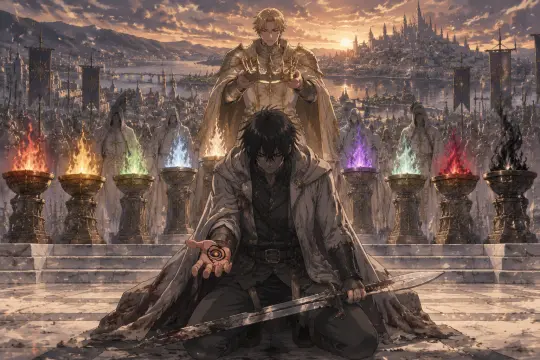
The tenth mark has no shape in the Roll: a black spiral around a single amber point. The Church calls it the Unwritten Hearth and declares it anathema. The Legion calls it proof that the cage is failing. Kaelen, the Greyharbor captain at the centre of our key visual, calls it a bad joke — and keeps his glove on in chapels.
A tenth mark is narratively useful because it is a category error. It is not a claim to a ninth house, and it is not a commoner's brand. It is evidence that the system's taxonomy has stopped describing the world. Every faction wants it for a different reason: the Church wants to record it, the Accord wants to bury it, the Legion wants to march behind it, and the Grey Lanterns want to sell it to all three.
Characters at the Hinge
Eight lives stand at the hinge of the war. We describe them by function rather than by a fixed cast list, because the world is built to be forked: a lord with a claim, a captain with a secret, and the people who decide what the fire is for.
Locations That Are Also Arguments
Events That Made the War
Four Factions, One Question
Each faction answers the same question — who owns the fire? — differently, and that is what makes every scene an argument rather than an exposition.
How Power Works on the Page
The setting is deliberately legible to a writer: a mark, a relic, a price and a witness. A scene can be built in one sentence. "A marked boy kindles a gate for a Legion column while a Church reader counts the years it costs him" gives you a location, a transaction and two factions without any exposition.
- Kindling — a marked bearer wakes a relic for heartbeats, a battle, or one remembered act. Once per battle in play; never twice for the third kind.
- The Debt — grey veins, ash in the hair, a soot cough. Track it as a clock, not a hit point: every tick changes how the character is photographed.
- The Law — markless hands may carry cold steel only. The brand on a markless palm is the world's most visible class marker.
- The Bells — nine bells can stop a battle. The drama is never whether they can be rung; it is who is willing to be the one who rings them.
Works from This World
Four works have been published from this world — two briefs, each rendered by two models on an identical prompt. The first is the world key visual: the Ash Coronation at Hearthfall. The second is a location: the Ember Gate at dusk. Neither model received a reference image, so the difference you see is the model's reading of the brief, not the brief itself.
Model Comparison: GPT Image 2 vs Krea 2
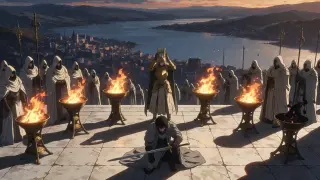
GPT Image 2 renders an event with a history: the captain has weight on his knees, the heir has a specific posture of embarrassment, the nine flames throw just enough bounce to describe the terrace, and the lake-city sits at a believable distance. Krea 2 renders the same event as a poster: fewer tonal steps, cleaner silhouettes, the ceremony compressed into a symmetric stage with a crown you can read at thumbnail size. Neither is wrong. One is built to be inspected; the other is built to be seen.
The Ash Coronation — GPT Image 2 vs Krea 2
Run your eye along the front plane in both frames. In the GPT Image 2 version the captain is close, low and large; his right palm is turned up and the spiral mark is legible; the broken sword lies across both knees. The heir stands behind him with cupped hands and no visible crown, which is the more interesting reading of a coronation missing a shard. In the Krea 2 version the heir wears the crown, stands at the exact centre, and the priests mirror left and right like altar boys; the captain is reduced to a small kneeling figure and the mark is gone. Krea 2 made a cleaner poster and lost the plot object.
The Ember Gate — GPT Image 2 vs Krea 2
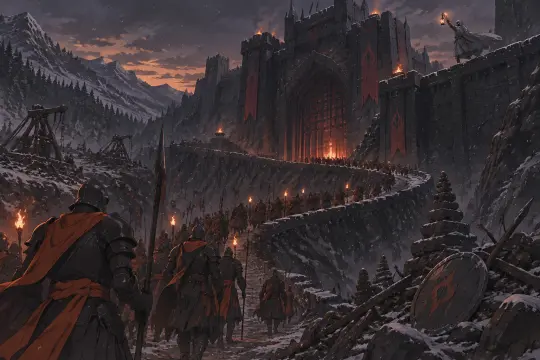
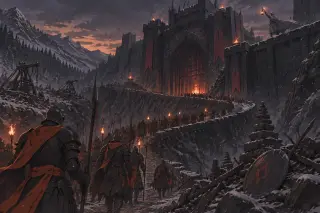
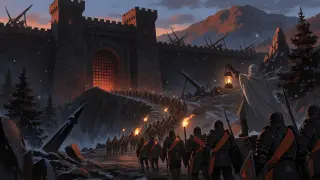
The location brief splits the models the same way. GPT Image 2 builds a pass you could walk: a switchback with a real gradient, a column strung along it at different depths, a siege engine abandoned on the left, and a scout small enough on the rampart that the gate feels enormous. Krea 2 flattens the gate into two black towers, turns the portcullis into a glowing grid, and plants a lantern-bearing scout in the near right corner — a better book cover, a worse map. The brief asked for a sealed fire under a road; only one frame makes you feel the road.
What the Comparison Proves
Run the same sentence twice and you learn more about a model than any benchmark. GPT Image 2 follows clauses literally and pays for it in speed and price. Krea 2 follows the mood and pays for it in specifics. For a world where the horror is administrative — a roll, a debt, a brand, a bell — the literal model wins, because the props are the argument.
- GPT Image 2 — best for the frame that carries evidence: marks, ledgers, bells, ash as a material, crowds with separate postures.
- Krea 2 — best for the frame that carries mood: a poster, a thumbnail, a key-art block with clean dark shapes and a readable crown.
- Both — respond to a prompt that names one light source and one price. The brief does more work than the model.
From Seed to Key Visual
Read the Roll
Open the world and read the rules before you write anything. The Embermarks card tells you what a mark can do; the Debt of Fire card tells you what it costs; the Nine Bells card tells you what can stop a battle.
Choose the transaction
Every frame in Caldrath should show somebody paying. A mark opened on a palm, a torch lit on a switchback, a bell rung too early. Pick one and make it visible.
Name the light
One source, no fill. Nine braziers, a red portcullis, a single lantern on a rampart. Two light sources turn tenebrist fantasy into generic dusk.
Render both models
Run the identical prompt through GPT Image 2 and Krea 2 and publish both as works with their own share pages. The comparison is the content.
Keep the frame that survives the crop
A key visual has to work at 1200 pixels wide and at 300. Keep the one with a readable silhouette, then re-prompt the next beat from the same world rules.
World, Not Work
In Neta Studio a world is the beginning of everything. A world holds characters, locations, events and factions as editable cards, and every image is generated from those cards rather than from a blank prompt box. That is why Caldrath can produce a coherent coronation and a coherent gatehouse without a reference image: both are drawn from the same written world.
A world is not a single image. A world is the source of every image: the location list becomes a background library, the character list becomes a cast sheet, the event list becomes a shot list. Fork the world and you inherit the whole argument, then rewrite the clause you want to fight about.
World → Key Visual
Pick a transaction from the timeline and stage it with the cast and the location cards. The studio keeps the palette and the light logic consistent.
World → Sequence
Turn the coronation into a run of frames: the crowd, the mark, the crown, the bell. Same rules, four posters, one story.
World → Asset Library
Each character yields a portrait, each location a plate. The world becomes a reusable art department you can hand to a team.
Why This World Matters
Tactical fantasy is usually built out of armies and maps. The Ashen Crown is built out of jurisdiction, and that is what makes it useful: a roll can be photographed, a debt can be staged, a bell can be seen in the frame. The setting gives a writer or a designer a visible object for every abstract fear — legitimacy, inheritance, the cost of a miracle.
- A single exchange — years for a kindling — that any reader understands in one sentence.
- Four factions that each answer the same question differently, so every scene has a built-in argument.
- Five locations that work as lighting setups: nine flames, a red gate, lake dusk, wet harbour, old ash.
- A visual style — anime cel-painted key art — that survives both a detailed render and a flat poster.
Reading the Ash: Motifs
Ash is the world's clock. It falls on Hearthfall, drifts off the Marches, and settles on the shoulders of anyone who has kindled. When you prompt a frame, decide what the ash is doing: falling, settling, or blowing sideways. Falling means the Accord is still running. Settling means something has just ended. Blowing sideways means an army is moving.
The second motif is metal that remembers. A relic is not a magic sword; it is a piece of the old crown that wakes when the right mark comes near. Photograph it as an object with a history — pitted, repaired, too heavy for the person carrying it — and the audience will understand the debt without a caption.
Fork This World
This world is public. You can fork it, inherit its characters, locations, events and factions, then rewrite the Roll, move the fire, or write a fifth faction that wants to pay the debt differently. The four published key visuals stay attached to the world, so a fork keeps the visual proof and gains a new argument.
Collaborative workflow
Start Creating
Create from This World
Inherit the nine houses, choose which debt comes due, and light the frame with one fire.
Every image on this page is a published work from this world, not a demo render: four frames, two briefs, two models, the same written world underneath. The studio link opens the living world where the cards can still be edited.