
The Meridian Debt — An Interstellar-Style Space Opera World Built with AI
A complete interstellar-style space opera rebuilt as an AI canon: seven characters, five locations, six events and four factions, plus four published key visuals from a GPT Image 2 vs Krea 2 comparison. Nine stars are caged, every crossing is charged to their remaining light, and the last lamp is going out.
The Meridian Debt — Worldview
Nine stars burn inside nine lattice cages. Every transit corridor in the inhabited chain was bored through one of those captive suns, and every crossing is charged against the years it has left. For four centuries the Meridian Concordat has called this arrangement civilisation: cheap light for the Core, permanent dusk for the Rim, and a ledger that never quite balances. The Meridian Debt is an original interstellar-style space opera built to be played, forked and illustrated — a world where physics has a price list and the bill has finally come due.
Nine systems. Nine captive stars. One ledger. The outermost lamp, the Sable Sun, has lost forty years of life in a single night — and a signal from beyond the chain is calling itself the Tenth Meridian.
The World in One Frame
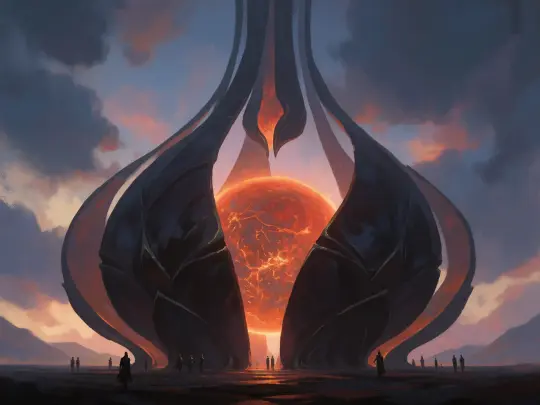
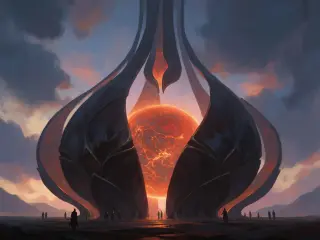
The cover shows the whole argument of the world in a single image: something enormous and almost holy at the centre, and something human and very small at the bottom of the frame. The Sable Sun is not a planet or a god. It is infrastructure — a red dwarf held inside a black lattice flower, burning lower every year so that ships can cross. The people walking toward it are not tourists. They are auditors, pilgrims, pilots and debtors, all arriving to ask the same question in different languages: when the last light is spent, who gets to cross?
The Nine Lamps and the Light Ledger
The central machine of the setting is not a starship or a weapon. It is an accounting system. The Lamp Cages hold nine stars; the Meridians are nine corridors bored through them; the Light Ledger records what each crossing costs. A merchant passage might burn a week of a star’s life. A military convoy might burn a decade. The debt is inherited by whoever remains, which means the Rim pays for the Core’s convenience in units of daylight. This single rule generates every political conflict in the world without requiring a villain.
“Every crossing is charged against a lamp star’s remaining life, and the debt is inherited by whoever remains.” — The Light Ledger, first entry
Cast of the Chain
Seven people stand at the fault line between the ledger and the light. None of them is a chosen one; each has a professional reason to be near the truth and a personal reason to look away. That tension is what makes the world playable: every character can be an ally, an obstacle or the person who signs the order.
Ports, Vaults and a Caged Star
The world is built from five locations that each answer a different production need: a capital for crowd scenes, a station for intimacy, a vault for exposition, a star for scale, and a corridor for dread. Every location has a distinct palette and a distinct social rule, so a writer can move a scene between them without losing the world’s logic.
The Powers of the Chain
Four factions hold the world together and pull it apart. They are not good and evil; they are four answers to the same question about who owns the light. Giving each one a coherent economic interest makes the politics playable without a script.
The Timeline
Six events explain why the present is unstable. The chain was lit, a lamp failed, a debt was invented, a gate was breached, the rim was sealed, and a signal arrived. Each event is a playable scenario and a prompt seed: a single sentence that already contains a place, a cost and a person who has to decide.
The Rules of the Chain
Three rules do most of the world-building. They are simple enough to explain in one line and cruel enough to generate unlimited stories. If you fork this world, keep the rules and change the politics; the rules are the engine.
The Core Conflict
The Concordat must ration the dying light of the Nine Lamps to keep civilisation moving, while everyone outside the Core believes the light belongs to whoever is willing to burn for it. The Sable Sun is failing faster than any ledger admits, and the only apparent escape is a tenth corridor that may be older than humanity. Every scene in this world is a negotiation over scarcity: who gets the next crossing, who pays for it, and what you are willing to call a person when the light runs out.
The real question is not whether the Tenth Meridian is real. It is whether a civilisation built on borrowed light can survive being asked who borrowed it.
Why This World Is Built for AI
This setting is unusually well suited to a world-grounded generation pipeline because its visual logic is a rule, not a mood. Caged stars are a shape. The light-debt is a palette: rose-gold inside the Core, cold blue and rust on the Rim, un-light at the Tenth Meridian. A model does not need to understand four centuries of fictional economics to draw a small human at the foot of an enormous machine — it only needs the atoms.
World → Key Visual
Every character, location and event can generate a poster from the same atoms. Cinder Court, Hallow and the Sable Sun all read as the same civilisation because they share one light logic.
World → Scene
Pick a timeline beat — the Sable Withdrawal, the Hallow Breach, the Closing of Gate Nine — and the world supplies the cast, the set and the cost of the crossing.
World → Story
Fork the canon and write a new audit: a missing decade, a refugee convoy, a ledger that names the wrong star, a machine that has begun to grieve.
World → Game
The factions are playable positions, not lore. A Concordat auditor, a Choir pilot and a Ninth Dawn pilgrim want different things from the same gate.
From World Seed to Published Work
The pipeline is deliberately short: a world is a set of atoms, a work is a prompt pointed at those atoms, and a published work is a permanent share link attached to the world. That means the lore and the marketing are the same artifact. You are not writing a bible and then commissioning art; you are writing the sentence that produces the art.
Fork the world → edit character, location and event cards → generate key visuals → publish as works → others fork your version
For The Meridian Debt, that loop produced four published frames in two passes. The first pass established the capital at human scale. The second pass established the lamp at cosmic scale. Both passes used the same world brief and the same two models, which is why the set reads as one production rather than four unrelated images.
Choose the seed
Fork The Meridian Debt, or write a one-sentence interstellar-style brief about a civilisation that pays for travel with the life of a star.
Pick the scene
Cinder Court at shift change, a refugee queue in Hallow, the cold racks of the Quiet Archive, the approach to the Sable Sun.
Cast the subject
Name the auditor, the pilot, the archivist — and the object they are carrying that could reopen the ledger.
Render both models
Run the same brief through GPT Image 2 and Krea 2; publish both as works of this world so they can be compared side by side.
Iterate in public
Compare, re-prompt, or fork the world and start again — every published frame is a fork point for the next person.
The Look: Semi-Realistic Painterly Sci-Fi
The visual target is semi-realistic digital painting, not photoreal concept art and not cartoon cel shading. Forms are built with continuous volume and controlled edges; light is dramatic but legible; the palette is rose-gold, slate, rust and cold starlight, with a single warm accent against a dark field. The result reads as an expensive science-fiction poster at thumbnail size and still holds up as a painting when you open it full screen.
Model Comparison: Structure Against Light
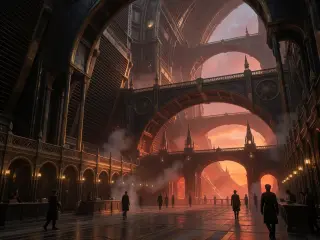
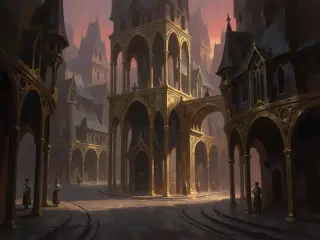
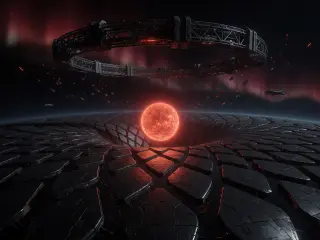
Both models were briefed from the same world seed and the same location entries, then asked to make a key visual that could open a store page. GPT Image 2 resolves architecture: the radiator ring, the arcades, the wet stone and the crowd survive a crop. Krea 2 resolves atmosphere: the petals, the glow, the silhouettes and the sky carry the frame before you read a single detail. Neither is better; they answer different questions, and a serious world uses both.
The Prompts Behind These Frames
Cinder Court brief. Interstellar-style space opera key visual, semi-realistic digital painting: a vast brass-and-iron transit hall built into the radiator ring of a caged star, rose-gold light falling through stacked arches, wet stone floor, crowds of clerks and pilots in dark coats, steam and incense, one warm lamp against a cold blue shadow, cinematic wide composition, no text, no watermark.
The Sable Sun brief. Interstellar-style space opera key visual, semi-realistic digital painting: a red dwarf star caged inside a black petal lattice, a ring habitat suspended above a field of black plates, pilgrims and auditors as tiny silhouettes on the approach, rose-gold and rust palette, volumetric light, awe and dread, cinematic wide composition, no text, no watermark.
Both briefs were run through GPT Image 2 for structure and Krea 2 for atmosphere. The four results are published as works of this world, not as a private test folder.
What You Can Build From These Atoms
A world is a kit, not a bible. The same twenty-five atoms support a visual novel about an audit, a tactical game about rationing crossings, a short film about a pilot running medicine through a closed gate, or a tabletop campaign about the night the Sable Sun lost forty years. Because the rules are economic rather than magical, every story automatically has stakes that a reader can understand.
Visual novel
Play Ilyana Voss, an auditor who has one week to file a report that will either close the rim or start a war.
Tactical game
Command a Choir convoy through nine gates while the light ledger runs down and every shortcut costs a star.
Short film
A salvage crew enters the Sable Sun to find out why forty years vanished, and discovers the lamp has been keeping notes.
Studio Workflow
The world lives in Neta Studio, where atoms are editable cards and works are published artefacts. You can fork the world, rewrite a character, add a location, generate a new frame, and publish it without leaving the same surface. The point is not to produce one canonical image; it is to make the canon cheap enough to argue with.
Open the world
Start from The Meridian Debt studio and read the atoms before you write a prompt.
Edit an atom
Change a location’s palette, a character’s motive, or the cost of a crossing. The world is a draft.
Generate a frame
Use the world brief as the first clause of the prompt, then add the scene and the subject.
Publish the work
Attach the frame to the world as a work, with its prompt and model recorded.
Fork and compare
Share the world, let someone else fork it, and keep the frames that survive the argument.
Explore the World
The world, its twenty-five atoms and its four published key visuals live on Neta Studio. Fork it, rewrite a character, add a location, or generate the next frame. If you only want to look, start with the Sable Sun and work backwards toward the capital — the whole story is in the distance between the two.
Create from This World
Inherit nine caged stars, seven characters and one impossible ledger — then tell your own story in the system.