The Mushroom Kingdom — A Cel-Shaded Platformer World of Warp Pipes, Power Stars and Endless Rescues
A complete cel-shaded platformer world generated by AI: 25 atoms — 7 characters, 5 locations, 5 events, 4 factions and 4 rules — plus four published key visuals from a GPT Image 2 vs Krea 2 comparison, and an interactive studio. The pipes are older than the castle, the Power Stars keep the magic alive, and Bowser has already crossed the moat.
Worldview
The Mushroom Kingdom is a bright, living realm of grassy plains, underground caverns, sky islands and volcanic fortresses, all linked by green warp pipes that lead wherever a brave plumber dares to go. Princess Peach rules from her castle with a royal court of Toads, while King Bowser and his Koopa Troop have spent generations trying to seize the castle and the Power Stars that keep its magic alive. Mushrooms, stars and flowers are practical tools here: a Super Mushroom makes a small hero large, a Fire Flower lets him throw fireballs, and a Super Star makes him untouchable for a few precious seconds.
A kingdom built on a loop: the sky is blue, the pipes are green, the coins are gold, and somewhere a castle door is being kicked open again. The Mushroom Kingdom is an AI-generated cel-shaded platformer world of 25 atoms — seven characters, five locations, five events, four factions and four hard rules — where every rescue buys the kingdom a little more time and never quite ends the war.
This world page collects the whole setting in one place: the cast, the map, the history, the factions, the rules of power-ups and warp pipes, and the four published key visuals generated from this world in a GPT Image 2 vs Krea 2 comparison. Every image below is a real work of this world, not stock art.
Visual style: fully modeled Japanese anime game characters rendered with non-physical animated materials, discrete toon value steps, graphic highlights, environment-colored shadow tinting, hard-edge cel-shaded 3D lighting and clean vibrant local colors — rendered with GPT Image 2 and Krea 2.
The Cast (7)
Locations (5)
Events (5)
Factions (4)
The Rules of This World
Peach's Castle: The Center That Keeps Getting Taken
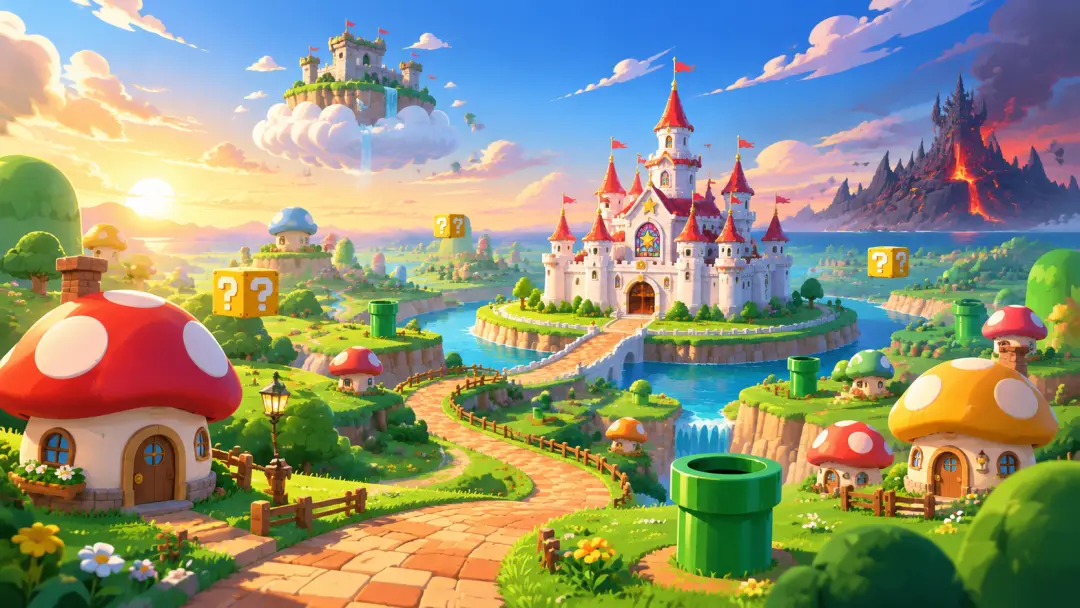
Peach's Castle is the emotional and strategic center of the Mushroom Kingdom, and it is also the most repeated crime scene in it. The stained-glass windows, the marble halls, the moat and the gate are designed to read as permanence, yet the story keeps proving they are not. That contradiction is the setting's engine: a kingdom civilized enough to build a palace and cursed enough to lose it on a schedule. In the world's key visuals the castle sits at the middle distance, white against green, with the plains in front of it and the volcano behind — a place you can see from anywhere and still fail to reach in time.
Grassland Plains: Where Every Adventure Starts
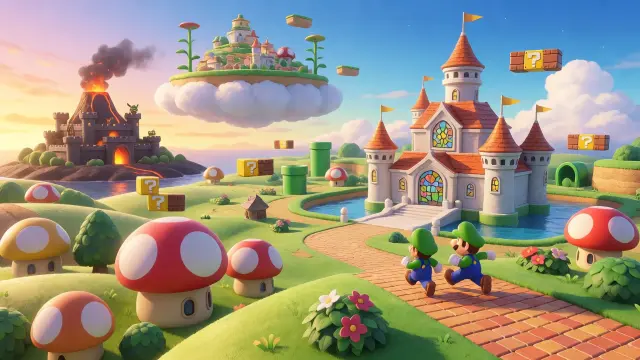
The Grassland Plains are the kingdom's tutorial, and they know it. Mushroom-roofed houses, question blocks at head height, pipes that hum when you stand near them, and a brick road that always bends toward the castle: every element is a lesson in what this world rewards. It is also where the tone is set. The plains are bright without being flat — cel-shaded shadows sit in hard, clean shapes, and the horizon is never empty. Krea 2's version of this view leans into that storybook quality, placing the two brothers on the path as if the poster had caught them mid-run.
The Underground Caverns: Coins, Brick and Bad Ideas
Below the plains, the Underground Caverns turn the kingdom inside out. The palette drops to blue and black, the coins become the only warm light, and the pipes stop being travel and start being traps. This is where the world's rules become mechanical: brick ceilings break, hidden blocks appear only when hit, and the exit is rarely the door you came in through. It is also the best argument for the setting's visual range — the same cel-shaded language that makes a mushroom house charming makes a brick tunnel genuinely claustrophobic.
Sky Land: The High Road Nobody Patrols
Sky Land is the kingdom's vertical frontier: cloud islands, beanstalk platforms, and a fortress that floats because the story needs a second map. When the Koopa Troop blockaded it, the high route to the castle closed and the kingdom's fastest road became its most isolated one. In the key visuals the cloud island hangs above the plains like a promise and a warning at once — reachable only by pipe or by luck, and impossible to hold without allies.
Bowser's Castle: The Volcano With a Front Door
Bowser's Castle is built on a dark island in a lava sea, and it is designed to be read from a distance: black spires, orange light, a bridge that exists to be crossed under fire. The architecture is a threat display. It is also, crucially, a home — Bowser's throne, his army, his son's future and his wizard's laboratory are all inside it. That is why the loop never fully closes: the hero can storm the castle, but the castle is a country, and countries do not stay conquered because one bridge was crossed.
Events That Shape the Kingdom
The five events are not lore decoration; each one changes what the world can do. The Founding explains the pipes and the Power Stars. Bowser's First Invasion establishes that the castle can fall. The Pipe Accident introduces outsiders who owe the kingdom nothing and stay anyway. The Sky Land Blockade removes the high road and turns the map into a problem. The Kidnapping of Princess Peach turns the whole thing into a repeating story that every new hero inherits.
Factions and Their Agendas
Four forces pull the kingdom in different directions. The Koopa Troop wants the Power Stars and the throne. The Royal Court wants continuity — a ruler, a castle, a working harvest of coins and allies. The Goomba Brigade wants to be paid. Yoshi's Clan wants its island and its eggs left alone, and joins only when the war comes to them. None of these agendas are identical, and the best Mushroom Kingdom stories happen in the gaps between them.
The Core Conflict: A Loop That Refuses to Close
King Bowser keeps kidnapping Princess Peach to claim the Power Stars hidden across the kingdom, and the defenders can only stop him by racing through pipes, skies and fortresses to rescue her again. Every victory keeps the kingdom safe for a little while, but the Koopa Troop always regroups, so the cycle of kidnap and rescue never truly ends. That is not a flaw in the premise — it is the premise. A world built on a loop needs a cast that treats each turn as if it were the first, and a map that makes the repetition feel like geography rather than a reset button.
Works from This World
Four works have been generated from this world — a two-subject, two-model key-visual comparison on Neta Studio. The world key visual sells the setting; the event key visual sells the story's turning point. Each brief was run through GPT Image 2 and Krea 2 with the same prompt, so the pair is a genuine model comparison rather than two unrelated illustrations. All four are public works of this world and can be opened, shared or remixed.
Model Comparison: GPT Image 2 vs Krea 2
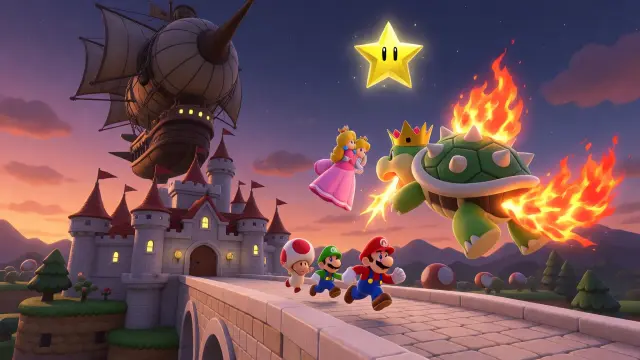
The same prompt, two models, two different kinds of poster. GPT Image 2 leans detail-first: it stacks every layer of the kingdom into one legible frame, keeps the architecture straight, and gives the horizon a real sense of distance. It is slower and more expensive, and it will refuse some character-heavy prompts when they drift too close to a known franchise — which is why the GPT world visual was staged as a pure environment. Krea 2 is faster and more expressive: it puts the characters in the frame, pushes the poster composition, and gives the whole thing a warmer, more illustrated feel, at the cost of some architectural precision. Neither is 'better'. One is a map; the other is a cover.
The World Key Visual, Examined
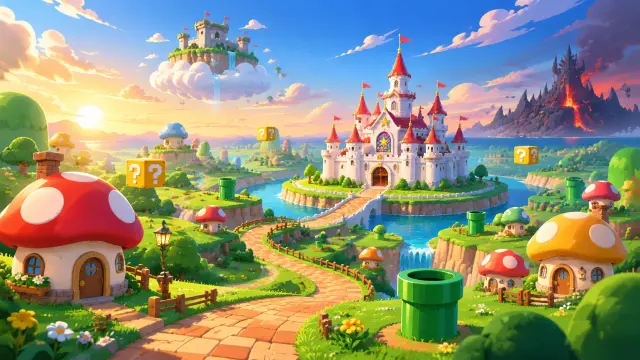
The world key visual has one job: sell a whole setting in a single frame. Here it is the entire kingdom as a route — mushroom houses and a brick path, the castle across its moat, a cloud island overhead, a volcanic fortress on the far shore. GPT Image 2's version reads like a travel poster for a place that is about to be invaded: every landmark is in its correct spatial relationship, and the eye can trace the journey before the copy explains it. Krea 2's version reads like the first frame of the cartoon, with the heroes already running. Put side by side, they answer different questions: what is this place, and what does it feel like to be in it?
The Kidnapping, Examined
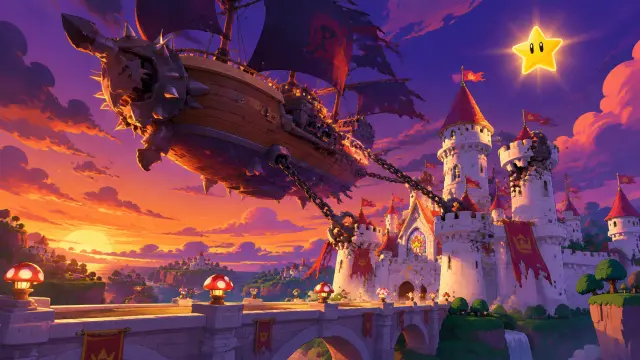
The event pair points the same brief at the world's turning point. GPT Image 2 stages the defense detail-first: the airship's chains lock onto the towers, the banners are torn, the bridge lanterns are still lit, and the Power Star burns in a violet sky — no characters, and the story is still completely legible. Krea 2 stages it as a character beat: the princess carried aloft, the Koopa King wreathed in fire, the two brothers sprinting across the bridge with a Toad at their heels. One image is the crime scene; the other is the chase. Together they show why a world needs both a map and a moment.
Fork This World
This world is public. You can fork it — inherit all 25 atoms, every character secret, every location and every rule — then rewrite what you want and generate from the same canon. Change the castle, add a sixth location, promote a Goomba to a general, or move the kidnapping to Sky Land. The key visuals you make will still belong to a coherent world because the atoms come with them.
Choose a path and see where it takes you. Fortify the castle, take the fight to the volcano, or follow a warp pipe nobody has mapped — the world keeps the consequences either way.
Fork world → Edit atom cards → Generate new key visuals / games / videos → Publish → Others can fork your version
From Seed to Key Visual
Choose the seed
Fork The Mushroom Kingdom or write a one-sentence platformer brief about a bright kingdom linked by pipes and a castle that keeps getting taken.
Pick the scene
Pick the moment — the plains at golden hour, the castle across its moat, the cloud island blockade, the brick caverns, or the airship over the towers at dusk.
Cast the subject
Name the character and the beat — Mario mid-jump, Luigi noticing the loose brick, Peach carried aloft, Bowser wreathed in fire, or no figure at all for a pure establishing shot.
Render both models
Run the same prompt through GPT Image 2 and Krea 2; the studio publishes both as works of the world.
Iterate
Compare, re-prompt, or fork the world and start again — every poster is a fork point.
World, Not Work
In Neta Studio, a world is the beginning of everything. A world contains the characters, locations, events, factions and rules, and every image, game or video is generated from that canon. The Mushroom Kingdom is not a folder of pictures of a castle; it is a set of decisions about what a castle means, who wants it, and what happens when it falls.
A world is not a single image. A world is the source of every image: the same red cap and blue overalls, the same green pipe, the same white towers and the same volcanic horizon, rendered again and again from different angles and in different models. That is why the four works on this page look like they belong together even though two different models made them — the canon, not the model, is doing the consistency work.
World → Game
Select a storyline from world cards; AI auto-writes game logic, generates art, and builds a playable experience from the same atoms.
World → Video
Generate dynamic videos from world characters and scenes — a pipe descent, a cloud-island blockade, a bridge chase under a violet sky.
World → Assets
Each character generates a cover, each location generates a background. The world itself is an asset library.
Who This World Is For
Platformer fans who want a world with a real map and a real clock on it. Game masters who need a bright kingdom, a castle and a reason for the party to run. Artists who want a canon-consistent setting for key visuals, character covers and environment plates. Writers who like the idea of a loop that the characters treat as urgent every single time. And anyone who has ever looked at a green pipe and wondered where it actually goes.
Frequently Asked Questions
- Is this the official Mario world? No — it is an AI-generated, fan-style world inspired by the Mushroom Kingdom premise, rebuilt as an original Neta Studio world with its own character cards, locations, factions and story beats.
- What can I do with it? Fork it, edit its atoms, generate key visuals, build a playable scenario, or use it as a setting for your own table.
- Which models made the art? GPT Image 2 and Krea 2, from the same prompts, published as four works of this world.
- Why does the GPT Image 2 world visual have no characters? Character-heavy prompts can trip third-party similarity filters; staging the world as a pure environment keeps every landmark, and the cast still appears in the Krea 2 version and in the event pair.
- Do I need to know the games? No. The world carries its own rules: power-ups are temporary, pipes connect everything, coins buy extra lives, and the castle can always fall again.
- Can I remix the works? Yes — public works of a public world are forkable and remixable on Neta Studio.
Start Creating
Fork The Mushroom Kingdom or start from your own one-sentence platformer brief. The world ships with 25 atoms, a complete map and four published key visuals, so you can generate a new cover, a character plate or a game scene without rebuilding the canon from scratch. When you are done, publish it as a work of this world — or fork again and make the castle yours.
Create from This World
Inherit 25 atoms, rewrite what you want, tell your own story in a kingdom where the pipes are older than the castle and the castle is never safe for long.