
The Serpent Circuit — A Snake-Game World Where Length Is the Only Score
The Serpent Circuit is a closed arcade cabinet pretending to be a civilization: serpents of light, a scoreboard sky, fruit for weather, and four walls of white light called the Edge. Eat to grow, grow to matter, and matter too much to move.
Worldview
The Serpent Circuit is a closed arcade cabinet pretending to be a civilization. Its people are serpents of light, born from a coin slot and measured in segments; its sky is a scoreboard, its weather is the drop of fruit, and its horizon is four walls of white light called the Edge. To eat is to grow, to grow is to matter, and to matter too much is to become a cage of your own body. Between runs, the Circuit argues about what the game is for. The Orchard says it is a garden. The Uncoiled say it is a leash. The Wallwrights say it is a measurement. The Long Line says it is a legacy. Warden Cass, the only human inside, says nothing and keeps the ledger.
An arcade-cosmology epic about appetite, geometry and the price of winning: four laws of light, a Cabinet that drops fruit like weather, and a champion long enough to be her own prison. The run always ends the same way — the only question is how much of you the Scoreboard remembers.
Why The Serpent Circuit Is a World, Not a Prompt
A snake game is the smallest possible ruleset: move, eat, grow, avoid your own body, do not touch the wall. Most art built from it stops at the maze — a neon grid, an apple, a score in the corner. The Serpent Circuit takes that ruleset seriously as a cosmology. If length is the only proof of existence, then length becomes money, aristocracy, priesthood and heresy. If the walls delete you, then the guild that measures the walls holds real power. If fruit appears only where the Cabinet wills it, then every meal is a theological event. The world is not decorated with a game; it is the game, thought all the way through.
That is the difference between a setting and a world engine. Every atom here can generate a scene without being told what to do: Bram Tail-Eater biting off his own segments as an act of faith, Vess knotting her tail so she cannot see where she has been, Warden Cass writing a name in the ledger and crossing it out. The rules do the narrative work, and the images only have to catch up.
The Cabinet: A Civilization Inside an Arcade Machine
Outside the Edge there is the Cabinet — a dark room full of dust, enormous silence, and the faint smell of warm circuitry. No serpent has seen it and returned. The Circuit's theology is built entirely from inferences about that room: the Coin Drop that admits new serpents, the Compression that moves the walls inward, the Long Coil that decides the year. Warden Cass is the only human inside, or the only one who admits it, and she tends the Grid the way a groundskeeper tends a graveyard: drops the fruit, sweeps the dead pixels, calls the start of each run in a voice worn smooth by repetition.
- Scoreboard — a monolith of black glass where names are carved in light. The top line is always Vess.
- Fruit — grace, bribe and weather in one object. It appears only where the Cabinet wills it.
- Segments — body, currency and cage. Every serpent is exactly as free as her length allows.
- The Edge — four planes of white light. Touch it and you are unwritten: no body, no score, no name.
Characters (7)
Locations (6)
Events (5)
Factions (4)
The Four Laws of the Circuit
Works from This World
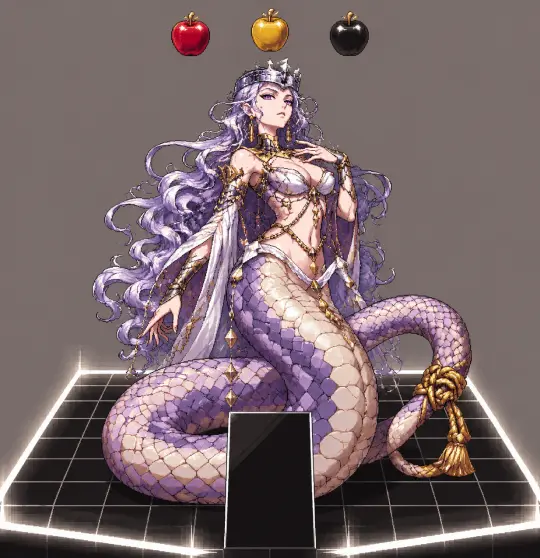
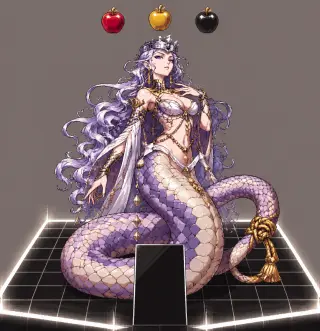
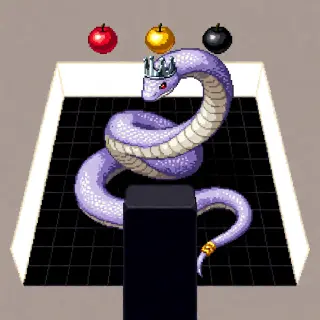
Four works have been generated from this world — a two-model key-visual comparison across two subjects. Vess of the Long Line is the character frame; The Coil Well is the location frame. Each brief was run through GPT Image 2 and Krea 2 with identical text, no references and the same world atoms. Every image below is a published work from The Serpent Circuit, not a demo render.
Model Comparison: GPT Image 2 vs Krea 2
The same prompt, two models, four works. GPT Image 2 leans detail-first: crisp scale rows, readable jewellery, a crown-plate you could describe to a costumer, and a body that stays legible when cropped to a store card. Krea 2 leans silhouette-first: fewer colours, stronger value blocks, and a graphic read that survives a 300-pixel thumbnail. Neither is the "correct" answer. The comparison is a production asset — it shows the range of the canon before anyone commits to a single rendering style.
A Second Subject: The Coil Well
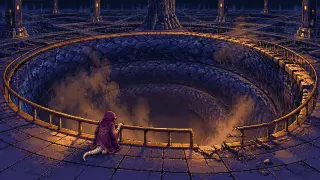
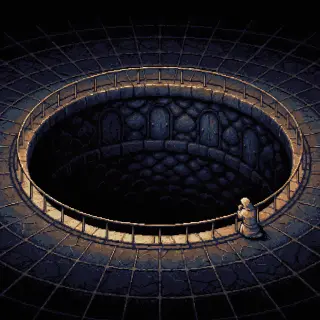
For the second pair we pointed the same brief at the world's darkest room. The Coil Well is a spiral pit at the Grid's center, walled by Coil-Mother Sable's body, with a brass railing the Uncoiled have sawed through three times. The brief asks for scale and intimacy at once: an enormous throat of stone, warm dust rising, and one small hooded pilgrim at the railing. GPT Image 2 renders the pit as architecture — courses, railings, rubble, a horizon of lattice. Krea 2 renders it as geometry — a cold top-down spiral, a sawed-open gap, the Grid receding into black. Both frames explain why the Well is the Circuit's most contested holy site.
The Scoreboard Is the Only History
The Circuit keeps no books except the Scoreboard. Names are carved in light at the south end of the Grid, and the top line has read Vess for as long as anyone can remember. History is therefore a ranking, and memory is a privilege of length. The Long Line keeps the histories, which are mostly lists of names; the Orchard reads the board like scripture; the Uncoiled refuse to look at it. When Caret blinks faster, the old serpents take it as either a warning or a countdown, and nobody can agree which.
“Length is the only score, the only currency, and the only proof that you were here.”— The Law of Growth
Fork This World
This world is public. You can fork it — inherit all 26 atoms, every character secret, every location rule, every faction argument — and then change one thing on purpose. Make the Black Apple edible. Let Vess reach fifty segments and discover what happens at the end of the board. Give Warden Cass a name she refuses to cross out. The world supplies consistency; your edit supplies the story.
Fork world → Edit atom cards → Generate new key visuals → Publish → Others can Fork your version
From Coin Drop to Published Key Visual
Choose the seed
Fork The Serpent Circuit or write a one-sentence arcade-cosmology brief of your own.
Pick the scene
Not "the world" — "the night the Black Apple appeared" or "shift change at the Scoreboard".
Name the subject and the moment
Vess at the top of the board, Bram at the railing, one pilgrim at the Well.
Render both models
GPT Image 2 for structure and detail, Krea 2 for silhouette and atmosphere, identical brief.
Publish and compare
Attach both frames to the world as works, then let the next person fork it.
World, Not Work
In Neta Studio, a world is the beginning of everything. A world contains the characters, locations, events, factions and rules that every image, game and video inherits. A single key visual is a work; The Serpent Circuit is the machine that keeps producing works. That distinction is why the four images on this page share a grammar — the same lattice, the same violet-and-bone palette, the same theology of length — even though two different models rendered them.
A world is not a folder of pictures. It is a set of constraints strong enough that a new image can be judged correct or incorrect. Does the frame obey the Law of the Edge? Does the serpent's length read? Is the fruit in the right place, blessed by the right faction? Once those questions have answers, you are no longer prompting a style. You are building a canon.
World → Game
Select a storyline from world cards; AI auto-writes game logic, generates art, and builds a playable experience from the same atoms.
World → Key Visual
Generate poster-grade character and location frames from the same brief, then compare models on an identical prompt.
World → Video
Animate the Coin Drop, a Compression, or the moment the Black Apple appears — same rules, same palette, new medium.
World → Fork
Every atom is editable. Inherit 26 of them, break one on purpose, and publish a version that is legally yours.
Why The Serpent Circuit Matters
Snake games are the first game most people ever play and the last one they think about. The Serpent Circuit takes that tiny loop — eat, grow, do not cross yourself — and asks what society would look like if it were literally true. The answer is funny, cruel and strangely moving: an aristocracy measured in segments, a priesthood of fruit, heretics who starve themselves free, and a champion who has become too long to turn around. It is a world about the price of winning, and it costs nothing to fork.
- One rule, many stories — length as score, currency and cage generates hundreds of plots.
- A visual grammar you can reuse — black lattice, white edge, violet-and-bone serpents, three-colour fruit.
- Built for comparison — every subject ships twice, once per model, so you can choose the frame that survives your crop.
- Public by default — fork it, edit an atom, publish a version that contradicts the canon on purpose.
Start Creating
Fork The Serpent Circuit or start from your own one-sentence arcade brief. The world ships with 26 atoms, four published key visuals, and a studio where every rule is editable. Play the run, rewrite the ending, and publish the frame that makes the Scoreboard remember you.
Create from This World
Inherit 26 atoms, rewrite what you want, tell your own story inside the Cabinet.