
Tidegate — An AI Harbor World Where Every Door Costs a Name
At the ninth hour of the ebb, the sea caves under Tidegate open as doors onto other shores. Wardens license the crossings, monks ring the hours that keep them honest, and every passage is paid for with a name, a year, or a home.
Worldview
Tidegate is a harbor town built on the roof of a drowned cathedral. At the lowest tide, the sea caves below the harbor open as doors — not to rooms, but to other shores: other centuries, other seas, other versions of the coast that the town is standing on. The doors are not magic in the decorative sense. They are infrastructure, and everything in Tidegate is arranged around the hour they are allowed to stay open.
A warm-grey 35mm film world about crossings and their price: four powers, one cracked bell, and a town that has learned to charge admission to the sea.
Why Tidegate Is the Perfect World Seed
Most fantasy worlds begin with a map. Tidegate begins with a schedule. The doors open at the ninth hour of the ebb, the bell counts how long they may stay open, and the tide closes whatever the bell cannot justify. That single rule gives the world a clock, a legal system, a black market and a moral problem before a single character is introduced.
It also gives every image a reason to exist. A doorway in a cave is not a backdrop; it is a transaction. Who is standing at it, what they are carrying, which faction licensed them and what they are about to owe — those four questions can organise an entire key visual. That is what makes Tidegate unusually good to build in, and unusually easy to judge: a frame either shows the price or it does not.
The Town: One Harbor, Two Shores
Tidegate is not a kingdom with a border. It is a harbor with a ledger. Above the waterline are the Ashby Lighthouse, the Customs Exchange, the Ninth Bell Tower and the shanty market of the Lowtide Arcade. Below it are the Saltglass Caves and the drowned cathedral, and through them the far shores: the Drowned Orchard, the dry seabeds, the coasts that should not be reachable by boat.
- The Tidewardens — the harbor guild that licenses crossings. Grey oilskin, brass tally-keys, and a count of open doors kept secret even from the Exchange.
- The Order of Bellringers — monks who ring the hours that keep doors honest. Brown habits, rope belts, and a tide-almanac they never show anyone.
- The Salt Cartel — smugglers running goods and people through the doors. Tarred ropes, tide-mark tattoos, and no names in any ledger.
- The Customs Exchange — the harbor authority that taxes and confiscates door-keys. Green visors, brass cages, and debt ledgers chained shut.
Characters (7)
Locations (6)
Events (5)
Factions (4)
The Four Laws of the Tide
Works from This World
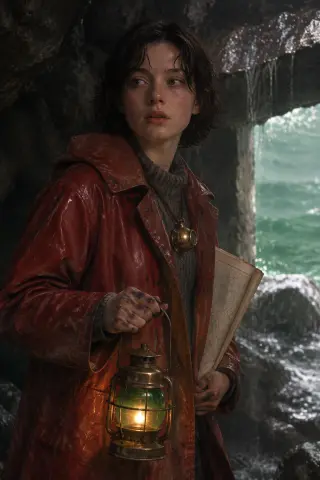
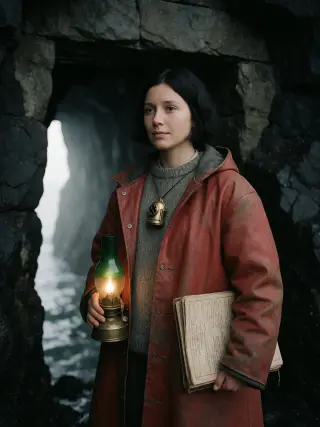
Four works have been generated from Tidegate: a two-model comparison across two subjects. The first pair is the world itself — the Saltglass Caves at the ninth ebb, with a Tidewarden at the threshold. The second pair is Iselde Crane, the keeper’s daughter who hears the doors before they open. Each prompt was run unchanged through GPT Image 2 and Krea 2, so the difference you see is the model, not the brief.
Model Comparison: GPT Image 2 vs Krea 2
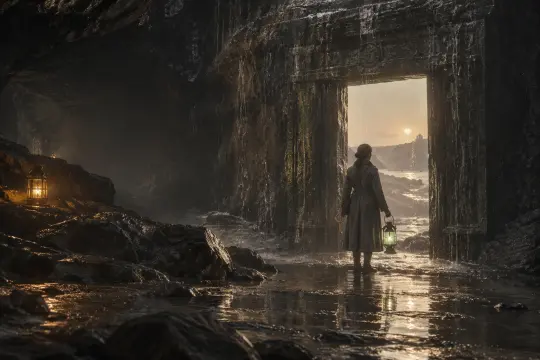
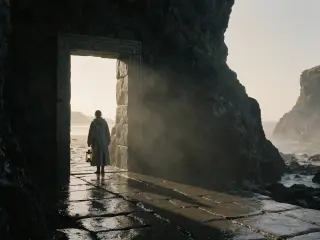
The brief for the world key visual asked for the same geography in both cases: a wide shot inside the Saltglass Caves, black basalt slick with seawater, a drowned stone doorway with the sea sheeting down its lintel, a pale coast visible through the frame, and a Tidewarden seen from behind with a lantern and a brass tally-key. Only the size parameter changed to fit each model’s supported range.
GPT Image 2 renders the threshold as a place you could stand in: two lanterns, wet rock, moss, a coast with a lighthouse on the horizon and a keeper whose posture tells you she has done this before. Krea 2 renders it as a diagram of the same decision: dark mass, bright opening, one figure, one path. Neither is wrong. The first is a film still; the second is a poster.
The Saltglass Caves: What You Are Looking At
The Saltglass Caves are the world’s front door. Every rule in Tidegate can be read off this one frame: the stone doorway is older than the town, the seawater on its lintel is the tide that opens it, the lantern is the hour being counted, and the coast beyond is the thing the town is selling access to. The keeper is not exploring. She is working.
The detail that matters most is the second light. There is the lantern in the keeper’s hand and another lantern on the rocks to the left, which means someone else is already inside the cave, waiting. That is not decoration; it is the first line of a story about who gets to use the door and who has to wait their turn.
Iselde Crane: The Keeper Who Hears the Doors
For the second pair the camera moves in. Iselde Crane is the lighthouse keeper’s daughter, and her gift is not magic in the usual sense: she hears the note each door makes before it opens, the way a sailor hears weather in the rigging. That makes her the one person in Tidegate who knows a crossing is coming before the bell does, which is valuable to every faction and safe for none of them.
“She does not open the doors. She hears them coming, and then she decides who to tell.”
Why Tidegate Is a World, Not a Prompt
A prompt produces an image. A world produces decisions. Ask for “a dark fantasy harbor” and you get wet cobbles and a lantern. Ask what a town does when the sea opens a door it cannot close, and you get a scene that can only belong to Tidegate.
The test is simple: can a new image be judged correct or incorrect without asking the person who made it? In Tidegate, yes. Grey oilskin means a licensed crossing. A green visor means the Exchange is collecting. A brass tally-key means someone is counting the hour. A door with sea light in it means the tide is still on your side. Those are not decorations — they are a visual grammar, and all four works on this page speak it.
Fork This World
Tidegate is public. Forking it inherits all 22 atoms — every character secret, every location rule, every event, every faction — plus the four published works as references. You can move the harbor to another coast, write a fifth faction that wants the doors sealed, or give Nell a door of her own. The world will hold.
Fork world → Edit atom cards → Generate new key visuals → Publish → Others can Fork your version
From a Blank Door to a Published Key Visual
Choose the seed
Fork Tidegate, or write one sentence: “a harbor town where the sea opens doors, and every crossing costs a name.”
Pick the threshold
Not “the world” — “the ninth ebb at the Saltglass Caves” or “the night Nell forgets her mother’s face.”
Name the subject and the hour
Iselde at the cave mouth. Maren at the cracked bell. Odo on a wet causeway with a crate he will not open.
Render both models
GPT Image 2 for texture, staging and light; Krea 2 for silhouette and graphic structure, on an identical brief.
Publish and compare
Attach both frames to the world as works, then let the next person fork it and decide what their door costs.
World, Not Work
In Neta Studio, a world is the beginning of everything. A world contains the characters, locations, events, factions and laws that any work can draw from. A work is one frame taken from that world — a key visual, a character poster, a scene that could only happen here.
That is also why this page puts the comparison next to the lore instead of in a gallery. The four images are not a portfolio. They are evidence that the atoms are strong enough to survive two completely different renderers and still read as the same harbor.
World → Key Visual
Generate poster-grade character, event and location frames from the same atoms, then compare models on an identical prompt.
Pick a faction, not a genre
Tidewardens, Bellringers, Salt Cartel and Customs Exchange each imply a different palette, a different camera and a different kind of debt.
Let the door cost something
Every crossing takes a name, a year or a home. Put the price in the frame and the world stops being decorative.
Start Creating
Fork Tidegate or start from your own one-line harbor brief. The world ships with 22 atoms, four factions, five events and four published key visuals — enough structure to generate a hundred scenes that all belong to the same coast, and enough room to change every one of them.
Create from This World
Inherit 22 atoms, rewrite what you want, decide what your door costs.