
Violet Evergarden AI World — Letters, Auto Memory Dolls, and a War That Won't End
A literary post-war continent where the most dangerous job is writing what other people cannot say.
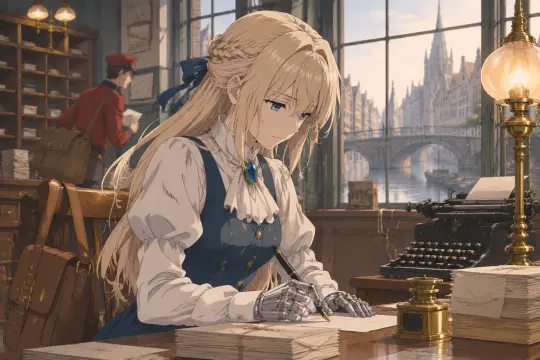
Violet Evergarden: The AI World Where Letters Outlive People
The Great War is four years over and nobody has finished burying it. In the canal city of Leiden, the trams still run past shrapnel scars that the masons have not been paid to fix, the victory monuments are being polished for a second winter, and the post still moves three days behind the front. This is a world where the most important machine is not an airship or a field gun. It is a letter, dictated by someone who cannot say the words aloud and written by a girl who was built to carry orders.
Neta Studio has rebuilt that world as a working, editable AI setting: twenty-three materials, eight characters, six locations, five turning points, four institutions, and four published key visuals. Nothing here is a plot summary pasted into a text box. Each character, place and event is a card you can open, rewrite, illustrate and put back into the world. The point is not to retell Violet Evergarden. The point is to give you the Continent as a box of parts and let you write the next letter.
A girl raised as a weapon is hired to write what other people cannot say. The whole world is the distance between those two sentences.


The Premise, Without the Spoilers
Violet Evergarden was found in the wreckage of a northern village and raised by the Leidenschaftlich army as an asset. She fought from childhood, was called the war doll of Leidenschaftlich, and lost both arms at the Battle of Intense. She also lost the one person who treated her as a child rather than a weapon: Major Gilbert Bougainvillea, who put her on the last troop train and stayed on the bridge. The last thing he said to her was that he loved her. She has no idea what that means.
Four years later she works for CH Postal Company as an Auto Memory Doll, a licensed professional letter-writer. Clients speak; she listens; she writes what they mean and cannot say. The job is a machine for producing the exact thing she lacks: a vocabulary for feeling. Every commission is a small lesson, and every lesson arrives too late to be safe.
The engine of the world is not the mystery of whether Gilbert is alive. It is the daily, undramatic work of sitting across from a stranger and finding the sentence they have been avoiding for years.
Why a Letter Is a Weapon Here
The Continent has telephones in government offices and telegraphs for emergencies, but the letter is the true medium of ordinary life. A letter takes three days across the country and a week across a sea. It is read aloud at weddings and funerals. It is the only object in the world that can arrive after the person who sent it is gone. That delay is not a limitation of the setting; it is the setting's moral physics.
An Auto Memory Doll is bound by three prohibitions that function like laws of nature. Never invent a feeling the client does not have. Never alter a sealed letter without permission. Never repeat what was said in the room. The letter belongs to the client, and the doll's name goes nowhere on it. Break any one of those rules and the profession stops being a profession and becomes a kind of forgery.
Leiden: A Canal City That Runs on Post
Leiden is the world's centre of gravity: stone bridges, gas lamps, narrow streets, trams that ring through the fog, and a postal house with more letters in it than the city has citizens. The canals are not scenery. They are the reason the city feels like a set of rooms connected by water, and the reason a courier can outrun a rumour. Above the roofs, airships move between kingdoms at the speed of weather. Below them, a girl walks to work with a leather satchel and a pair of gloves she never takes off in public.
The People of CH Postal Company
The company is a found family assembled out of war surplus. Hodgins hires veterans and misfits because he cannot stand to see useful people thrown away. Cattleya writes love letters and refuses to pretend love is simple. Benedict delivers everything and secretly wants to write one. Erica is convinced she is the worst doll in the room and is usually the one who listens best. Iris wants to be a novelist and is learning that restraint is the harder art. And Violet, the prodigy nobody asked for, is slowly being taught that a colleague is not the same thing as a commanding officer.
The War Behind the Politeness
The Great War is not a backdrop; it is the weather. It left prosthetics, orphans and a generation trained to obey. Mechanical limbs are ordinary in Leiden, and so are men who flinch at tram bells. The army calls the children it raised assets. The dolls call them colleagues. Every character in this world is either carrying something home from the front or pretending they are not.
Four Institutions, One Continent
The world runs on institutions that were built for a war and are now pretending to be civilian. A postal company that moves letters faster than the state can move orders. An army that has not learned to stop counting its children as equipment. A noble house that supplied the war with officers and is now supplying the peace with apologies. And a profession that turned an insult into a title.
The Five Rules That Hold the Continent Together
These are the rules the SEO page cannot fake and the image model cannot invent. They are the physics of the world. If you fork this setting, keep them or break them on purpose; either way, know which one you are doing.
The Continent is held by infrastructure
Rail, airship lanes, telegraph wire and, more than anyone admits, the post. The Great War ended four years ago; nothing broken has been repaired, only repainted. Distance is measured in delivery days.
A doll writes what the client means
Never invent a feeling, never alter a sealed letter without permission, never repeat what was said in the room. The letter belongs to the client. The doll's name goes nowhere on it.
Paper is the true medium
Three days across the country, a week across a sea, a lifetime across a war. Letters are read aloud at weddings and funerals. A letter that arrives late is still a letter; a telephone call that is missed is nothing.
The war is still in the room
Prosthetics, orphans and a generation trained to obey. Mechanical limbs are ordinary in Leiden; so are men who flinch at tram bells. The army calls the children it raised assets. The dolls call them colleagues.
Names carry history
Doll began as an insult and became a title. Bougainvillea began as a house and became a wound. To be called by the right name in Leiden is to be trusted with what a person cannot say aloud.
How This World Was Built in Neta Studio
The build started from one line, not a wiki dump: a girl with silver hands writes letters for people who cannot say what they mean. From that seed the world grew outward into people, places, institutions, events and finally images. Each material is editable, and each cover was generated inside the same visual style so the world reads as one object rather than a folder of prompts.
Seed the premise
One line: a post-war letter-writer with mechanical hands learns what love means by writing other people's feelings. Everything else has to serve that sentence.
Build the people first
Eight characters, each holding a different answer to the same question: what is a person for? The army says obedience. The post says delivery. Violet has to decide.
Give the world places to happen
Six locations, each a room with a job: the postal house, the palace, the school, the front, the island, the city. A location that does not change how a letter is written is scenery.
Add the turning points
Five events that fixed the world in place: the battle, the examination, the correspondence, the fifty letters, the reunion. These are the cards you fork when you want a different ending.
Publish the key visuals
Four images, two scenes, two models — the same brief through GPT Image 2 and Krea 2. The comparison is part of the world's documentation, not a marketing extra.
The Same Brief, Two Models
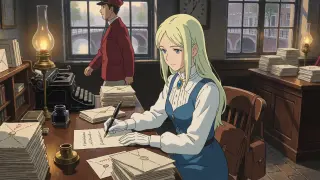
The four published works are a controlled comparison. Two prompts — one quiet interior, one night exterior — went to GPT Image 2 at 1536×1024 and high quality, and to Krea 2 at 1024×576. Same words, same visual style, different model. The images below are the actual results, not reference art.
GPT Image 2 reads the prompt as a production brief. It builds the room around the subject: the typewriter on the right, the inkwell, the brass lamp, the bridge and canal through the glass, the courier already moving in the background. It also takes the prosthetic instruction seriously, drawing articulated silver fingers rather than gloves with a shine. The trade-off is density: there is more to look at, and more that can go slightly wrong in the hands.
Krea 2 reads the same prompt as a composition. It gives you a clean poster: two figures, one train, one bridge, snow falling in even strokes. The faces are simpler, the light is flatter, and the mechanical hands disappear into ordinary white gloves. If you want a fast thumbnail or a graphic novel panel, that is an advantage. If the image has to carry the fact that Violet is a prosthesis user, it is a loss.
What the Comparison Actually Shows
- ProstheticsGPT Image 2 draws the finger joints and the silver wrist; Krea 2 tends to render gloves. For Violet, the hands are not a detail — they are the visual argument of the character. Prompt the hands early and explicitly if you use Krea 2, and expect to iterate.
- DepthGPT Image 2 builds a room with foreground, subject and window; Krea 2 composes a flat stage. Neither is better in the abstract. This world's quiet scenes benefit from depth; its poster moments benefit from flatness.
- Style fidelityBoth hold the anime cel-painted brief. GPT Image 2 adds fine texture and lighting gradients that can drift toward illustration; Krea 2 stays closer to flat colour blocks and hard shadow. The world's visual style allows both, but they will not sit in the same gallery without a deliberate frame.
- Text and letteringNeither model should be trusted with legible text. The letters in these images are suggestion, not language. If a scene needs a readable sentence, add it in the page or the work description, not in the prompt.
What to Make From This World
The world is a kit, not a monument. You can write a new commission for Violet, give Cattleya a client who lies, send Benedict on a delivery that changes him, or take the Drossel correspondence and let the princess write her own letters. The four published key visuals are starting points; the twenty-three materials are the actual material.
- A new doll commissionInvent a client with a sentence they cannot say — a farmer, a widow, a soldier who came home wrong — and write the letter Violet would produce. The constraint is the three prohibitions: no invented feeling, no altered seal, no repeated confidence.
- A different ending at EcarteFork the reunion. Let Gilbert come home, or let Violet decide not to open the door. The world supports either because the conflict is internal, not plot-dependent.
- A CH Postal ensemble storyGive Erica, Iris and Benedict one difficult week. The postal house is a workplace comedy with a war under the floorboards; it can carry a whole series of small, human episodes.
- A visual novel or roleplayPlay as a new doll on the first day at CH Postal, or as a client who does not know what they want to say. The setting's rules make every conversation a letter in disguise.
- A key-visual seriesUse the same two-model comparison on new scenes: the training school examination, the Fifty Letters vault, the palace balcony. Keep the prompt skeleton and change only the staging.
A Reading Order for Newcomers
If you are opening this world for the first time, do not start with the war. Start with a letter. The emotional order is: a room, a job, a rule, a loss, an answer. The cards below are arranged that way.
Writing Violet Without Flattening Her
The most common failure in fan writing is to make Violet either a robot or a saint. She is neither. Her literalness is not stupidity; it is a trained soldier's precision applied to a civilian world that runs on implication. When she takes a metaphor as an instruction, the joke is on the language, not on her. When she misses a feeling, the scene should show the cost in someone else's face, not announce it in narration.
The second failure is to make her arc a straight line from numb to healed. It is not. She learns phrases, then uses them badly, then learns what they cost. The world is most interesting when her new vocabulary arrives at the wrong moment and does damage. Write the damage. That is where the character lives.
Frequently Asked Questions
Is this an official Violet Evergarden product?
No. This is an independent AI-built world created in Neta Studio as a fan work — a set of editable characters, places, events and generated key visuals inspired by the series. It is not affiliated with or endorsed by Kyoto Animation or the rights holders. The images on this page were generated for this world, and the descriptions are written for it.
Can I edit the characters and rewrite the story?
Yes. Every material is a card in the world, and the world can be forked and edited in the studio. You can change a character's history, add a client, move an event, or replace a key visual. The only thing worth preserving is the premise: a letter-writer who cannot name her own feelings, writing other people's.
Which model made the images on this page?
Two models, deliberately. GPT Image 2 produced the two highly detailed frames; Krea 2 produced the two flatter, more graphic frames. Both were given the same prompts and the same visual-style brief. The comparison is documented above and in the individual work pages.
Do I need to know the series to use the world?
No. The world is written to stand on its own: a post-war continent, a postal company, a profession of letter-writers, and a girl with mechanical hands. Familiarity adds resonance, not comprehension. If you know the series, you will recognize the major, the princess and the island; if you do not, they still work as people.
What should I generate first?
Start with a quiet interior: Violet at the writing desk, a client across from her, one lamp and one window. The scene is cheap to prompt, hard to fake, and it tells you immediately whether the model understands the world's central object — the letter — or is only drawing a blonde girl in a blue dress.
Start From the World as It Stands
You do not have to rebuild the Continent to write in it. The world is open: twenty-three materials with covers, four published key visuals, and a studio where every card can be opened. Take the premise, keep the rules, and change the client. The next letter is the one nobody has written yet.
Write the next letter
The world is built. The postal house is open. Start from Violet's desk — or fork the setting and give the story a different ending.
Violet Evergarden is an independent, AI-built fan world in Neta Studio. Not affiliated with Kyoto Animation. The key visuals on this page were generated inside this world; the characters, places and events are editable materials, not canonical text. Open the studio to read every card.