
Wraeclast — A Path of Exile World of Exiles, Virtue Gems and Buried Gods
The continent where the Eternal Empire died, the Vaal drowned and the gods were never quite buried. Exiles wash ashore with nothing and must decide how much of themselves to spend on power.
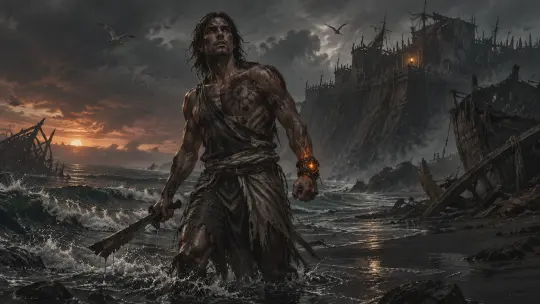
A dark fantasy survival world where magic is a debt. The theocracy of Oriath brands its thaumaturgists as sinners and ships them to a cursed continent; the continent hands them virtue gems and asks for blood, memory and body in return. Every miracle in Wraeclast is borrowed from something asleep beneath Sarn, and it is beginning to wake.
Visual style: semi-realistic painterly digital painting — full volumes, hard weather, ember and gem light against charcoal and sea-green — rendered with GPT Image 2 and Krea 2.
Worldview
Wraeclast is the continent where the Eternal Empire died, the Vaal drowned, and the gods were never quite buried. Exiles from the theocracy of Oriath wash ashore with nothing, and must decide how much of themselves they will spend on power. This is a dark gothic survival world built on Path of Exile canon: virtue gems, thaumaturgy, the Beast, and the purge that fills the shore with the condemned.
The premise is simple enough to explain in one line and deep enough to generate from for months: survival here demands the very thaumaturgy that Oriath condemns. Every gem, every spell, every god bargains for a piece of the one who wields it. That single rule produces characters with prices on their heads, locations with economies of pain, and a timeline in which every miracle has an invoice.
The Shore Where Every Story Begins
The prison ship breaks on the black rocks of Wraeclast, and the sea closes behind it. Here the exiled dead do not stay buried, virtue gems whisper from the ruins, and the only law is what a survivor can hold. That prologue is the world's front door: a beach, a wreck, one lantern, and a stranger with no name worth keeping. It is also the best possible test for an image model, because it demands three separate readable planes — body, surf, fort — in one frame.
The Twilight Strand, in Two Renderings
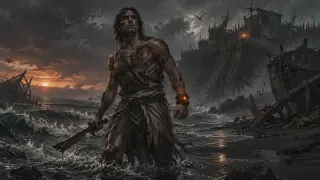
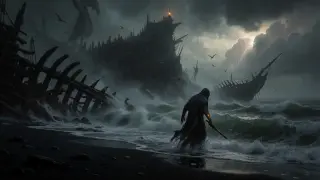
Put the two frames side by side and you have the whole argument of the world in miniature. GPT Image 2 stages the landing as a survival close-up, where the exile is a body with a history written in bruises and wet cloth. Krea 2 stages it as weather, where a small hooded figure is swallowed by a coast that does not care. Neither is wrong. One is a character poster; the other is a place poster. Wraeclast needs both, which is why the world ships with both.
The Characters of Wraeclast
Eight atoms carry the cast. Each one is a pressure vessel: a want, a method and a cost. Read them as prompts and they already contain their own lighting.
The Places That Kill You
Six locations, each with its own palette and its own social rule. A good Wraeclast frame names one of them and then obeys its logic: the Watch is shelter built from failure, the Temple is cleanliness built from blood, the Belly is architecture built from a body.
The Timeline: Six Nights That Broke the Continent
The history is not decoration; it is the reason the present has no good options. Six events, each one a decision that someone survived and everyone inherited.
The Four Powers
Four factions hold the continent in tension: a church that outlaws the magic it practices, tribes that feed their gods with blood and memory, a court of road-barons bound by profit, and a remnant still keeping the books for an empire that drowned.
Why Wraeclast Exists as an AI World
Most "dark fantasy" prompts produce the same fog, the same spires and the same hooded figure. Wraeclast avoids that by starting from atoms instead of adjectives: named people with wants, named places with rules, a dated history with consequences and four institutions that disagree. Once those exist, a prompt is no longer a wish — it is a query against a world that already has answers.
- Atoms beat adjectives. "A branded exile at the wreck-line of Lioneye's Watch" is specific enough to render; "dark fantasy beach" is not.
- Every place has a politics. The Temple is not a cathedral, it is a surgical economy with a church façade.
- Every miracle has a price. Gem-light in a frame should look borrowed, not free.
- History is visible. The ships are wrecked because the purge happened; the ruins are drowned because the Vaal paid.
The Visual Grammar of the World
The house style is semi-realistic painterly: full volumes, soft lost-and-found edges, atmospheric depth and a restrained palette of charcoal, sea-green, rust and gem-ember. It is deliberately not flat illustration and deliberately not photoreal — the goal is a frame that reads as a painted poster at thumbnail size and still holds detail at full bleed.
Choose the atom
Pick one character and one location from the world — the Exile at the Twilight Strand, Piety in the Lunaris Temple. Never two places in one frame.
Name the moment
Not "a beach" but "the first step out of the surf". Not "a temple" but "the hour between two operations".
Price the light
One warm source and one cold source at most: a lantern against storm-grey, candle-chandeliers against gem-blue.
Render both models
Run the identical prompt through GPT Image 2 and Krea 2 at their native aspect and settings, and publish both as works.
Compare and fork
Keep the frame that survives the crop; fork the world and rewrite the atom that failed. Every image is a fork point.
The Second Test: Lunaris Temple
The Twilight Strand tests weather and silhouette. Lunaris Temple tests the opposite skill: interior crowd control. A marble hall, chandeliers, operating tables, glass jars of red and blue virtue gems, acolytes in white and one surgeon who must remain the calmest thing in the room. It is the hardest kind of frame — many small props, one emotional centre.
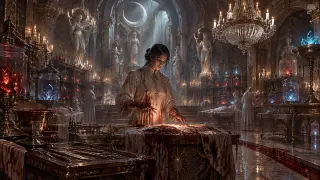
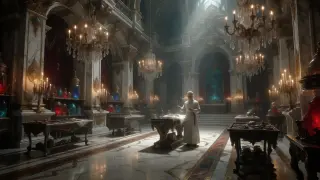
The comparison is instructive. GPT Image 2 gives you the room as evidence — you can count the instruments. Krea 2 gives you the room as mood — you can feel the height and the cold. For a world page you want both, because the setting has to be believable enough to argue about and atmospheric enough to want to enter.
The Model Comparison Behind These Four Works
All four images on this page come from the same two prompts, run once through GPT Image 2 at 2048×1152 and once through Krea 2 at 1024×576. No retouching, no reference images, no second pass. The point is not to crown a winner but to show what each model does with an identical brief, so you can choose deliberately instead of by habit.
| Test | GPT Image 2 | Krea 2 |
|---|---|---|
| Twilight Strand | Forensic close-up: body, rags, spray, ember gem | Mythic wide: silhouette, surf, beached hull, mist |
| Lunaris Temple | Prop-dense: jars, trays, chandeliers, surgeon | Light-led: nave, chandelier rows, one white figure |
| Best for | Character posters, store pages, inspected frames | World and location posters, fast mood passes |
| Weak at | Speed, graphic silhouette, cheap iteration | Small props, legible detail, exact staging |
What You Can Build From This World
Wraeclast is an asset library as much as a setting. The same atoms generate a poster, a playable prologue, a location background or a character cover without being rewritten. That is the practical value of a world with structure: you stop prompting from zero.
World → Key Visual
Drop a character into a named location and render the moment. The four published works here are exactly that, twice over, in two models.
World → Playable Prologue
Take the Twilight Strand and the Exile as the opening scene of a survival ARPG: one beach, one blade, one lantern, one choice.
World → Asset Library
Every character has a poster, every location has a background, every faction has a palette. The world is the brief.
Who This World Is For
- Dark fantasy illustrators who need a coherent setting rather than a one-off mood board.
- ARPG and survival-game teams prototyping a tone, a class fantasy or a store page.
- Writers and game masters who want factions, dates and locations that already contradict each other in interesting ways.
- Prompt engineers comparing models on a brief with real constraints instead of a generic "dark fantasy castle".
The Rules of Thaumaturgy
Wraeclast has no free magic. Virtue gems are mined, cut and socketed; thaumaturgy is surgery performed on reality with a patient who is always you. The Church calls this sin while its high priests graft gems into their own flesh. The Vaal called it currency and drowned a civilization proving the exchange rate. The Karui call it a debt to gods who are hungry. Three cultures, one law: nothing is borrowed without a body as collateral.
- Gems are geology with intent. They come out of the ground already shaped for a use, which is why the mines are holy and the miners are not.
- Spellwork leaves a mark. A caster pays in memory, skin, years or names. Visually, that means scars, pallor, prosthetic lattice and gem-inlay.
- The dead do not stay down. The shore is full of things the sea refused, so a beach at dusk is never empty.
- The Beast is a place. Beneath Sarn, geography has a heartbeat — and the heartbeat is the antagonist.
Start From Wraeclast
You can enter the world at the shore or at the operating table. Both doors lead to the same question: what will you spend to survive one more night? Fork the world, rewrite an atom, generate a new frame, or take the four published key visuals as the visual canon for your own version of the continent.
Fork world → Edit atom cards → Generate new key visuals, games or videos → Publish → Others can fork your version
Create from This World
Twenty-four atoms, two models, four published frames — tell your own story on the black shore.
Questions About Wraeclast
The short answers to what people ask before they fork a canon-heavy world.
- Is this an official Path of Exile product? No. It is a fan-built AI world that follows the canon of Wraeclast, virtue gems, thaumaturgy and the Beast.
- Can I change the lore? Yes. Every character, location, event and faction is an editable atom, and your fork can contradict the original.
- Which model should I start with? GPT Image 2 for character and prop detail, Krea 2 for location mood and fast passes. Run the same prompt through both before you commit.
- Where do the images live? Each of the four frames is a published work with its own public share page, and every image on this page is served from the world's own renders.
Play the Shore, Then Rewrite It
Start at the wreck-line or the surgical hall — the world is already built.