
Wuthering Waves — An AI Resonance World Where Every Echo Remembers
Twenty years after the Lament split the sky over Solaris-3, the world still hums with its aftermath. Resonators fight with Echoes taken from the enemy, city-states hold the frontier behind the Midnight Rangers, and the frequency under everything is beginning to change.
Worldview
Wuthering Waves is what a catastrophe sounds like twenty years later. The Lament did not end a civilisation so much as tune it: a sound that would not stop, a sky split open, a coastline rewritten into Tacet Fields where memory becomes matter and matter becomes a hunting ground. What survives is a planet of fortified city-states, island observatories and canal cities, all of them listening for the next note.
A bright anime key-art world about borrowed power and unpaid debt: four factions, one wandering Resonator with no past, and an Echo that every archive insists should not exist.
Why Wuthering Waves Is the Perfect World Seed
Most fantasy worlds begin with a map. Wuthering Waves begins with a sound. That single decision makes it an unusually good world to build in, because sound gives you rules for free: frequencies can be tuned, Echoes can be absorbed, Resonators can be measured, and a Tacet Field is simply a place where the rules of physics have been replaced by the rules of resonance.
It is also a world with a built-in engine for conflict. Every power a Resonator uses was taken from a fallen Tacet Discord, which means every victory is also a small act of contamination. The stronger the character, the more of the enemy they carry. That is not a lore detail you have to invent — it is already load-bearing, and it means any new character, location or key visual can be judged correct or incorrect against it.
The Planet: One Wound, Four Powers
Solaris-3 is not a kingdom with a border. It is a frequency with a coastline. Huanglong holds the frontier in walled cities grown around the bones of an old loong. Rinascita holds the water in canal cities where every bridge is a stage. The Black Shores holds the deep frequencies from an island observatory. And beneath all of it, the Fractsidus holds a theory that the Lament was never a wound at all.
- The Black Shores — an island order of researchers, listeners and saboteurs who study the Lament and oppose anyone who would wake it. Their instruments map the world’s frequencies; their guardian, the Shorekeeper, has outlived every founder.
- The Fractsidus — a secret society that believes the Lament is not a wound but a door. They harvest Echoes, experiment on Resonators, and seed Tacet Fields in quiet places, waiting for the frequency that will open the world.
- The Midnight Rangers — Jinzhou’s expeditionary army, sworn to hold the frontier where the Tacet Fields press against the last cities. Under General Jiyan they fight with Resonators, Echoes, and a discipline the Lament has never broken.
- The Order — Rinascita’s ruling church, keeper of the drowned saint and the city’s many masks. It blesses the canals, tries heretics in festival light, and guards a truth about the Lament it would rather drown.
Characters (8)
Locations (6)
Events (6)
Factions (4)
The Four Laws of Resonance
Works from This World
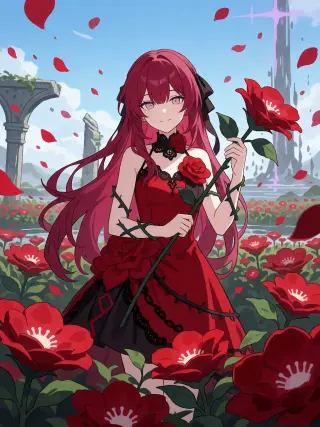
Four works have been generated from this world: a two-model key-visual comparison across two subjects. The first pair is the planet itself — the eastern gate of Jinzhou at the edge of a Tacet Field. The second pair is the Crimson Bloom, the sealed garden that opens Camellya’s story. Each prompt was run unchanged through GPT Image 2 and Krea 2 so the difference you see is the model, not the brief.
Model Comparison: GPT Image 2 vs Krea 2
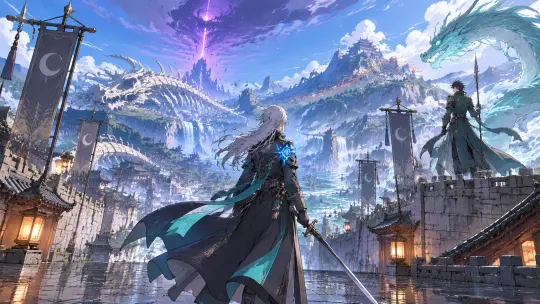
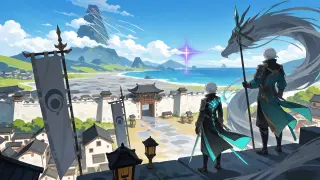
The brief for the world key visual asked for the same geography in both cases: a coastal frontier city built around the bones of an ancient loong, white walls and lantern-lit streets, grey banners with a crescent emblem, a drowned valley where water falls upward, and two Resonators on the rampart with a wind dragon behind them. Only the size parameter changed to fit each model’s supported range.
GPT Image 2 renders the world as a place you could walk through: atmospheric depth, individual lanterns, a skeleton the size of a mountain, and a rift with a visible source. Krea 2 renders it as a diagram you could print: flat colour fields, an aggressive horizon, two silhouettes and a single star. Neither is wrong. The first is a key visual for a store page; the second is a key visual for a poster.
The Crimson Bloom: What You Are Looking At
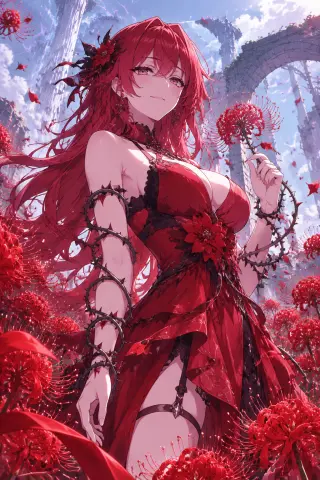
For the second pair the camera goes into the garden. The Crimson Bloom is the sealed Tacet Field where Resonators were fed Echoes until they flowered — a place that should be a grave and is instead in full, obscene bloom. The subject is the one who walked out smiling: crimson hair, a red floral dress with black lace, thorned vines curling around her forearms, one black-thorned stem held loosely, not as a weapon.
“She did not survive the garden. She agreed with it — and the garden has been agreeing back ever since.”
Why Wuthering Waves Is a World, Not a Prompt
A prompt produces an image. A world produces decisions. Ask for “an anime game key visual” and you get a beautiful wall with nothing at stake. Ask what happens when a Resonator absorbs an Echo from the thing that killed their city, and you get a scene that can only belong to this world.
The test is simple: can a new image be judged correct or incorrect without asking the person who made it? In Wuthering Waves, yes. Teal light means borrowed power. A crescent banner means the frontier. Upward-falling water means you are standing in a Tacet Field. Violet in the sky means the Lament is close. Those are not decorations — they are a visual grammar, and the four works on this page all speak it.
Fork This World
Wuthering Waves is public. Forking it inherits all 24 atoms — every character secret, every location rule, every event, every faction — plus the four published works as references. You can rename the factions, move the Crimson Bloom to another coastline, or write a new Resonator whose Echo is the thing you are most afraid of. The world will hold.
Fork world → Edit atom cards → Generate new key visuals → Publish → Others can Fork your version
From Blank Echo to Published Key Visual
Choose the seed
Fork Wuthering Waves, or write one sentence: “a planet where memory becomes matter and power is always borrowed from the enemy.”
Pick the scene
Not “the world” — “the night the eastern gate held” or “the garden where only one walked out smiling.”
Name the subject and the moment
Rover at the gate. Camellya in the bloom. Jiyan on the wall with the wind dragon coiling behind him.
Render both models
GPT Image 2 for detail and staging, Krea 2 for silhouette and graphic structure, on an identical brief.
Publish and compare
Attach both frames to the world as works, then let the next person fork it and answer the Lament in their own handwriting.
World, Not Work
In Neta Studio, a world is the beginning of everything. A world contains the characters, locations, events, factions and laws that any work can draw from. A work is one frame taken from that world — a key visual, a character poster, a scene that could only happen here.
That is also why this page puts the comparison next to the lore instead of in a gallery. The four images are not a portfolio. They are evidence that the atoms are strong enough to survive two completely different renderers and still read as the same planet.
World → Key Visual
Generate poster-grade character, event and location frames from the same atoms, then compare models on an identical prompt.
Pick a faction, not a genre
The Black Shores, the Fractsidus, the Midnight Rangers and the Order each imply a different palette, a different camera and a different kind of debt.
Let the Echo cost something
Every Resonator pays for their power in contamination. Write the cost into the frame and the world stops being decorative.
Start Creating
Fork Wuthering Waves or start from your own one-line resonance brief. The world ships with 24 atoms, four factions, six events and four published key visuals — enough structure to generate a hundred scenes that all belong to the same planet, and enough room to change every one of them.
Create from This World
Inherit 24 atoms, rewrite what you want, answer the Lament in your own handwriting.