
Your Name: The Thread of Musubi — An AI Anime World of Time, Bodies and Comets
A complete Your Name-inspired world rebuilt as an AI canon: eight characters, six locations, six events, three factions and five rules, plus four published key visuals from a GPT Image 2 vs Krea 2 comparison. Two skies, one braid, and a comet that has already happened.
Your Name: The Thread of Musubi — Worldview
Itomori is a caldera town of about three thousand people, built around a blue lake in the mountains of Gifu. It has one high school, one shrine on the hill, one train line along the water, and a festival that nobody can quite explain. Mitsuha Miyamizu is the shrine maiden of that town. She braids a cord she did not choose, performs rites she does not understand, and wants, more than anything, to wake up as a boy in Tokyo.
Three years away, in a rented flat in Yotsuya, Taki Tachibana draws buildings for a career he has not started and works shifts at an Italian restaurant. He is not looking for a girl in a mountain town. He is not looking for anything yet. Then they begin to wake in each other's bodies, and each of them starts repairing a life they have never seen.
A comet called Tiamat returns every twelve hundred years. This time it comes apart. Everything in this world turns on the hour when day and night overlap, and on whether a name can survive being forgotten.
The World in One Frame
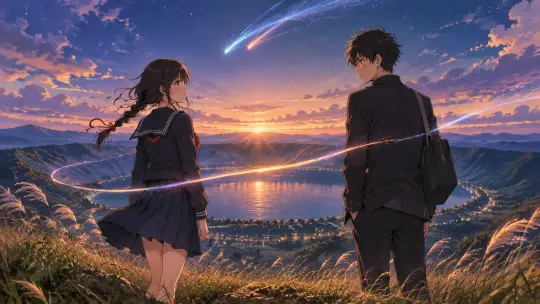
The cover is not a montage. It is one hour, one ridge, two people. Mitsuha stands on the left in a dark sailor uniform, her braid lifted by the wind, the red cord visible at the end of it. Taki stands on the right in a black school jacket and a shoulder bag, hands loose, face half-turned toward her. Neither is running. Neither is touching. The distance between them is the entire story, and the film is about the impossibility of closing it.
Look at what the frame refuses to do. The comet is not a fireworks display; it is already splitting, quietly, above a town that has no idea. The lake is calm. The grass is ordinary. The light is the only supernatural thing in the picture, and even the light is behaving like weather. That restraint is the visual thesis: this is a disaster film disguised as a romance, and a romance disguised as a weather report.
What Itomori Actually Runs On
The town runs on three institutions that do not agree with each other. The Miyamizu shrine keeps the rites: the kumihimo, the kuchikamizake, the dance at the festival, and a warning that has been repeated for twelve hundred years without anyone writing it down. The town hall, run by Mitsuha's father, keeps the future: budgets, demolition plans, a mayor who buried the shrine to be electable. And the high school keeps the present: gossip, tests, part-time jobs, and the ordinary cruelty of wanting to leave.
Tokyo is not the opposite of Itomori. It is the same world at a different zoom level. Taki's city is bright enough to hide a comet; Mitsuha's town is dark enough to see one. The three-year gap between them is never explained by technology or magic. It is simply the distance between a place that is about to disappear and a boy who will spend years learning that it existed.
Musubi is the Miyamizu name for the connective principle. Time is a braid, not a line. Every meeting leaves a thread, every thread can be pulled, and the hour when the braid loosens is called kataware-doki.
Cast: Eight People Inside One Braid
Every character in this world is defined by what they are willing to believe. Mitsuha believes she can leave. Taki believes a place can be found twice. Hitoha believes the old rites are instructions, not poetry. Toshiki believes the town cannot afford to be wrong. The friends around them — Sayaka, Katsuhiko, Okudera, Tsukasa — are not a audience; they are the people who make the plan physically possible.
Six Places That Should Not Exist
Each location answers a different production question: where the town performs its official story, where the past is stored, where the impossible becomes visible, and where the ordinary world keeps interrupting. The geography is small on purpose. Almost everything happens within a walk of the lake, which makes the final distance feel even larger.
The Timeline: Six Events, Twelve Hundred Years
The chronology is deliberately simple because every event is also a prompt seed: one sentence that already contains a place, a subject, and a physical impossibility. Read it in order and you have the whole plot; read any single line and you have a key visual.
Three Factions, One Town
The factions are not armies. They are three answers to the same question: what is a town for? One answer is memory, one is administration, one is friendship. The story works because all three are defensible, and because the comet does not care.
The Rules of the World
Two rules do most of the world-building, and both are physical before they are mystical. A body can be borrowed, but only while the owner is asleep, and the memory of the borrow fades like a dream. A braid can connect two times, but only at the hour when the light is neither day nor night. Everything else follows from those two constraints.
The Core Conflict
Two people love each other across three years and a comet. Mitsuha is already dead in Taki's present; Taki is a stranger in Mitsuha's past. Their only bridge is a body swap neither controls, a braided cord, and the hour of kataware-doki — and every bridge is erased a little more with each waking.
To save Itomori, Taki must reach a girl who has already died. To save herself, Mitsuha must believe a voice from a future that has no record of her. Underneath it runs the older argument: the shrine against the town hall, memory against erasure, and whether a name can survive being forgotten.
The question is not whether the comet can be stopped. It is whether anyone can be asked to remember a town that has already been written out of the map. The film's answer is a braid: not a rescue, a thread.
The Look: Hand-Painted Twilight, Not a Filter
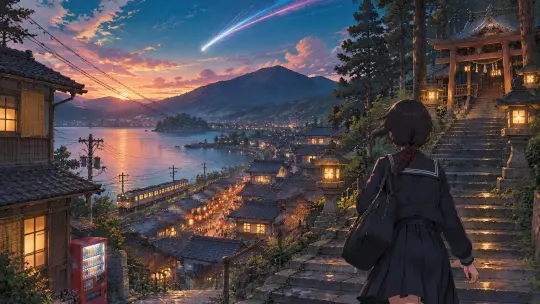
The visual target is not modern glossy anime and not a retro filter. It is hand-painted background art at feature scale: soft airbrushed skies, hard-edged architecture, and a deliberate contrast between the warmth of lantern light and the cold blue of the lake. The film looks expensive because it looks observed, not because it looks shiny.
Restraint is the style lock. Itomori is rural, so the materials are ordinary: wet stone, painted wood, corrugated metal, vending machines, power lines. The supernatural enters through light and weather, not through glowing runes. If a frame could be mistaken for a photograph taken at dusk, the frame is working.
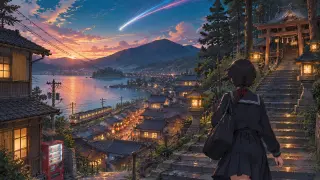
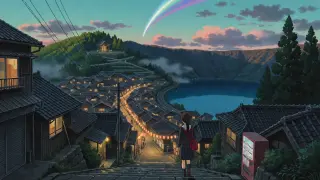
Model Comparison: GPT Image 2 Against Krea 2
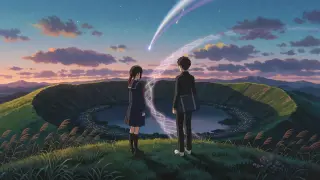
Both models were briefed from the same world atoms and the same two scene briefs, at the same moment in the story. GPT Image 2 produced the detail-first frames: legible architecture, correct costume details, a crowd of small lights that holds up when you crop. Krea 2 produced the atmosphere-first frames: flatter values, bolder silhouettes, a poster that reads from across a room.
Neither is the correct answer. The useful question is what the frame has to survive. If it will be cropped into a vertical thumbnail, Krea 2's silhouette wins. If it will be inspected as a full-bleed hero, GPT Image 2's detail wins. The comparison is not a leaderboard; it is a choice of job.
The Prompts Behind These Frames
Both prompts follow the same six-clause order: medium and genre, place, subject, evidence of physics, light and weather, and a negative clause. Nothing in the order is decorative. Medium tells the model which visual system to use; place gives it a horizon; subject gives it a scale; physics gives it weight; light gives it a mood; the negative clause keeps it from adding text that nobody asked for.
Crater brief. Anime key visual, 16:9 theatrical composition, hand-painted background. The grass-covered rim of a volcanic crater above a caldera lake at kataware-doki, the violet hour when day and night overlap. Two teenagers stand a few paces apart on the ridge: a girl in a dark school uniform with a red braided cord tied into her hair, and a boy in a black jacket with a shoulder bag, both seen three-quarter from behind, faces only half-turned. Between them the air shimmers like a braid of light, threads of sunset and early starlight crossing in a soft arc. Above, a comet has split into two glowing fragments with one long pale tail. Far below, a small town's lights ring the dark lake; reeds bend in the wind. Cinematic anime lighting, painted clouds with warm rim light and cool blue shadows, delicate line work, rich mid-tones, natural film grain, no text, no watermark, no logo.
Town brief. Anime key visual, 16:9 theatrical composition, hand-painted background. A small mountain town built around a blue caldera lake at dusk: terraced houses with dark tiled roofs, a shrine on the hill above the town, one railway line along the water, festival lanterns beginning to glow along the main street. In the foreground a middle-school girl in a dark uniform with a red braided cord in her hair climbs wet stone steps toward the shrine, seen from behind. Above the ridgeline a bright comet with a split tail hangs in a teal-and-rose sky, clouds lit from below. Detailed power lines, shutters, vending machines, and cedar trees; soft volumetric haze. Hand-painted anime background art, theatrical feature quality, warm sodium light against cool dusk blues, no text, no watermark, no logo.
The prompts are long on purpose, but they are not a mood board. Every clause is doing a job that a camera would otherwise have to guess. The difference between a poster and a wallpaper is usually one missing clause about physics — the weight of a bag strap, the way a lantern reflects on wet stone, the fact that a comet should not be brighter than the town it is about to erase.
What You Can Build From These Atoms
A world is a kit, not a bible. The same twenty-eight atoms support a visual novel about a courier who keeps missing the same train, a short film about a grandmother teaching a girl to braid, or a poster series in which every frame is a different hour of the same day. The atoms are specific enough to generate from and loose enough to argue with.
Visual novel
Play Mitsuha in the week before the festival: every rite you perform correctly buys a little more time, and every memory you keep costs you a day in Tokyo.
Short film
A grandmother and a granddaughter braid a cord on a shrine step while the radio reports a comet nobody is watching. Ninety seconds, one cut, no comet shown.
Poster series
Twelve frames, one town, twelve hours: dawn at the lake, noon at the school, dusk at the shrine, midnight at the crater. The comet appears in exactly one.
Campaign setting
Run a shrine that must evacuate a town that does not believe in disasters. Every session is a budget meeting, a festival, and a countdown nobody else can see.
Why This World Is Built for AI
This setting is unusually well suited to a world-grounded generation pipeline because its visual logic is a set of repeatable materials: wet stone, dark wood, tiled roofs, blue water, lantern light, and one comet. A model does not need to invent a style. It needs to place those materials in the right order and get the hour right.
It also has a built-in comparison axis. The same brief can be rendered as infrastructure or as poster; as a documentary town or as a mythological crater; as GPT Image 2 detail or Krea 2 atmosphere. That makes it a useful test world for anyone learning to direct image models, because the failure modes are visible immediately: wrong hour, wrong material, wrong scale, or a comet that looks like a decoration instead of a threat.
From World Seed to Published Work
The pipeline is deliberately short: a world is a set of atoms, a work is a prompt pointed at those atoms, and a share is the proof that the work exists. For this world, that loop produced four published frames in two passes — one crater brief and one town brief, each rendered by GPT Image 2 and Krea 2 from the same text.
Fork the world → edit character, location and event cards → generate key visuals → publish as works → others fork your version
Read the atoms
Start with one character, one location and one event. The crater frame uses Mitsuha, Taki, the Sacred Crater and Kataware-doki at the Crater. Four atoms are enough for a poster.
Choose one hour
Decide whether the frame is dawn, noon, dusk or kataware-doki. The hour determines the palette, the shadow length and whether the comet is visible.
Write six clauses
Medium, place, subject, physics, light, negative. Keep the order. Do not add a seventh clause about style until the first six are working.
Render two models
Run the same prompt through GPT Image 2 and Krea 2. Compare silhouette, detail and legibility at thumbnail size before you decide which one to publish.
Publish and caption
Write a caption that names the model, the atoms and the hour. A published work with an honest caption is worth more than ten unlabelled generations.
Studio Workflow
The world lives in Neta Studio, where atoms are editable cards and works are published artefacts. You can fork the world, rewrite a character, change the hour of an event, and regenerate the frame without touching the rest of the canon. The studio is also where the four published works live, each with its prompt and its model attached.
Open the world studio
Every atom is a card: characters, locations, events, factions and rules. Edit the card, not the prompt, when you want to change the story.
Generate inside the world
Point a model at the cards you want to use. The world supplies the nouns; the prompt supplies the camera.
Compare before publishing
Keep both models' outputs side by side. Publish the one that survives the crop you actually need.
Share the work, not the session
A share link opens the finished frame and its world context. It does not expose the workshop.
Explore the World
The world, its twenty-eight atoms and its four published key visuals live on Neta Studio. Fork it, rewrite a character, move the festival to a different year, or generate the frame the film never shows: the morning after the comet, when the town is still there and nobody knows why.
Create from This World
Stand on the crater rim at kataware-doki — then tell the story that happens after the light goes out.
Four published works from two briefs, rendered by GPT Image 2 and Krea 2. Every image on this page is a real router-files asset from this world.