
AI Alchemy Adventure World Generator — A Country That Charges for Miracles
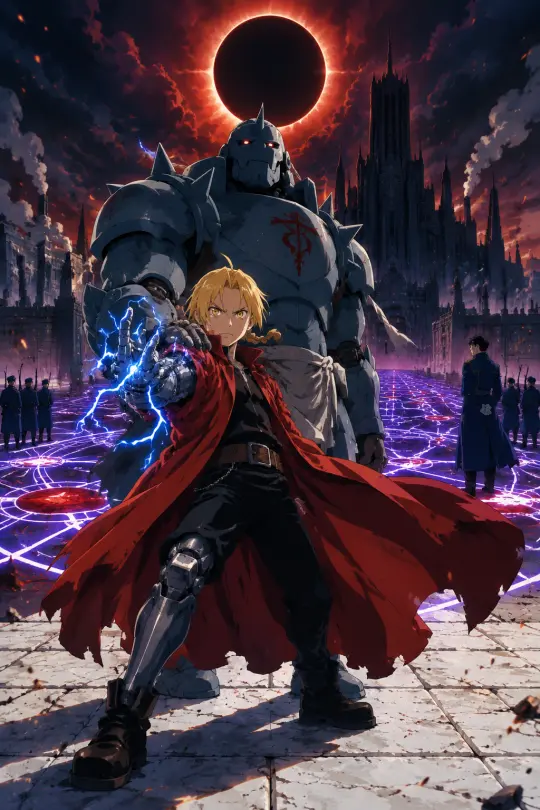
Build an AI alchemy adventure world: a law of exchange, a military patron, eight characters, six pressure points and four published key visuals. Free to play in your browser.
AI Alchemy Adventure World Generator — Build a Country With a Bill
A boy claps his hands and the stone under his palms becomes a blade. A soldier two streets away writes down the shape of the array. A colonel signs a form that authorises the boy to do it again tomorrow. That is the difference between an alchemy adventure and a magic adventure: every miracle has a witness, a licence and a cost, and the country is keeping the receipts.
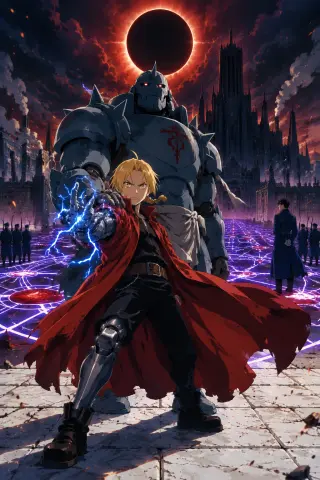
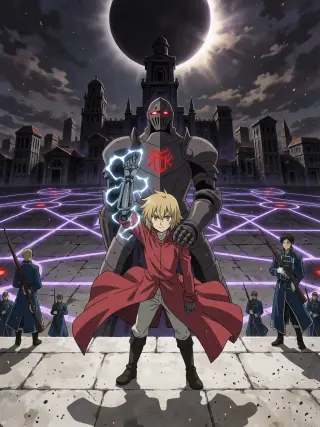
This page is a build guide for an AI alchemy adventure world: how to turn a law of exchange into a playable engine, how to cast a party that is also a government, and how to stage six pressure points so a player can enter at any of them. Every example is drawn from the published Fullmetal Alchemist world on Neta Studio and its four real key visuals — two prompts, each run unchanged on GPT Image 2 and Krea 2.
What makes an alchemy adventure different
Magic systems usually exist to make the protagonist special. An exchange-based system exists to make the protagonist solvent or insolvent. That single change reorganises everything: fights become negotiations with material, healing becomes triage, travel becomes logistics, and the villain becomes a creditor. The player is not asking “do I have enough mana?” They are asking “what am I willing to lose, and who is going to make me pay it?” The second difference is institutional: alchemy in Amestris is licensed science, so the adventure has a patron, a paymaster and a surveillance apparatus. A player cannot simply go into the desert and experiment. Someone files a report — and that friction turns every scene into a small political act.
The world is the antagonist
Most adventure worlds are a map with a villain on top. This one is a map that is itself the villain. The roads are part of a circle; the prisons are part of a circle; the border wars were fought to widen the circle. The player can walk anywhere and still be inside the crime. That is a much stronger engine than a dark lord in a tower, because it cannot be defeated by a single final battle.
- A map that means somethingEvery location should sit on top of something buried: a lab under a capital, a massacre under a desert, a nation under a ruin. When the player moves, they should be moving across evidence.
- A patron with a ledgerGive the party an institution that funds them and records them. The military works because it is genuinely useful and genuinely corrupt, so the player keeps accepting its help.
- A law the player can feelThe exchange rule must appear in the interface, not just the lore: every big move subtracts something the player can see. A cost that only exists in dialogue is not a mechanic.
Start with the bill, not the magic system
The common mistake is to write a taxonomy of spells first. Write the invoice first. What does the world charge for changing matter? Who collects? What happens to a person who cannot pay? Once those three answers are fixed, the “magic system” writes itself, because every ability is now a line item with a creditor attached.
Name the law
State the exchange in one sentence a player can repeat. “To create, something of equal value must be lost” is enough. Do not add exceptions before you have used the rule once.
Name the cost
Make the cost physical, social or temporal — never abstract. A limb, a rank, a memory, a year of a person’s life. The player must be able to point at what disappeared.
Name the creditor
Someone or something enforces the debt. In this world it is the Gate, the military and the homunculi at once, which is why the pressure never lets up.
Name the exception
Allow exactly one way to cheat, and make it monstrous. The philosopher’s stone is a battery made of people. The exception is the story.
A cast of eight is a party and a government
Eight characters is enough to field a party of four and staff a conspiracy. The trick is to give each one a different relationship to the same crime: the boy who committed it, the brother who paid for it, the mechanic who repairs its consequences, the colonel who ordered it, the sniper who covered it, the survivor who avenges it, the monster who enjoyed it, and the head of state who designed it. Put any three in a room and you have a scene with no neutral corner.
- The debtor Edward: brilliant, vain, and personally liable. He drives the plot because he is the only character who believes the bill can be paid off.
- The collateral Alphonse: the body that was taken. He is the party’s conscience and its hardest witness, because he cannot be distracted by food, sleep or a pretty face.
- The repair crew Winry: the person who maintains the machinery the plot depends on. She gives the party a home base and a reason to come back alive.
- The institution Mustang and Hawkeye: the patron and the safeguard. One wants power to do good; the other has already decided what to do if he stops being good.
- The opposition Scar, Envy and Bradley: three different refusals of the same country. One avenges, one enjoys, one governs. None of them is wrong about the facts.
Six pressure points instead of a plot
Do not write a chapter list. Write six situations that can be entered from any direction. Each one should be legible in a single sentence, carry a different kind of cost, and leave the world changed in a way the other five can reference.
Locations must hide something
A good location in this world has a surface function and a buried function. The capital is a capital and a laboratory. The fortress is a fortress and a secret. The desert is a desert and a mass grave. When you write a location card, write both sentences; the second one is what the player will remember.
The Resembool problem: where do you put the soft scene?
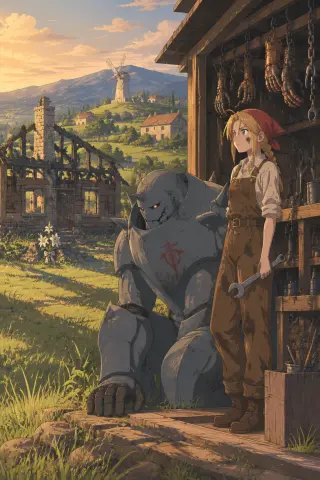
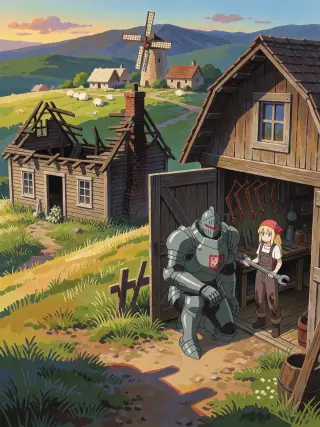
Every dark adventure needs one green place, and it must be compromised. Resembool is the party’s home, the only location with grass, sheep and a windmill — and it contains the burnt house where the story began. Put the soft scene here and it will hurt more than any battlefield, because the player can see what the characters would have had if the law had been kind. It is also the best place to teach the world without a tutorial: let the player help repair an automail arm while the mechanic explains tolerance, weight and the cost of the steel. By the time the arm clicks into place, exchange is a craft rather than a rule.
What the two models add to production
Art is not decoration in a world-building pipeline; it is continuity. If the capital changes shape between scenes, the player stops believing the conspiracy. Running the same prompt through two models is a fast way to decide what kind of continuity you need. GPT Image 2 gives you spatial detail you can reuse as a background plate. Krea 2 gives you a graphic, high-contrast look that survives small UI windows and rapid iteration.
- GPT Image 2 for the background plateUse it when the scene needs geography: where the plaza is, where the crowd stands, which tower blocks the eclipse. The extra detail pays off when characters are composited in later.
- Krea 2 for the mood boardUse it to test palette, silhouette and poster read before committing. Its compression shows you what the scene looks like at thumbnail size, which is how most players first meet it.
Art direction for a diesel-and-steam alchemical world
The look is early twentieth-century industrial, not medieval fantasy: wool coats, leather belts, brass fittings, rifles, steam, brick and white stone. Alchemy adds one unnatural colour — a cold blue for active transmutation and a violet-red for the national circle. Keep the palette disciplined. If everything glows, nothing does. Generate each region empty first, add one silhouette for scale, choose one light idea, and paint the unnatural colour last, exactly where the player’s eye should go.
Pacing a six-hour arc
Six pressure points at roughly forty minutes each is a clean first arc. Open in Resembool to establish the debt, move to Central to establish the institution, drop into the Fifth Laboratory to show what the institution does with people, go to Ishval to show what it has already done, return to Central for the Hughes beat, and end under the eclipse. The player should feel the country tightening around them, not the plot accelerating.
The ending problem
Do not write a cure. Edward does not need to be forgiven, and Amestris does not need to be saved by a nicer king. The ending that fits this world is smaller and stranger: a body recovered at a price, a stone refused, a report filed that will be ignored, a house rebuilt badly on the same hill. The player should close the story unsure whether the country will change, but sure that the people they travelled with are less alone than they were. Anything tidier is a betrayal of the law.
Publishing and sharing the result
A world is only real when someone else can open it. Publish the world, publish the key visuals, and share the scene links. Keep the four works together as a set so a reader can see the same eclipse and the same village through both models. The comparison is part of the argument: interpretation is not fixed, which is exactly what the characters are fighting about.
Questions about building this use case
- Can I build this without the original cast? Yes. Keep the law, the institution and the six pressure points; rename the people. The engine is the exchange rate, not the character names.
- How many characters do I need for a first arc? Four is enough: the debtor, the collateral, the repair crew and the institution. Add the opposition when the party needs a mirror.
- Should the player be able to use the stone? Allow it once, and make the cost visible immediately. A game that forbids the stone is a lecture; a game that lets the player use it and then shows them the invoice is a story.
- Do I need custom art for every location? No. Four strong plates — a capital, a laboratory, a fortress and a village — will carry a six-hour arc. Reuse them with different light and weather.
Start your alchemy adventure
One law, one country, one bill that never stops arriving. Open the world and write the first scene — or read the cards before you touch the prose.