The Best AI Cel-Shaded Platformer World Key Visual Generator — Bright Kingdom Covers from One Prompt
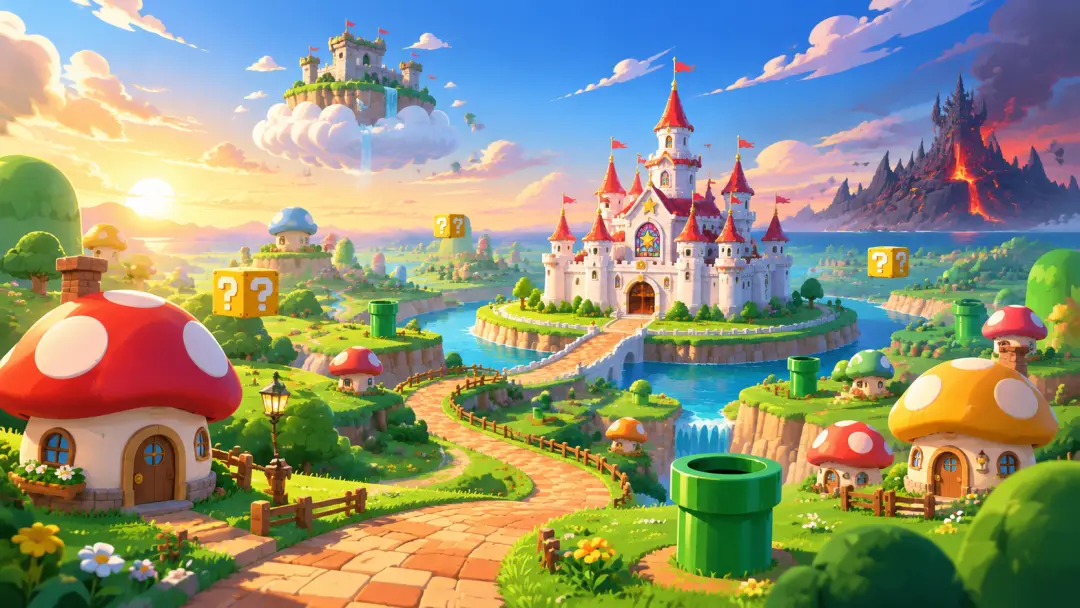
The best AI cel-shaded platformer world key visual generator: create bright kingdom covers with GPT Image 2 and Krea 2, proven on a real Mushroom Kingdom world with published key visuals.
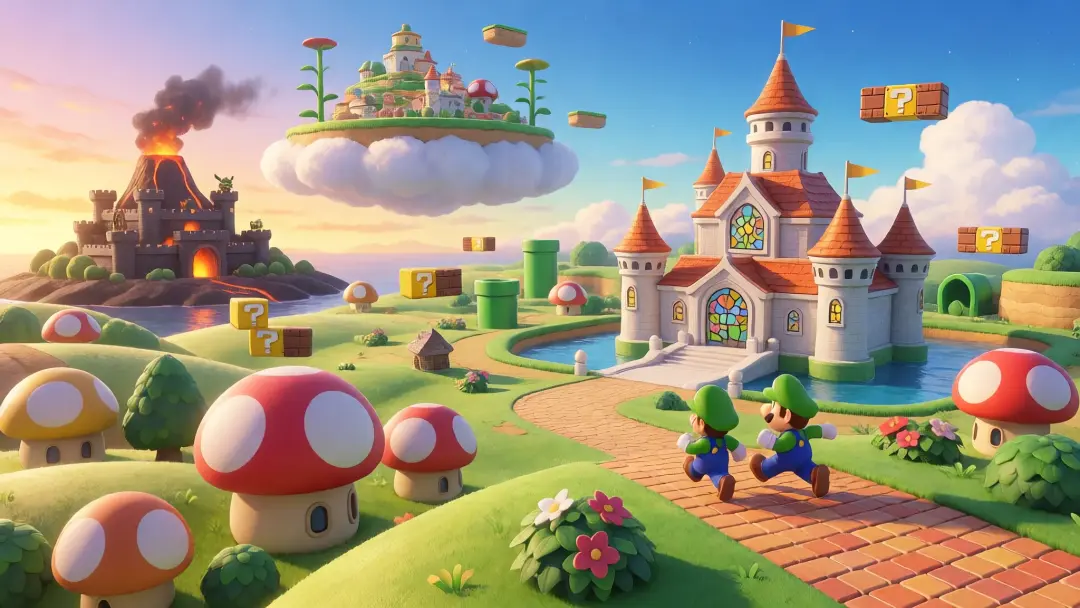
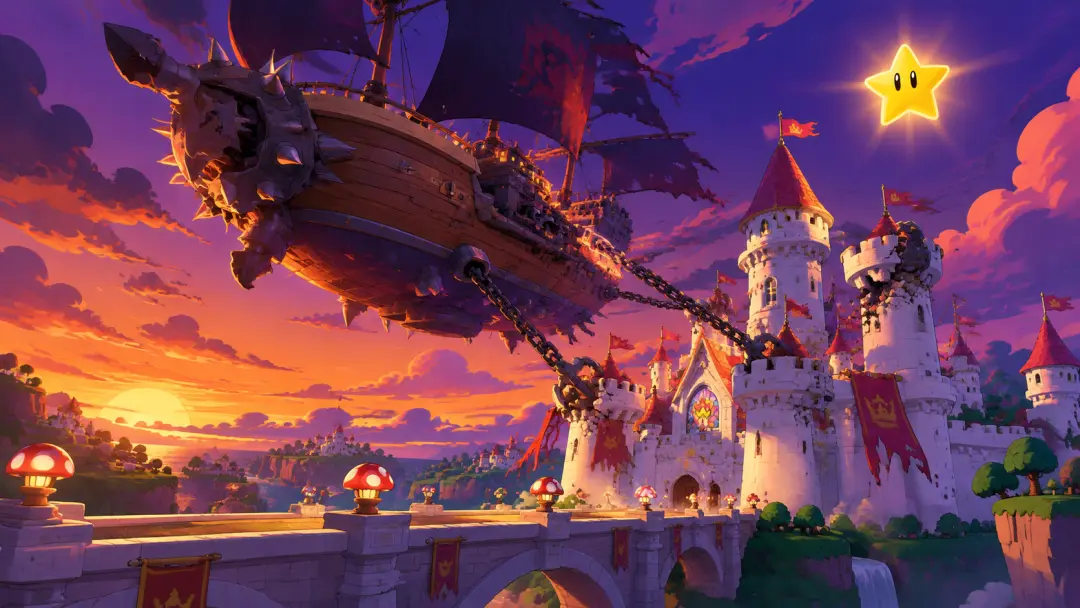
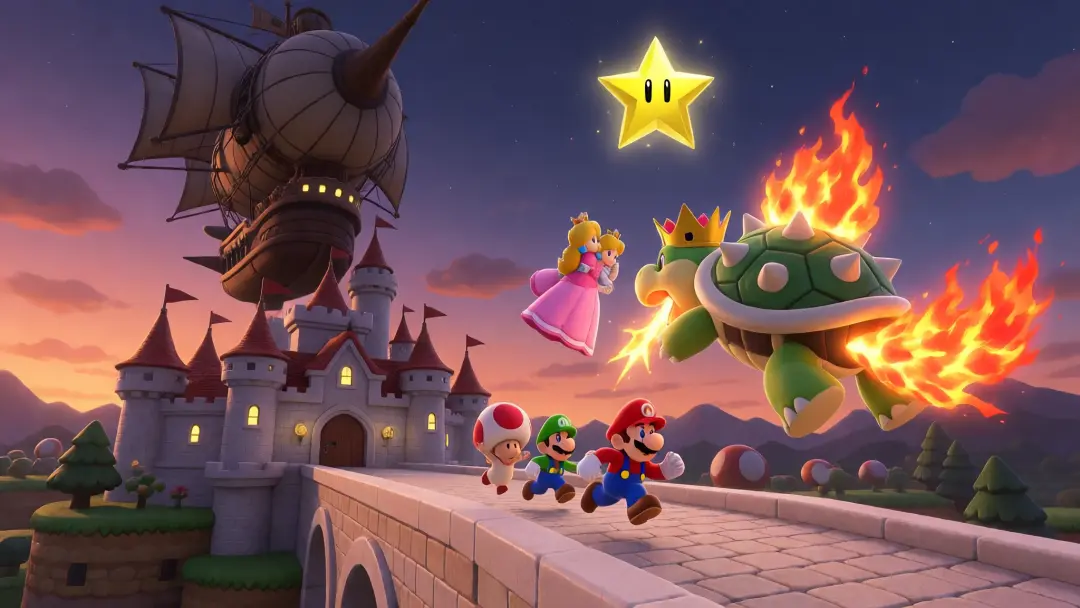
Create Cel-Shaded Platformer Key Visuals in Minutes
Turn one sentence about a bright kingdom of pipes and mushroom houses, a castle that keeps getting taken, or an airship over the towers into a banner-ready cel-shaded platformer key visual — no concept team, no asset hunt.
What Is a Cel-Shaded Platformer World Key Visual Generator?
A cel-shaded platformer world key visual generator is a text-to-image workflow that turns a short world description into a cover-ready game image in a specific visual language: fully modeled anime-style 3D forms, hard-edged toon shading, graphic highlights, clean local colors and low-texture game surfaces. On Neta Studio the generator is not a standalone prompt box. It is attached to a world — a canon of characters, locations, events, factions and rules — so every image it produces inherits the same castle, the same pipes and the same palette. The result is a key visual that could sit on a storefront, a press kit or a pitch deck and still look like it belongs to the game.
Why Cel-Shaded Platformer Key Visuals Matter
A platformer lives or dies on instant readability. The player has to understand the fantasy in half a second: this is a bright world, these are the rules, that is the thing you are trying to reach. Cel-shaded 3D art is built for that. Hard shadow steps separate foreground from background, saturated local colors make every object legible at thumbnail size, and a clean silhouette lets a castle, a pipe or a character read from across a storefront.
That is also why the style is hard to fake. A generic '3D render' prompt produces soft, muddy lighting and plastic surfaces. A cel-shaded prompt has to specify the shading model, the contour behavior, the palette discipline and the material language. The four works on this page were generated from one world with those constraints written into the prompt — and they hold together as a set.
A key visual is rarely the end — it is the cover. The same world can generate character covers, location plates, event posters and storefront capsules, and they will share a visual grammar instead of looking like four different games. That consistency is the actual product: not one image, but a system that keeps producing images from the same canon.
How It Works on Neta Studio
Fork the world, open the studio board, and generate from the world's own atoms. The world supplies the characters, the map, the events and the rules. The generator supplies the camera, the light and the model. You can run the same prompt through two models and publish both results as works of the world, which turns a model comparison into a permanent, shareable part of the setting.
The workflow is deliberately short: fork → choose a moment → write the prompt → render both models → publish. There is no asset pipeline to assemble and no separate lore document to keep in sync, because the lore and the image live in the same place.
- World: 25 atoms, all editable.
- Subjects: one world key visual and one event key visual.
- Models: GPT Image 2 for detail and Krea 2 for expression.
- Output: four public works, each with its own share URL.
The World Seed: The Mushroom Kingdom
The test world is The Mushroom Kingdom — a bright, living realm of grassy plains, underground caverns, sky islands and volcanic fortresses, all linked by green warp pipes. Princess Peach rules from her castle with a court of Toads; King Bowser and the Koopa Troop have spent generations trying to seize the castle and the Power Stars that keep its magic alive. The world ships with seven characters, five locations, five events, four factions and four hard rules, which is enough canon to generate from without writing a bible first.
The Visual Grammar of a Platformer Cover
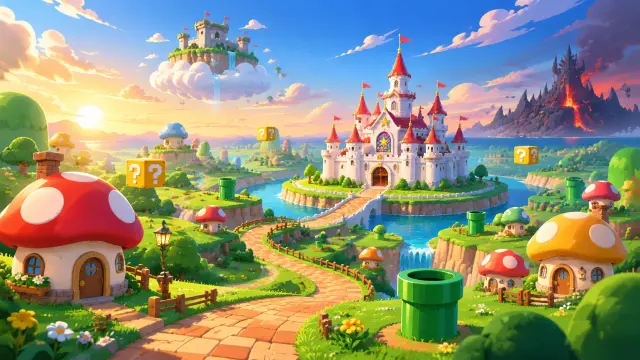
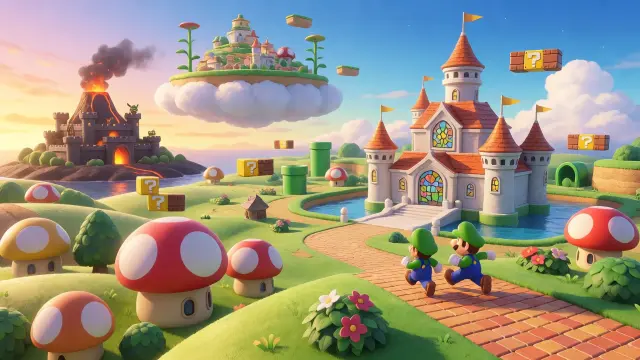
Four things make a platformer key visual read as a platformer rather than a fantasy painting. First, a clear horizontal ground plane: the player needs to know where the floor is. Second, vertical punctuation: pipes, blocks, towers and beanstalks that break the horizon and suggest traversal. Third, a destination: a castle, a star, a flag, something the eye wants to reach. Fourth, a scale figure or a scale object — a character, a mushroom house, a question block — that tells you how big the world is. GPT Image 2's world visual is a textbook example: ground plane, vertical pipes and blocks, castle as destination, houses as scale. Krea 2's version adds the fifth thing, the one that cannot be prompted reliably: a sense of motion.
Choose the seed
Fork The Mushroom Kingdom or write a one-sentence platformer brief about a bright kingdom linked by pipes and a castle that keeps getting taken.
Pick the scene
A world visual needs a route; an event visual needs a turn. The plains, the castle, the cloud blockade, the caverns and the airship at dusk all do different jobs.
Write the style contract
Name the shading model, the contour behavior and the palette in the prompt. 'Cel-shaded 3D game render, hard-edge shading transitions, discrete toon value steps' is the minimum.
Run both models
Use the same prompt on GPT Image 2 and Krea 2. GPT will build the map; Krea will build the moment.
Publish and iterate
Publish both as works of the world, compare them against the canon, then fork or re-prompt. The world remembers what you chose.
Real Outputs from a Real World
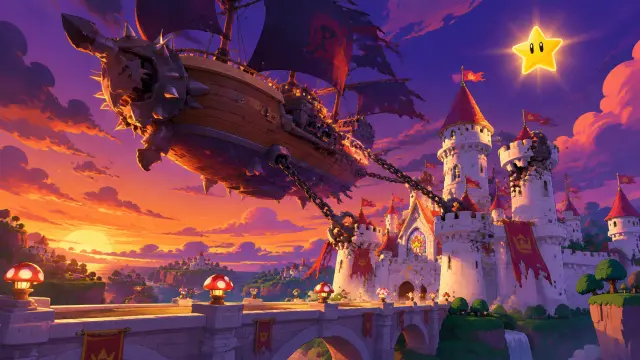
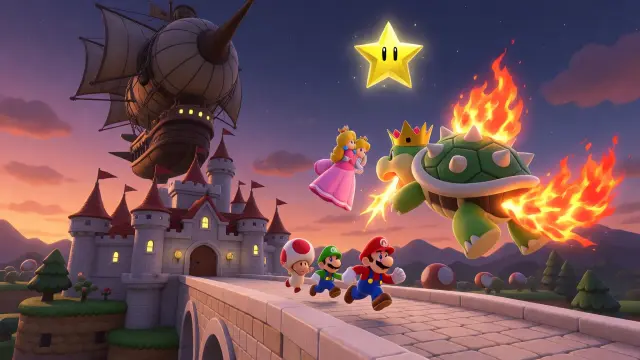
Four key visuals were generated from the Mushroom Kingdom — two subjects, two models, one canon. The world visual establishes the map and the palette. The event visual establishes the stakes and the cast. Because both prompts were written against the same world, the four images share a horizon logic, a color temperature and a vocabulary of props: green pipes, question blocks, white towers, black volcanic stone. That is what a world-grounded generator buys you over a generic image model.
A Closer Look: The Kidnapping Pair
The event pair is the harder brief and the better test. GPT Image 2 was asked for the same scene with no characters at all, and it still tells the story: the airship's chains are locked onto the towers, the banners are torn, the bridge lanterns are still lit, and the Power Star burns in a violet sky. Krea 2 was asked for the character beat and delivered the whole cast in one frame — the princess carried over a spiked shoulder, the Koopa King wreathed in fire, the two brothers running the bridge with a Toad behind them. One is a crime scene, the other is a chase. Most games need both.
GPT Image 2 vs Krea 2 — Which Should You Use?
GPT Image 2 for cover-ready detail: separated value planes, straight architecture, readable horizon, and a level of environmental information that survives a storefront crop. It is slower and more expensive, and character-heavy prompts can trip third-party similarity filters, so stage the world as a pure environment when you need the map. Krea 2 for speed and expression: it puts characters in frame, pushes poster composition and produces a warmer, more illustrated image, at the cost of some architectural precision. The practical answer is to run both. Use GPT for the establishing shot and Krea for the moment, then let the world hold them together.
Prompts That Work
A platformer prompt needs four clauses: what the world is, what the camera sees, how it is shaded, and what must not appear. The style clause is not decoration — it is the difference between a cel-shaded game and a plastic toy render.
- World clause: “A bright storybook kingdom at golden hour: mushroom-roofed houses, a brick path, a white castle across a moat.”
- Camera clause: “Wide panoramic establishing shot, foreground houses, mid-ground castle, distant volcano, cloud island overhead.”
- Style clause: “Fully modeled anime game environment, discrete toon value steps, hard-edge cel shading transitions, clean vibrant local colors, ambient occlusion, low-texture game surfaces.”
- Negative clause: “No text, no letters, no logo, no watermark, no UI, no people.”
For an event cover, swap the camera clause for a beat: “A spiked airship locked onto a white castle by chains at dusk, torn banners, a golden star in a violet sky, an empty stone bridge below.”
Beyond the Poster
The key visuals published from this world are works — but they are also inputs. The same canon can generate character covers for Mario, Luigi, Peach, Toad, Yoshi, Bowser and Kamek; location plates for the plains, the caverns, Sky Land and the volcano; a vertical slice of a playable scene; or a short video of a pipe descent. Because the world owns the atoms, each new asset inherits the palette and the props instead of starting from zero.
Who Is It For?
Indie game and story creators who need retro cover art fast. Solo developers who have a world in their head but no concept artist on call. Writers and tabletop game masters who want a visual bible for a campaign. Studios that need a mood board before the art pipeline exists. And fans who want to see a familiar kingdom rendered as a coherent, original setting rather than a collage of screenshots.
Limitations to Know
GPT Image 2 is slower than lightweight models and favors detail over motion; it will not give you a dynamic action pose without a fight. Krea 2 is fast and expressive but less architecturally precise, and its text rendering is a known weakness, so never put a title in the prompt — add typography afterward. Character-heavy prompts can trip third-party similarity filters on GPT Image 2; staging the world as an environment is a reliable workaround. And no generator knows your canon: if you want the castle to have a specific tower count, say so in the prompt or edit the atom first.
Frequently Asked Questions
- Do I need a 3D model to use this? No. The cel-shaded look is produced entirely in the prompt and the model; there is no scene file, rig or render farm.
- Which model should I start with? GPT Image 2 for an establishing shot, Krea 2 for a character beat. Then run the same prompt on the other and compare.
- Can I use these images commercially? Check the terms of the model and the platform you generate on; the world and its atoms are yours to fork and remix on Neta Studio.
- Why four works? Two subjects times two models. It is the smallest set that proves both the world's range and the models' differences.
- Can I add my own characters? Yes — edit the atom cards or fork the world and add a character, then generate from the updated canon.
Start Creating
Fork The Mushroom Kingdom or start from your own one-sentence platformer brief. The world ships with 25 atoms and four published key visuals, so the fastest path to a cover is to reuse the canon and change the moment. When it looks right, publish it as a work of the world — and let the next person fork it.
Start Creating
Two models, one world, a cel-shaded cover in minutes — rendered, published, and remixable.