
AI Neo-Noir Detective RPG — Build a Case You Can Play
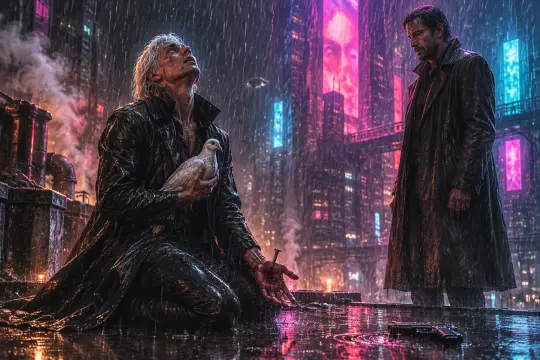
Build a rain-soaked detective RPG where every clue is a card, every interrogation is a scene, and the case changes depending on what you ask. A practical blueprint with a real playable world and four published key visuals.
AI Neo-Noir Detective RPG — Build a Case You Can Play
A neo-noir detective RPG is not a city with a murder in it. It is a case that keeps changing shape as you touch it: a clue that implicates the person who hired you, a witness who is not legally a person, a confession that arrives before the crime. The genre runs on information asymmetry, and that makes it unusually well suited to an AI world.
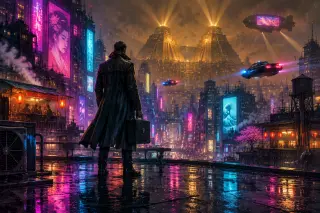
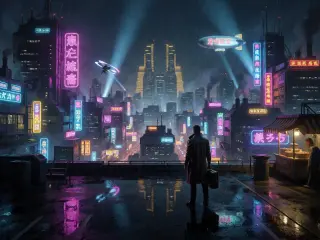
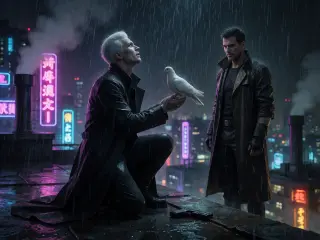
This page is a practical blueprint for building one in Neta Studio. It uses a real, playable world — Blade Runner: The Empathy Test — as the worked example, with four published key visuals generated from two identical prompts on GPT Image 2 and Krea 2. Everything here is a system you can copy, not a mood board.
A detective story is a machine for converting questions into consequences. The case is the interface.
What Makes a Neo-Noir Detective RPG Different
Fantasy RPGs ask whether you can win the fight. Noir asks whether you can afford the answer. The player is not collecting power; they are accumulating knowledge that makes their life worse. That inversion changes every system in the game, from the dialogue wheel to the map.
- The case is the mapLocations unlock through testimony and evidence, not through levels. A nightclub is not a district; it is a lead that happens to have a dance floor.
- Every witness has a versionNo NPC gives neutral exposition. Each one describes the same event with a different culprit, and the player has to decide which version to act on.
- The clock is a characterA countdown — a lifespan, a warrant, a deadline — turns investigation into cost. Every scene you spend on one lead is a scene you did not spend on another.
- The ending is a verdictThe final choice is not a boss fight. It is a decision about which evidence counts and who is allowed to give it. That is the genre’s native climax.
Start From a Case, Not a City
The most common failure in AI noir is building the city first. A city is infinite, and an infinite setting produces a player who wanders. A case is finite, and a finite case produces a player who investigates. Build the case, then build only the six locations the case actually needs.
Write the lie
Decide what the client believes happened and what actually happened. The gap between those two sentences is your entire game. Keep both under fifty words.
Write three witnesses
One who profits from the lie, one who is hurt by it, one who is not legally allowed to testify. Each gets a card with a costume, a tell and one claim they will not repeat under pressure.
Pick six locations
A police office, a corporate atrium, a market, a club, a domestic interior and a place the client cannot go. That is enough geography for a three-session case.
Set the clock
A countdown that the player can feel but not stop. In Blade Runner it is the four-year lifespan; in your case it can be a warrant, a disease or a ship leaving orbit.
Write the verdict
Three endings, each defined by which evidence the player presents and who is allowed to speak. Do not write a good ending and two bad ones; write three defensible ones.
The Blade Runner Worked Example
Blade Runner: The Empathy Test is a complete case structure disguised as a setting. The client is the LAPD. The lie is that replicants are products and therefore cannot be murdered. The actual event is that four manufactured people came home to ask their maker for more life. The player is a blade runner with a machine that can measure empathy and no way to measure his own.
What makes it useful as a template is that every card is already a game object. Characters carry tells and props. Locations carry access rules and lighting. Events carry pressure points. Rules carry the clock. You can swap the IP and keep the structure: a border official, a test, a countdown, a maker and a witness who cannot testify.
How the Empathy Test Becomes a Game Mechanic
A test is the ideal noir mechanic because it produces information and cost at the same time. The player asks a question, the machine reads the body, and the scene gives back a number that may be wrong. The uncertainty is not a bug; it is the genre.
| Question | “You’re in a desert. You see a tortoise on its back.” |
| Signal | Capillary dilation, blush response, pupil flutter |
| Player gain | A read on the subject: human, replicant, or unreadable |
| Player cost | The subject knows they are being measured; pressure +1 |
| Failure mode | The read is correct but the player does not believe it |
The key design move is that the machine never lies and is never sufficient. It gives a result, not a verdict. The player still has to decide what to do with a person who has been classified as a product. That gap between measurement and judgment is where the roleplay lives.
Directing Interrogations Beat by Beat
An interrogation is not a dialogue tree. It is a scene with a physical layout, a power balance and a clock. Write it the way you would stage it, then let the AI fill the lines.
Set the room
Who is between the subject and the door? Where is the machine? What can the subject reach? The answers decide what can escalate without anyone speaking.
Open with a question that is not the real question
Ask about the tortoise, the wasp, the photograph. The real question is always “what are you?” and it must not be asked until the subject is tired.
Let the subject take something
A cigarette, a glass of water, a name. Give them one small piece of control so the scene has something to lose.
End on a cost
The player gets an answer and pays for it: a bruised hand, a lost lead, a machine that now has their own baseline on file. Never end on pure information.
Building the City as a Clue Map
In a neo-noir RPG, geography is epistemology. A place exists because someone told you about it, and it changes meaning once you learn who paid for the lights. Build six locations and give each one an access rule and a secret.
Model Choice for Noir Key Visuals
Noir is a lighting genre before it is a story genre. That makes key visuals unusually important: a single frame has to establish the palette, the power balance and the weather. Two models handle the job differently, and the difference is worth designing around.
- GPT Image 2 for the case fileUse it for establishing shots, costume sheets and any frame where the viewer must understand the geography of a scene. It keeps rain, reflections, props and depth in one image.
- Krea 2 for the posterUse it for covers, thumbnails and social crops. It compresses the scene into two or three values and a strong silhouette, which is exactly what a case cover needs.
- Generate both from one promptWrite the brief once. Run it on both models before iterating. The comparison tells you whether the problem is the prompt or the model.
- Never use either for textKrea 2 is explicitly weak at legible text; GPT Image 2 can render it but it will look designed rather than painted. Put titles in the layout, not in the image.
Pacing a Three-Session Case
Three sessions is the right length for a first neo-noir arc: enough time for a lie to unravel, short enough that the clock still hurts. The structure below assumes two to three hours per session.
Session 1 — the lie
The client states the case. The player meets two witnesses and gets one piece of physical evidence that contradicts the official story. End on a name they should not know.
Session 2 — the cost
The player follows the name into a location they are not allowed to enter. They lose something: a weapon, a contact, a clean conscience. The pressure meter crosses its first threshold.
Session 3 — the verdict
The witnesses are in one room. The player presents evidence, chooses who may speak, and discovers that the truth does not settle the case. End on the choice, not on an explanation.
Questions About Building a Neo-Noir RPG
Do I need a combat system?
No. Noir conflict is social, procedural and physical in short bursts. A single “violence” resolution — who gets hurt, who sees it, what it costs — is enough. Combat systems turn investigations into tactics, which is the wrong genre.
How many characters do I need?
Eight is a good ceiling for a first case: four people with power, two who are hurt by it, one who cannot testify and one who is lying about which side they are on. The Blade Runner world uses exactly that distribution.
Build a case, not a city
The world is built and the visual language is proven on two models. Start your own case — or open the studio and copy the card structure first.
Blade Runner is an independent, fan-built world in Neta Studio and is not affiliated with Alcon Entertainment, Warner Bros. or the rights holders of the film. Every character, place, event, faction and rule here is an editable world material rather than canonical text. The four key visuals on this page were generated inside this world with GPT Image 2 and Krea 2 from two identical prompts. Open the studio to read every card.