
AI Sci-Fi World Generator
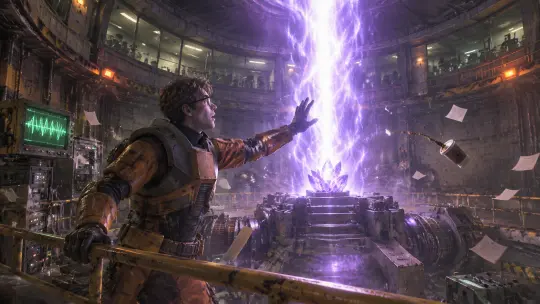
Generate a grounded sci-fi world: the six-part anatomy, the scene formula, a six-clause prompt recipe and four published key visuals from a GPT Image 2 vs Krea 2 comparison.
Start with an AI sci-fi world generator that gives you a place, a rule and a cost — not just a spaceship on a hill.
What This Page Covers
This is a working page for anyone who wants to generate a grounded sci-fi world and get images that belong to the same place. It uses Half-Life as the test case: a setting with no starships, no laser swords and almost no future technology that could not be built in a basement. Everything below is drawn from the four published works on this page, which were rendered from identical prompts by two models.
- The six-part anatomy that makes a sci-fi world feel governed rather than decorated.
- The scene formula: one place, one rule, one cost, one witness.
- A six-clause prompt recipe you can reuse for any grounded setting.
- Two worked examples and an honest model comparison.
Sci-Fi Worlds Are Built From Consequence
Most AI sci-fi worlds fail for the same reason: they generate the aftermath and skip the cause. You get ruins, neon and vapour without any answer to the only question that matters — what did somebody do, and who is paying for it? Half-Life avoids that trap because its entire visual language descends from one bad decision in one room.
A generator is only useful if it can hold that chain. If your world seed cannot produce a cause, a cost and an authority, you are generating wallpaper. If it can, every prompt has somewhere to point.
The Six-Part Anatomy
Six cards are enough to make a world that can be rendered from several angles. This is the same anatomy the Half-Life world uses, and it is deliberately short: a longer list gives you lore, a shorter one gives you a mood.
Why an Occupation Beats an Invasion
An invasion is a single afternoon; an occupation is a decade of Tuesdays. For image generation the second is far more productive, because it produces repeatable furniture: a scanner on a pole, a queue at a gate, a banner on a facade, a family walking past a soldier. Those props can be rearranged into hundreds of frames without ever repeating a composition.
The Scene Formula
A grounded sci-fi frame needs four things in one image: a place that belongs to an institution, a rule made visible, a cost being paid, and a witness who is not the protagonist. Drop any one of them and the frame becomes a still from a film nobody has seen.
- Place: concrete, cable trays, wet asphalt, yellow hazard stripes. Materials carry the genre.
- Rule: one thing in the frame that could not happen in our world — a violet rift, a spire, a drone.
- Cost: a burned hand, a ration card, a prosthetic leg, a queue that has been standing too long.
- Witness: somebody watching from a doorway, a glass booth or a rooftop. The witness makes it a story.
Worked Example: The Test Chamber
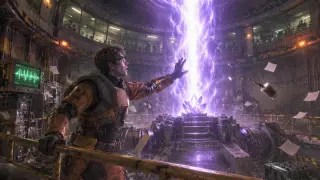
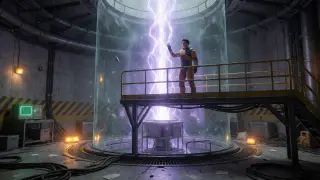
The first brief asks for the exact second the sample is inserted. Everything in the prompt is a consequence of that second: the energy column rises from the cart, the paper lifts because the air pressure changed, the coffee cup tips mid-air, the observation glass is full of people who are about to become survivors. The instruction that matters most is the last one — the physicist should look stunned, not heroic.
GPT Image 2 read the brief as a stack of planes and put the physicist's forearm and glasses in the nearest one, the rift in the second, the catwalk rail in the third and the observation crowd in the fourth. Krea 2 read the same brief as a diagram and made the chamber a glass cylinder with one figure and one filament. Both are usable; they answer different questions.
Worked Example: The Checkpoint City
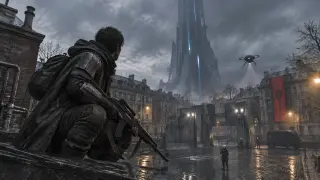
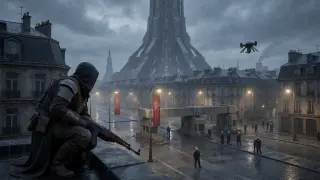
The second brief moves from a room to a system. A resistance fighter on a rooftop, a plaza below, a checkpoint with a queue, a drone in the rain and a spire that owns the skyline. The composition has to explain the occupation without a caption: the checkpoint is the state, the rooftop is the network, and the spire is the reason both exist.
The Prompt Recipe
Name the place first
Concrete chamber, wet European rooftop, sealed mining street. Location before plot; the model needs a room before it can put anyone in it.
Name the rule
One impossible element only: a violet rift, a black spire, a scanner drone. Two impossible elements and the frame stops being grounded.
Name the witness and the cost
Who is watching, and what have they already paid? A scarred hand or a uniform with a name tag does more than an adjective.
Set the light
One dominant source with a colour, plus one accent. Emergency amber against rift violet is enough for this whole world.
Set the camera
Cinematic 16:9, eye level or slightly below, 35–50 mm equivalent. Avoid fisheye and avoid drone-top-down; both break the human scale.
Ban the interface
No HUD, no text, no logos, no watermark. Grounded sci-fi dies the moment a frame looks like a game menu.
Model Choice for This Genre
For grounded sci-fi the model has to do two things well: props and people at different distances. Props carry the institution — a barrier, a scanner, a ration card — and people carry the cost. GPT Image 2 is currently the stronger of the two on both counts, and it is also better at keeping a crowd from turning into mush. Krea 2 is faster and cleaner, and its weakness with legible text does not matter here because the brief bans text anyway.
- Choose GPT Image 2 when the frame has to explain a system: checkpoints, queues, labs, crowds.
- Choose Krea 2 when the frame has to work as a cover: one silhouette, one light, one idea.
- Do not mix the two inside one sequence unless the difference is the point. Palettes drift fast.
Consistency Without References
None of the four works on this page used a reference image. Consistency came from the written world: the same materials, the same two lights, the same rule that the impossible element is singular. That is cheaper and more portable than a reference sheet, and it survives a model switch. When you do use references, use them for costume or palette continuity, not for composition: a reference image will copy the camera as well as the coat, and then every frame in your sequence looks like the same photograph.
From World to Story
The same six cards that produce key visuals produce a campaign. The locations become a shot list, the factions become a cast of institutions, the timeline becomes a queue of scenes, and the characters become the people who have to choose between them.
World → Key Visual
Stage one consequence with one location and one witness. The studio keeps palette and light logic consistent across renders.
World → Sequence
Run the same event from four angles: the decision, the accident, the evacuation, the silence. Same rules, four frames.
World → Series
Give each faction its own plate, then let the resistance plate contradict it. A world is a set of arguments that share a skyline.
The three failure modes of AI sci-fi are over-spectacle, under-law and two-light soup. All three are prompt problems dressed as model problems, and all three are fixable in one sentence.
- Over-spectacle: three suns, six moons and a floating city. Strip it to one impossibility.
- Under-law: a world with no authority in the frame. Add a checkpoint, a uniform or a queue.
- Two-light soup: teal and orange fighting for the same plane. Pick one key and one accent.
- Game HUD cosplay: crosshairs, ammo counters and lens flares. Ban interface elements explicitly.
Frequently Asked Questions
- Do I need a reference image? No. The four works here used none; the world text carried continuity.
- Which model should I start with? GPT Image 2 for systems and crowds; Krea 2 for covers. Run both on one prompt before you commit.
- How many locations do I need? Six is enough to argue with itself. Twelve is a wiki, not a world.
- Can I use an existing IP? Build your own version of the tone. The anatomy transfers; the names do not.
- How long does a world take? The cards are the slow part. Once they exist, a key visual is minutes.
Generate Your Own Sci-Fi World
The world is public and forkable. Take the six cards, keep the cost, and render your own occupation.
The Half-Life world on this page keeps its prompts and its share pages. Fork it, swap the founding mistake, and the rest of the anatomy — border, authority, resistance, cast — will still do its job.