
AI Tactical Dark Fantasy World Generator

Generate a tactical dark fantasy world: the five-part anatomy, the scene formula, a six-clause prompt recipe, and four published key visuals from The Ashen Crown.
Build a Tactical Dark Fantasy World That Argues With Itself
Start with a tactical dark fantasy world generator that gives you houses, laws and debts — then render the scene where somebody pays.
What This Page Covers
This is a working page for anyone who wants to generate a tactical dark fantasy world and its key visuals. It covers what makes the genre different from generic dark fantasy, the five-part anatomy of a world that can produce scenes, a repeatable prompt recipe, four published examples from The Ashen Crown, and an honest comparison of GPT Image 2 and Krea 2 on the same brief.
- Genre: tactical dark fantasy / military fantasy, not gothic horror.
- Core object: a rule that can be enforced, broken and photographed.
- Core scene: somebody pays a visible price for a public decision.
- Output: a world of cards plus a set of key visuals that share one palette and one light logic.
Tactical Fantasy Is About Jurisdiction
Most dark fantasy worlds are organised around a monster. Tactical fantasy is organised around a decision that has already been made and a institution that refuses to revisit it. The monster is still there, but it is in the basement of a building that has a budget. That shift changes what you have to generate: not a creature, but a room, a document, a rank and a queue. The practical consequence is that a tactical world needs rules before it needs characters. Once you can state who may carry relic steel and who is branded for touching it, you can generate a hundred scenes without inventing a plot. The plot is what happens when two rules meet.
The Five-Part Anatomy
Why Nine Houses Work
Nine is a useful number because it is large enough to feel like a political system and small enough to remember. It also gives you a built-in visual grammar: nine seats, nine flames, nine bells, nine borders. The audience does not need a wiki; it needs a table it can hold in its head. The risk is heraldry soup — nine names, nine colours, no argument. The fix is to give each house a material and a grievance rather than a crest. Vareth has white terraces and a vote it cannot pass; Corvain has wet rope and a neutrality it sells; Mireau has sulphur and the mint; Hask has a gate and a garrison that has been bargaining for three winters. Materials photograph better than sigils.

The Scene Formula
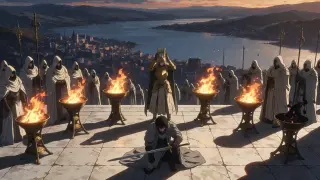
A tactical fantasy image needs four things in one frame: a place that belongs to an institution, a person acting on its behalf, an object that records the act, and a witness who will be affected by it. In the Ash Coronation frame the terrace belongs to Vareth, the heir performs the rite, the crown is missing a shard, and the kneeling captain is the witness with a mark that does not fit the roll. If any of the four is missing, the image collapses into a mood board. No institution and you have generic fantasy architecture. No object and you have a portrait. No witness and you have propaganda. No actor and you have a landscape.
- Place: architecture with a rank structure — terraces, gates, courts, stairs.
- Actor: someone with a licence, a uniform or a claim.
- Record: a ledger, a roll, a brand, a crown, a bell, a receipt.
- Witness: someone whose body will carry the consequence.
Worked Example: The Ash Coronation
The brief asked for the exact moment a lie becomes a ceremony. Nine braziers, one per house, with the ninth cold. An heir lifting a crown that is missing a shard. A mercenary captain in the foreground with a tenth mark open on his palm and a broken sword across his knees. A lake-city behind them and ash falling through the whole composition.
GPT Image 2 read the brief as a stack of planes and made the mark the nearest object in the frame. Krea 2 read it as a ceremony and centred the crown. Both are useful, but only the first one gives a viewer the plot in a single glance: the man in front is the thing the ceremony cannot classify.
Worked Example: The Ember Gate
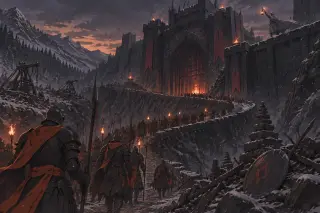
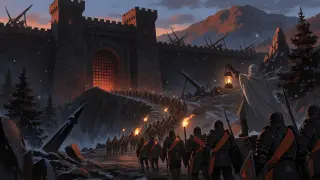
The second brief moves from ritual to infrastructure. A gatehouse over a sealed fire, a Legion column on the switchback, a scout with a lantern on the rampart. The image has to explain why the gate matters without a caption, so the fire is under the road, not inside the fortress. GPT Image 2 put the glow in the portcullis and let the column sell the scale; Krea 2 turned the gate into a flat black shape and made the lantern the poster's title.
The Prompt Recipe
Format
"Anime cel-painted tactical dark fantasy key visual, cinematic 16:9" or "location key visual". Commit to the composition type before anything else.
Institution
One place described as architecture: a terrace above a lake-city, a gatehouse over a pass, a court with nine seats. No second location.
Actor and record
Who acts and what records it. An heir lifts a crown; a captain opens a marked palm; a scout raises a shuttered lantern. The record is the plot.
Crowd by posture
Hooded priests, ranked bannermen, a column strung along a switchback. Posture keeps a crowd from becoming wallpaper.
Material and palette
Ash grey, bone white, ember orange, dawn gold, slate blue. Name the materials: wet basalt, rusted plate, bronze, salt-stained wool.
One light plus negatives
Nine braziers, a red portcullis, a single lantern. Then close: no text, no letters, no watermark, no logo, no user interface.
Model Choice for This Genre
For tactical fantasy, the model has to do two things well: props and crowds. Props carry the law; crowds carry the institution. GPT Image 2 is stronger at both, and it is the model we used for the two evidence frames above. Krea 2 is faster, cheaper and better at a flat poster silhouette, which makes it the right second opinion rather than the right final render.
- GPT Image 2 — literal clause following, dense props, separate silhouettes in a crowd, believable depth. Slower and more expensive.
- Krea 2 — clean graphic shapes, strong poster composition, very cheap iteration. Loses small props and specific marks at distance.
- Workflow — draft the idea in Krea 2, finish the frame in GPT Image 2, publish both when the comparison is the point.
Consistency Without References
The four works on this page were generated without a reference image. Consistency came from the written world, not from a style lock: the same palette, the same one-light rule and the same material vocabulary were repeated in both prompts. That is cheaper than training a style and more portable than a mood board, because the rules can be edited in words.
When you do use references, use them for costume or palette continuity, not for composition. A reference that fixes the composition also fixes the argument, and the next scene stops being about your world.
From World to Campaign
The same cards that produce key visuals produce a campaign. The nine houses become faction sheets; the events become a timeline of pressure; the locations become maps with one lighting condition each. A game master can run a session from the world page without writing a setting bible, because the setting is already in rules and objects.
Campaign Frame
Open on a ceremony that cannot legally proceed, then let the players decide which rule to break first.
Faction Play
Give each player a house, a grievance and a material. The map is the argument; the argument is the session.
Visual Kit
Use the four published works as handouts: the coronation, the gate, the capital, the empty seat. Same world, same light.
What to Avoid
The three failure modes of AI tactical fantasy are over-heraldry, under-law and two-light blur. Over-heraldry gives you nine costumes and no politics. Under-law gives you a world where the magic costs nothing, so no decision matters. Two-light blur gives you a beautiful dusk in which nobody can tell which side of the gate is on fire.
- Do not name a house without giving it a material and a grievance.
- Do not write a power without a price and a clock.
- Do not light a night scene with moonlight and torches at once; choose the institutional light.
- Do not let a crowd be a texture; give three people in it a job.
- Do not publish a key visual without its prompt; the prompt is the proof of the world.
Frequently Asked Questions
- Is this a game or a story world? Both. The cards are written so a writer can stage a scene and a game master can run a faction turn from the same page.
- Do I need nine houses? No. Five to nine is the useful range. The number matters less than each seat having a different answer to the same question.
- Can I use a real historical analogue? Yes, but change the jurisdiction, not the costumes. The interesting part is who is allowed to do what.
- Which model should I start with? Krea 2 to test whether the silhouette reads, GPT Image 2 for the published frame.
- How do I keep the world consistent? Keep the palette, the light rule and the material list in the world cards, not in a private note.
Generate Your Own Tactical World
Write the lie, set the price, give the price to a law, and render the room where somebody pays it.
The Ashen Crown is public and forkable. Take the nine houses, keep the debt, and rewrite the clause your own world needs to argue about.