
AI Underwater Dystopia World Generator
How to generate an AI underwater dystopia world: the six-part anatomy, the scene formula, the prompt recipe and a GPT Image 2 vs Krea 2 comparison, using Rapture as the worked example.
Start with an AI underwater dystopia world generator that gives you a sealed city, a scarce substance and a price — not just a ruined corridor with a fish swimming past.
What This Page Covers
This is a working page for anyone who wants to generate an underwater dystopia that feels like a society rather than a level. It uses the public BioShock: Rapture world as the worked example: eight characters, six districts, six events and four factions, plus four published key visuals produced from two identical prompts sent to GPT Image 2 and Krea 2.
The method is portable. You can swap Rapture for a flooded orbital station, a sunken arcology or a submarine city under sanctions. What transfers is the anatomy: a sealed place, a scarce substance, a founding law and a class of people who pay for it.
Why Underwater Dystopias Beat Generic Sci-Fi
An underwater city gives you three gifts that a generic future city does not. First, a physical antagonist that never needs a motive: pressure. Second, a border that cannot be crossed casually: the surface is not a place you can walk to when the politics get bad. Third, a visual palette that is instantly readable: warm artificial light inside, cold blue-black water outside, glass holding the difference.
That combination makes the politics physical. A locked bathysphere is not a metaphor for a class barrier; it is a class barrier with a hatch. A leaking corridor is not a symbol of neglect; it is a budget decision that kills people. When the setting does the arguing, the prose can stay quiet.
The Six-Part Anatomy
Six cards are enough to generate scenes from this genre. Fewer and the world becomes a mood; more and it becomes a wiki. The order matters: the law comes before the cast, because the law explains why the cast is desperate.
Pressure Is the Antagonist
Most AI worlds generate a threat with a face. Underwater dystopias are stronger when the threat has no face at all. Pressure does not negotiate, does not hate you and does not stop when the plot is resolved. It simply makes every political decision a structural one: who gets the dry room, who gets the good seal, who gets to pretend the hull is fine.
The Scene Formula
A usable underwater-dystopia frame needs six clauses in one sentence: a subject with a job, a room with a history, a consequence already in progress, one dominant light, a restrained palette and an explicit negative list. The consequence clause is the one most prompts omit, and it is the one that turns a set into a story.
A weak prompt describes a place. A strong prompt describes somebody paying for the place. The difference is usually one verb: waiting, signing, hiding, selling, locking, draining.
Worked Example: The Flooded Ballroom
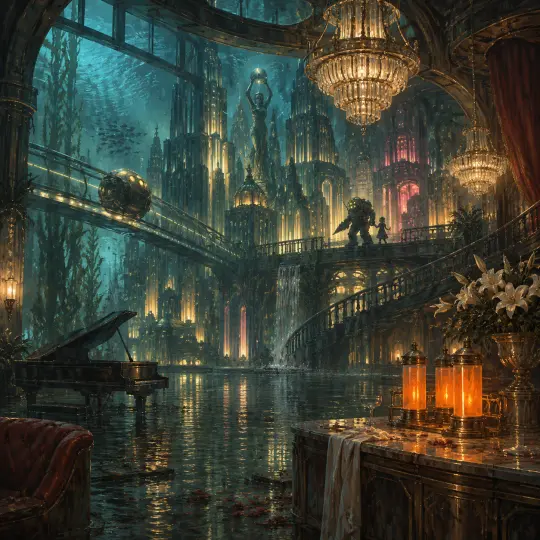
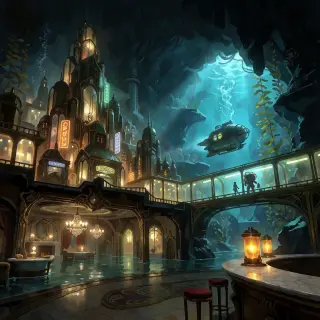
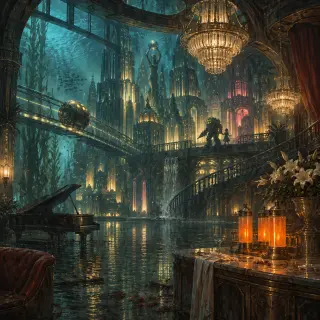
The first brief asks for the exact room where the city's promise is still visible. A grand ballroom, chandeliers, a half-sunken piano, a marble bar with amber ADAM canisters, a bathysphere gliding along an elevated track beyond the glass, and a Big Daddy with a Little Sister on a balcony above the water. The subject is not a person but a class: the room itself is the survivor.
GPT Image 2 built the frame as a stack of physical planes: wet floor, bar, piano, track, towers, sea. The reflections do most of the storytelling, and the amber canisters give the eye a warm anchor in a cold room. Krea 2 read the same brief as a wider, simpler establishing shot: the city outside the glass is the subject, the bar counter is a foreground frame, and the whole image reads at thumbnail size.
Worked Example: The Bathysphere Arrival
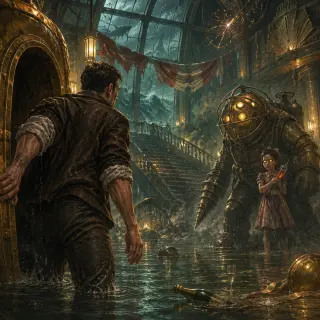
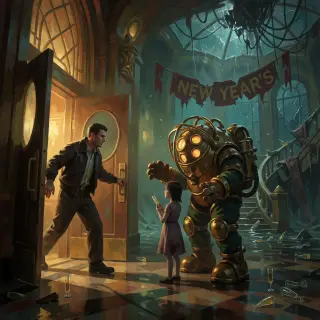
The second brief is the opposite skill. No panorama, no city skyline, no crowd. One threshold, two parties and a date. A survivor steps out of a brass bathysphere into a flooded ballroom; a Big Daddy with glowing portholes and a Little Sister holding an ADAM syringe wait across the water; torn New Year bunting and floating champagne glasses date the party to the night the civil war began.
GPT Image 2 made the frame heavy and wet: the survivor's back fills the left third, the bathysphere door leaks, the Little Sister is small enough to be a real child and the Big Daddy's rivets catch the light. Krea 2 made the same beat graphic and theatrical: a warm doorway, a chessboard floor, a readable NEW YEAR banner and a rounded, toy-like Protector. GPT Image 2 wins on dread; Krea 2 wins on instant story.
The Prompt Recipe
Subject with a job
Name a person and what they do in the room: a founder at a podium, a surgeon between operations, a survivor with a wet jacket and no memory. Avoid "a man" or "a woman"; give the model a role.
Room with a history
Specify the room and what happened in it: a ballroom after a New Year party, a hospital wing after a cosmetic trial, a smuggler's dock at low tide. History is what makes the props mean something.
Consequence in progress
Add the verb that costs something: draining, locking, selling, hiding, signing, stitching. The frame should catch an action that has already begun.
One dominant light
Choose a single source and an accent: warm chandelier plus amber canisters; cold glass light plus one red exit sign. Two key lights flatten the politics into decoration.
Restrained palette
Name five colours at most: brass, oxblood, ivory, deep teal, ADAM amber. Forbid the palette of the wrong genre: clean cyberpunk neon, dry steampunk brass, generic horror green.
Explicit negatives
No text, no watermark, no logo, no modern signage, no dry floors, no scuba gear. A negative list is a style guide, not a superstition.
Model Choice for Underwater Dystopia
The genre is a material test. Water, glass, brass and wet fabric are exactly where image models reveal their weaknesses: reflections double, caustics turn into noise, rivets melt and skin goes plastic. GPT Image 2 is slower but usually keeps the material logic coherent long enough to survive a full-size view. Krea 2 is faster and more decorative, with cleaner silhouettes and a stronger poster read, but it will simplify the mess that makes a room feel lived in.
- Use GPT Image 2 when: the frame must survive inspection — interiors, reflections, crowds, wet detail, a specific prop list.
- Use Krea 2 when: the frame must work at card size — covers, headers, social images, a single unmistakable silhouette.
- Use both when: you are publishing a comparison and want the difference to be the content.
- Avoid either when: the brief needs exact typography or a real logo. Neither model is a layout tool.
Consistency Without References
None of the four renders on this page used a reference image. Continuity came from three things: the world cards, a fixed palette sentence and a fixed light sentence. That is enough for a small set. If you need a recurring character across many frames, a reference image becomes worth the cost, but it is not the first tool to reach for. Most inconsistency is a missing constraint, not a missing reference.
From World to Story
A world of this shape generates plot without extra prompting. The locked transport creates a class barrier. The scarce substance creates a black market. The founding law creates a founder who cannot compromise. Put any two characters in any district and the scene already has a conflict, a location and a cost.
World → Key Visual
Choose one district and one law. Stage a character paying for the law inside the district. The frame now has a story, not just a set.
World → Sequence
Run the fall in four frames: dedication, discovery, massacre, arrival. Same palette, four posters, one argument.
World → Asset Library
Each character yields a portrait, each district a plate, each faction a banner. The world becomes a reusable art department for a team.
Frequently Asked Questions
- Do I need to know BioShock to use this page? No. The anatomy is explained from scratch; the Rapture cards are the worked example, not a prerequisite.
- Can I use a different disaster? Yes. Replace the ocean with vacuum, flood, ice or a quarantine cordon. Keep the sealed place, the scarce substance and the paying class.
- How many locations do I need? Six is enough to argue with itself. Twelve is a wiki, not a world.
- Why publish two models on one prompt? The comparison is content. It shows what each model protects and what it sacrifices, which is more useful than a five-star rating.
- Can I sell the renders? Check the model and platform terms; the world itself is public and forkable.
Generate Your Own Underwater World
Take the sealed city, the scarce substance and the founder's law, and render the room where somebody pays.
The Rapture world on this page keeps its cards, its prompts and its four published key visuals together. Fork it, swap the ocean for another pressure, and keep the part that matters: a place that is expensive to leave and a law that makes leaving necessary.