Free Aseprite Alternative — Browser Sprite Editor & AI Sprite Generator
Make your own aseprite free alternative
Aseprite costs money and needs installing. Here is a free browser alternative that generates sprites from a sentence — and goes one step further into a 3D world.
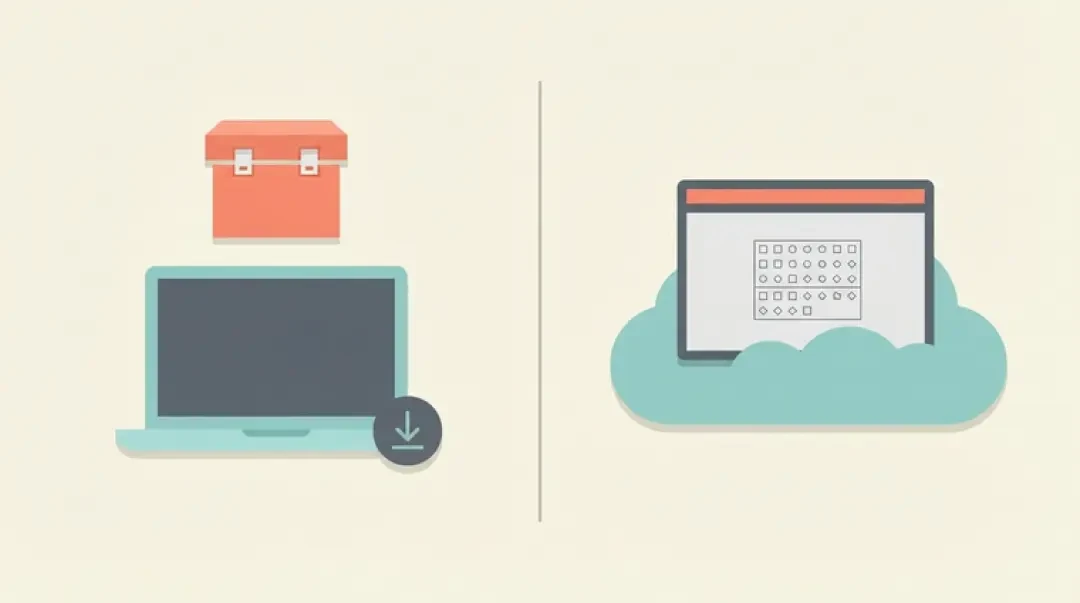
Aseprite is not free. The official builds are paid software and they install per machine. If you are looking for an aseprite free alternative, the useful question is not which clone is closest — it is which kind of free you actually need. Three different things get called free: free of cost, free source, and free of an install. Neta Studio is the third kind. It runs in a browser tab, generates a sprite from a written sentence, lets you edit the frames by hand, and then places the finished sprite into a walkable 3D world.
This page answers the price question first, because that is the question people actually type. Then it gives Aseprite a fair hearing, groups the free options by the form of free they offer rather than by brand, and states plainly what you lose when you move the work into a tab: no scripting API, no offline editing, and less comfort on very large sprite sheets. From there it demonstrates the workflow end to end — one sentence to a sprite grid with idle, walk and attack frames, then the same assets dropped into a 3D scene you can walk through.
Is Aseprite Free? (No)
No. Aseprite is paid software. You buy a license and you get the official compiled builds for Windows, macOS and Linux. That is the first sense of the word free — free of cost — and Aseprite does not meet it.
The second sense is free source. The source code is publicly available: you can read it, build it yourself, and modify it. People do compile it from source and run that. It is legitimate under the license, but it is not the official build, you own the toolchain problems, and no update is pushed to you. The distinction matters when someone says Aseprite is open source, so it is free. The source being readable and the official binary being free of charge are two different claims, and only the first one is true.
The third sense is free of an install — running somewhere you set nothing up, on a machine whose software you do not control. Aseprite fails that one too. So does its free fork. The fork is a separate install with its own download, built on an older codebase than the current Aseprite and maintained by different people. It opens .ase files and it carries the pixel tools from that era, but features added to Aseprite since the fork are not in it. If you want to know whether the free fork works like Aseprite: like an older Aseprite, yes. Like the current one, no.
| Sense of free | What it means | Aseprite |
|---|---|---|
| Free of cost | You pay nothing to run the official build | No — official builds are paid |
| Free source | The code is readable, buildable and modifiable | Yes — the source is available |
| Free of an install | Nothing to download; it runs where you already are | No — desktop app, per-machine install |
| Free fork | A separately maintained build from older source | Exists as a separate install, not the official release |
What Aseprite Does Well
Aseprite is a strong desktop pixel editor, and the reasons are specific. The frame timeline and layer stack are built for animation rather than bolted on: layers, frame tags, onion skinning and playback controls sit in one panel. Tiled mode draws your sprite repeating so you can check seams while you work. The palette system and pixel-perfect stroke handling are tuned for low-resolution work instead of scaled down from a photo editor.
The parts that are genuinely hard to replace in a browser are the automation ones. Aseprite exposes a Lua scripting API and a command line interface. You can write a script that renames layers across every file in a folder, or a build step that exports a sprite sheet plus a JSON frame map every time you save. There is no browser equivalent of that, and there will not be one soon: a tab cannot walk your filesystem and rewrite a folder of .ase files.
Say it plainly. Nothing in a browser is a drop-in replacement for Aseprite. The .ase project format is not round-tripped by browser tools, so your layers, tags and palette live in the desktop app. What a browser tool can own is the pipeline around the sprite — generating a base, making quick edits, and putting the finished asset into a scene.
- Frame timeline with tagsLayers and frames in one grid, with named tags that map directly to animation clips on export.
- Tiled modeDraws the canvas repeating so tile seams are visible while you draw, not after.
- Lua scriptingAutomates repetitive edits inside the editor: layer naming, palette swaps, batch changes across files.
- Command line exportHeadless export of sprite sheets and JSON frame data, which makes it usable inside a build step.
- Palette and pixel toolsIndexed palettes, pixel-perfect strokes and dithering designed for small canvases.
- Native file handlingReal file dialogs, real folders, and a native format that stores layers instead of flattening them.
Free Alternatives by Kind of Free
Most lists of alternatives sort by brand. That is the wrong axis, because two tools that are both called free can have nothing in common. Sort by the shape of free instead: is it free because you do not pay, free because the code is open, or free because there is nothing to install?
The point of the split is that you can combine routes. Generate a base in a tab, clean it up in a browser editor or in the free desktop fork, and export the atlas from whichever tool has the features you need.
Free Aseprite alternative: free desktop builds and forks
This is the closest match to Aseprite in behaviour. Free desktop forks keep the pixel-first workflow, native file dialogs, offline operation, and no canvas ceiling beyond your own memory. The free fork of Aseprite is the obvious entry here; compiling Aseprite from source is the other. General-purpose raster editors that cost nothing can also do pixel work, but you are running a photo pipeline to draw a 16×16 icon, and those tools fight you on indexed palettes and pixel-perfect strokes. The trade is what you already know: a separate install, per machine, and if it is a fork, an older feature set.
Free Aseprite alternative: browser editors
Browser pixel editors need no install. They open in a tab, they work on a Chromebook or a locked-down work laptop, and sharing is a link rather than a file. They handle the normal case comfortably — a 32×32 or 64×64 sprite, a handful of layers, a short animation. They do not handle scripting, and they hand you files through the download dialog instead of a save command.
Free Aseprite alternative: generators with usage limits
Prompt-to-sprite generators are a different category. You are not getting an editor first; you are getting output. Free tiers typically cap how many generations you get, cap resolution, and attach license terms that vary, so read them before you ship anything commercial. The output is usually a flattened PNG or a sheet rather than layered frames, which means editing one limb means editing the whole sprite.
| Route | Free means | Best when | What it costs you |
|---|---|---|---|
| Free desktop fork or source build | No payment, open code | You want Aseprite-like behaviour offline | Separate install; the fork lags the current version |
| Free browser editor | No payment, no install | Short sessions, small canvases, shared machines | No scripting API; browser canvas and memory limits |
| Generator with a free tier | No payment up to a cap | You need a starting pose or a whole clip set | Caps and license terms vary; output is flattened |
What You Give Up Online
No scripting API. This is the biggest one. In a desktop editor you can automate anything repetitive: rename layers, batch-convert a folder, run an export on save. In a browser tab you have no handle on the filesystem, so a batch operation becomes export each file, run a local script on the exports, import the results. If your workflow depends on automation, the browser is the wrong end of the pipeline for it.
No offline work. The first load needs a network, and a tab is not durable storage the way a file on disk is. A reload mid-edit loses whatever was not exported. Treat the tab as a scratch buffer, not a vault: export the PNG and the JSON frame map early and often, and keep the file you care about in your own storage. There is no autosave-to-disk, because there is no disk.
Large sheets are less comfortable. Browsers impose a maximum canvas dimension and a maximum total canvas area; the numbers differ between browsers and devices, and mobile is far below desktop. A single 64×64 frame is nothing. An atlas several thousand pixels on a side with many layers is where you start noticing. Undo history also lives in memory, so the deepest undo stack on the largest canvas is the first thing to get slow.
And the small stuff: the browser owns the shortcuts, so the key that saves in your muscle memory may close a tab instead; pen and tablet input is less consistent than on a native app; filenames get typed into a download dialog rather than a save dialog. None of this is a reason to avoid a browser editor. It is a reason to know which half of the job you are doing in it.
Generate a Sprite in the Browser
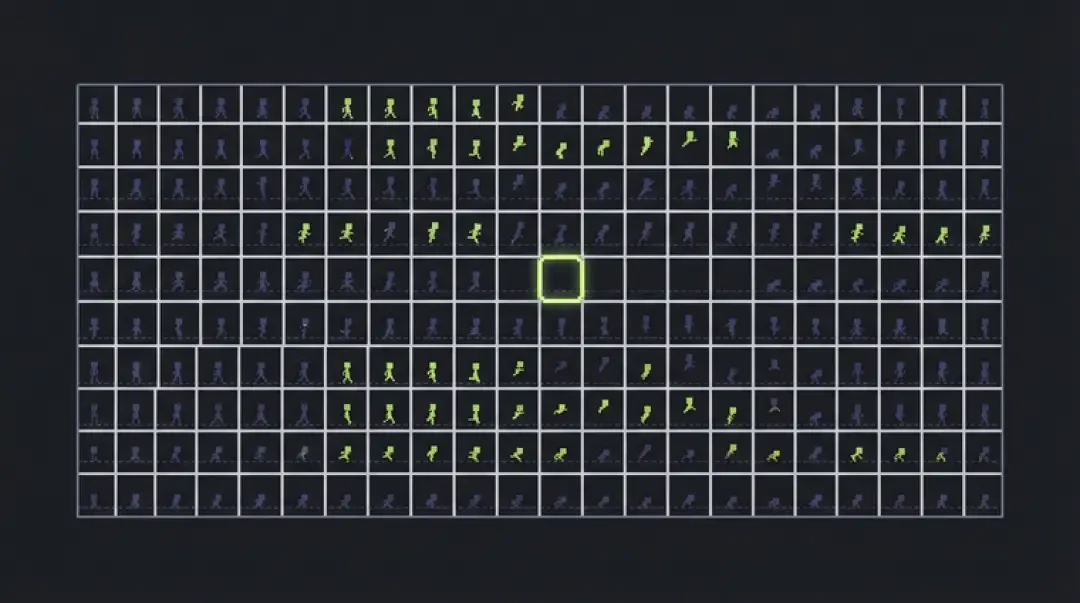
The workflow in Neta Studio starts with a sentence, not a canvas. Agent Sprite Forge takes a written description of a character and returns a sprite grid: frames laid out at the resolution you picked, palette-locked, with the clips already separated. You then edit those frames with the same pencil and eraser you would use if you had drawn them yourself.
What comes back is not a single image. It is a grid — a row per clip — so idle, walk and attack arrive as separate animation tags instead of one strip you have to slice. A walk cycle gets the longest strip, because leg positions have to alternate twice per loop to read at speed; an attack reads fine shorter, because the whole action is a wind-up and a strike. Everything is drawn at the grid size you chose: 16×16, 32×32, 64×64. Pick the size you intend to ship at. Generating at 64×64 and downscaling to 32×32 destroys detail the generator will not re-invent for you.
Expect variation between runs. The same sentence twice gives you two different sprites. That is useful — regenerate until the silhouette and palette are right — but do not mix frames from two runs into one clip. The shading direction and outline weight will not match, and the eye catches it immediately in motion.
01
Open the sprite editor in a browser tab. Nothing to install.
02
Write one sentence describing the character: body type, palette, what it is holding, the view angle.
03
Choose the grid size — 16×16, 32×32 or 64×64 — and lock a small palette.
04
Select the clips you need: idle, walk, attack.
05
Generate, then scrub the timeline. Check the silhouette at 100 percent zoom, not zoomed in.
06
Fix frames by hand — pencil, eraser and line tools work on generated frames exactly as on drawn ones.
07
Export the sprite sheet and the JSON frame map, then bring both into the 3D game builder.
Two Ways to Get a Sprite
Both routes live in the same tab and share the same tools, so the choice is about speed, not about which editor you opened. The rule of thumb: generate when the hard part is the pose, draw when the hard part is the precision.
Route one: draw it by hand
Hand drawing is faster when the sprite is small and the shape is already in your head. A 16×16 item icon in three colours is a handful of pencil strokes; describing it and cleaning up the result takes longer than drawing it. It is also the faster route when consistency across a set is the entire point — six characters sharing one palette and one body type. A generator will give you six plausible characters that do not look related. Hand-drawing lets you hold the rules yourself.
Route two: generate it, then edit it
Generating is faster when you need a pose you do not have, or a whole clip set at once. A walk cycle is the clearest case: the generator produces the key poses and the in-between leg positions, and your time goes into cleanup rather than construction. It is also the right route for anything disposable — a placeholder enemy for a test scene, a prop for a level you are still blocking out. Edit on top of the generated frames; the tools do not change because the pixels came from a prompt.
| You need | Faster route | Why |
|---|---|---|
| A 16×16 icon in three colours | Hand | Fewer strokes to draw it than to describe it and clean up the result |
| A walk and attack set for a new character | Generate, then edit | The key poses are the slow part; frame consistency is what you check by hand |
| Six characters sharing one palette | Hand, or one generated base reused | A generator returns six unrelated characters, not a family |
| A placeholder for a scene you are still building | Generate | The asset is disposable; speed matters more than polish |
| A tile or a UI element | Hand | Square grids and hard edges are easier to draw than to describe |
Sprites, Then a World
In a desktop pixel editor, the sprite is the end of the pipeline. In the 3D game builder, it is the middle. You import the sprite sheet and the JSON frame map, the builder maps each clip name to an animation, and the sprite becomes a textured quad in a 3D scene — a flat surface that turns to face the camera as you move, which is how a 2D character reads as a 3D one.
Two settings decide whether it looks right. Pixel-per-unit controls how large one sprite pixel is in world units; set it once and keep every character and prop on the same value, or your sprites will sit at different scales in the same scene. Texture filtering has to be Nearest. With smoothing on, a 32×32 sprite goes soft at the edges and stops matching the geometry around it. If your generated output has anti-aliased edge pixels, either clean them to hard pixels or accept the blur — the two styles do not sit well together.
This is the step a desktop pixel editor does not reach, and it is the reason to keep the sprite in the same tool as the scene. A walk cycle you just generated is a walk cycle you can immediately walk around with: place the character, set the collision volume, and check whether the frame timing feels right at the speed the camera actually moves. Timing that loops correctly in an editor often reads wrong at movement speed. You can start from Mini World, a compact scene you can walk in, or from a larger demo world like The Cyclops' Island, and swap the character for your own.
Walk into the world it belongs to
The free question is answered on this page; the more interesting one is what you can do with a sprite once you have it. Open a pixel world that was built in the same browser tab — no editor, no install, and no purchase.
FAQ
Is Aseprite free? +
No. The official compiled builds are paid software. The source code is available and you can build it yourself, and a free fork exists, but the fork is a separate install built on an older codebase rather than the official release.
What is the best free alternative to Aseprite? +
It depends on which free you need. A free desktop fork is closest in behaviour but still an install. A browser sprite editor or generator needs no install at all, which is the gap Neta Studio fills: generate a sprite from one sentence, edit the frames, export the sheet and its JSON frame map, then place the character in a 3D scene.
Does the free fork work like Aseprite? +
Like an older Aseprite. It opens .ase files and carries the pixel tools from the codebase it forked, but features added to Aseprite since then are not in it. It is maintained by different people on its own release schedule, so treat it as a separate tool rather than the same one at no cost.
Can I animate in a browser? +
Yes, at sprite scale. A tab handles a 32×32 or 64×64 character with idle, walk and attack clips, and plays them back on a timeline while you scrub. What you will not get is a scripting API to batch-process those clips, or comfortable work on atlases several thousand pixels on a side.
Can I use the sprites commercially? +
Check the license of whichever tool produced the sprite — free tiers differ, and some restrict commercial use. On the Neta Studio side the assets you create are yours to use; confirm the current terms before a commercial release, and keep your source frames, because unflattened frames make edits and provenance easier to prove.
Do I need to install anything? +
No. The editor and the generator run in a browser tab. You need a network connection for the first load, and you get your files through the browser download dialog rather than a save command — after that, the exported PNG and JSON are ordinary local files you can move anywhere.
Back to the 3D Game Builder
All 31 finished 3D worlds, games and scenes live on one page — every one of them playable.