
The Best AI Anime Key Visual Generator — Twilight, Comets and Small Towns
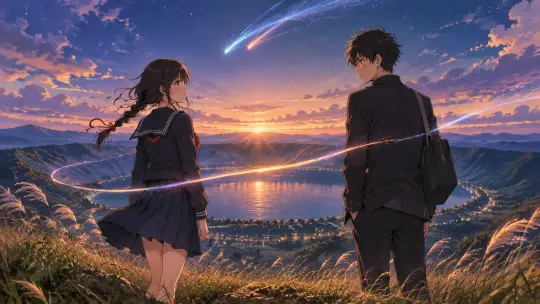
The best AI anime key visual generator: render twilight craters, festival towns and splitting comets with GPT Image 2 and Krea 2. Proven on the Your Name: The Thread of Musubi world with four published works.
Generate an Anime Key Visual from One Sentence
Describe the hour, the place and the two people in it. Neta Studio turns the sentence into a world and the world into a cinematic anime key visual.
What an Anime Key Visual Generator Actually Has to Do
A key visual is not an illustration of a scene. It is the single frame that tells a stranger what the story will cost them. It has to establish a place, a relationship, a threat and a mood in one crop, and it has to survive being shrunk to a thumbnail, cropped to a vertical, and printed on a poster without losing the story. Most image tools can make a beautiful anime frame. Very few can make a frame that still works when the context is removed.
- One readable idea: the viewer should be able to describe the film in a sentence after two seconds.
- Physical honesty: straps, shadows, wet stone and lantern reflections must behave, even when the sky does not.
- A correct hour: dawn, dusk and kataware-doki are different visual systems, not different colour filters.
- A scale for the threat: the comet must look distant enough to be beautiful and close enough to be fatal.
- No accidental text: clean frames, no fake titles, no watermarks, no invented logos.
Tested on a Real World, Not a Prompt Gallery
This page is built on one specific world — Your Name: The Thread of Musubi, a caldera town, a Tokyo boy and a comet that returns every twelve hundred years. Every frame below was generated from that world's atoms, with the same two briefs run through two models. That matters because it lets you compare outputs without comparing unrelated aesthetics: the variable is the model, and the world is fixed. The test set is deliberately small and hard — one crater at twilight, one town at dusk, two teenagers, one comet, one braid of light. There is no crowd to hide behind, no neon to fake depth, and no action to disguise a broken composition. If a model can make these frames, it can make a key visual.
Why Twilight Is the Hardest Anime Lighting
Twilight is where anime backgrounds usually cheat. The sky is easy — gradients are cheap. The hard part is what the light does to everything else: how wet stone holds a lantern, how a school uniform loses its colour without losing its shape, how a face turns into a silhouette while still reading as a specific person. Kataware-doki raises the difficulty, because the scene is supposed to be lit by two light sources at once: the last of the sun and the first of the stars.
A model that only knows "sunset" will produce an orange sky and a black foreground. A model that understands the hour will produce cool shadows with warm edges, a lake that reflects the sky rather than the sun, and a comet that is brighter than the stars but dimmer than the lanterns. That difference is the whole test.
The rule for this world: the supernatural enters through light and weather, never through glowing runes. If the sky is impossible and the stone still looks wet, the frame is working.
The Four Frames: A Fair Comparison
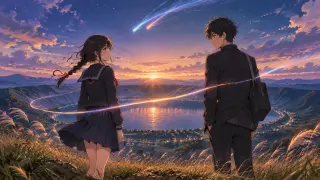
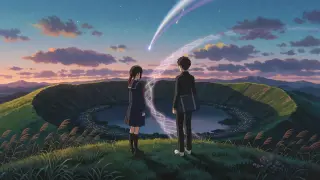
Two briefs, two models, four published works. GPT Image 2 was run at 1536×864 with high quality; Krea 2 was run at 1024×576, its maximum useful wide size. Both received the same text, with no reference images. The comparison below is not about which model is better. It is about which frame does the job you need.
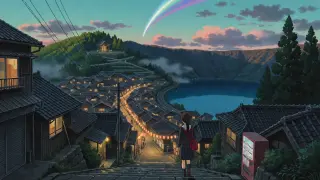
What GPT Image 2 Gets Right
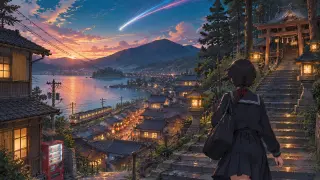
GPT Image 2 is the detail model. It reads a long brief and distributes the information across the frame instead of collapsing it into a mood. In the crater frame, the girl's braid, the red cord, the boy's bag strap, the guardrail and the ring of town lights are all present and correctly scaled. In the town frame, the shrine, the stairs, the train, the vending machine and the festival street coexist without turning into clutter.
- Architecture that behaves: roofs, stairs and power lines follow plausible perspective.
- Costume continuity: sailor uniforms, bag straps and the red cord survive without melting.
- Small narrative props: a vending machine, a train, a lantern row — each does a job.
- Prompt obedience: six clauses in, six clauses represented out.
- Crop resilience: the frame still reads when you cut it to 4:5 or 1:1.
What Krea 2 Gets Right
Krea 2 is the atmosphere model. It does not try to reproduce every noun in the brief. It finds the emotional centre — two people, a ring of water, a thread of light — and builds a poster around it. The result is flatter, bolder and faster to read, which is exactly what a thumbnail, a social card or a title sequence needs.
- Graphic silhouettes: figures read as shapes before they read as characters.
- Value control: the frame stays legible in a small crop or a dark UI.
- Speed and cost: fast enough to iterate ten compositions before choosing one.
- Mood-first colour: the palette arrives before the detail does.
- Style range: useful when the world needs a poster, not a simulation.
The Six-Clause Prompt That Produced These Frames
The prompt is not a poem. It is a shot list in prose. Six clauses, always in the same order, so you can diagnose which one failed when a frame comes back wrong. The order matters more than the adjectives.
Medium and genre
Anime key visual, 16:9 theatrical composition, hand-painted background. This tells the model which visual system to use before it sees a subject.
Place
The grass-covered rim of a volcanic crater above a caldera lake. One horizon, one ground plane, one scale.
Subject
Two teenagers a few paces apart, a girl in a dark school uniform with a red braided cord, a boy in a black jacket with a shoulder bag, seen three-quarter from behind.
Evidence of physics
Reeds bending, a bag strap under weight, a braid of light crossing in an arc, town lights reflected in the lake.
Light and weather
Kataware-doki, warm rim light, cool blue shadows, painted clouds, natural film grain.
Negative clause
No text, no watermark, no logo. This is not optional if the frame will be published.
Composition Rules for Anime Posters
Anime key visuals are built on a few repeated compositional moves. A low horizon makes the sky feel like a character. A single vertical element — a torii, a stair, a braid — gives the eye a way in. A figure seen from behind invites the viewer to stand where they stand. And a bright object in the upper third gives the frame a destination.
- Low horizon: more sky, more threat, more silence.
- One vertical: a stair, a torii, a thread. Not three.
- Back view: the viewer becomes the witness, not the subject.
- Upper-third light: the comet, the moon, the last sun. Give the eye somewhere to land.
- Foreground texture: grass, wet stone, roof tiles. It sells the scale.
From One Sentence to Four Published Works
The production loop is short enough to run in an afternoon. Start with a sentence, attach it to a world, generate two models, compare, publish the one that survives the crop. The important part is the last step: a work that is published with its prompt and its model becomes evidence, not a screenshot.
Sentence → world atoms → six-clause prompt → GPT Image 2 + Krea 2 → compare → publish → share
Use Cases Beyond the Poster
The same pipeline produces more than a hero image. A world with consistent atoms can generate a poster series, a visual novel background set, a short film's establishing shots, or a campaign's entire visual language. The constraint is not the model; it is whether the world has enough specific nouns to point at.
Poster series
One frame per hour of the same day, same town, same two people. The comet appears once, and the series is about the hours it is not there.
Visual novel
Establishing shots for every location: shrine, school, lake, crater, Tokyo stair. Consistency comes from the atoms, not from a style prompt.
Short film
Six key frames as a shot list. The dialogue can be written later; the visual argument is already done.
Campaign world
A single sentence brief becomes a world, a cast and a visual system that other people can fork and extend.
Common Failure Modes
Most bad anime key visuals fail for one of five reasons, and four of them are prompt problems rather than model problems. The fifth is a taste problem: the frame is beautiful and says nothing.
- Wrong hour: an orange sunset where the story needs violet twilight.
- Floating subject: figures pasted on a background with no contact shadow or ground plane.
- Scale collapse: a comet the size of a streetlamp, or a town the size of a diorama.
- Clutter: too many nouns, no single idea, a frame that reads as a collage.
- Accidental text: fake titles or watermarks that make the image unusable.
Start From This World
The fastest way to learn this pipeline is to start from a world that already has atoms. Your Name: The Thread of Musubi has eight characters, six locations, six events and five rules, plus four published works you can inspect, fork and regenerate. Change one thing — the hour, the model, the year — and you have a new frame with the same visual logic.
Make Your Own Twilight Key Visual
Open the world, pick two characters and one hour, and generate the frame that the story has been hiding.
Four real published works from this world, generated with GPT Image 2 and Krea 2 from the same two briefs.