Interactive story generator

AI Interactive Story Generator — Choices Write the Plot

Describe a premise and get a playable story: three choices at every scene, branching routes, and an ending card that names your path.

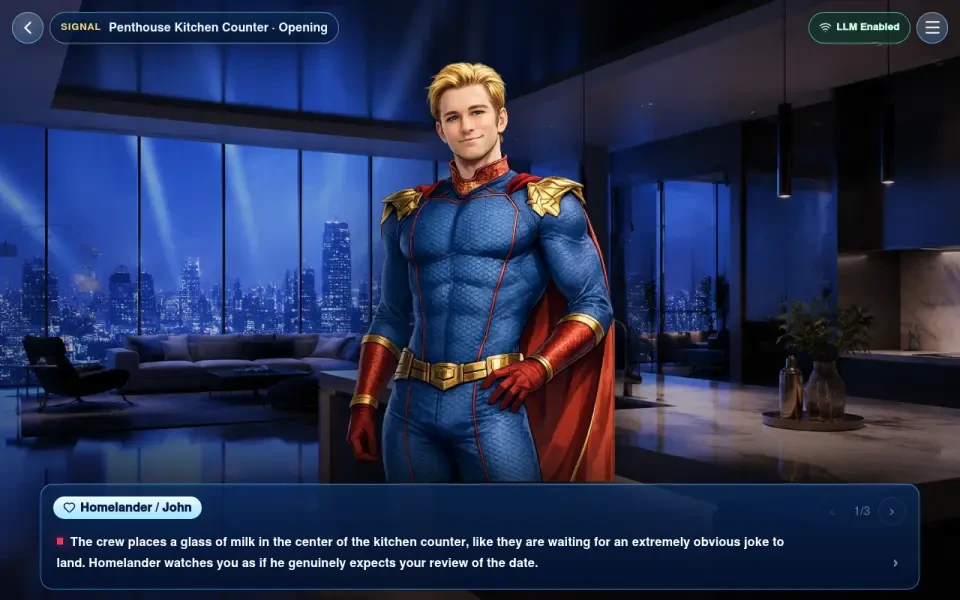
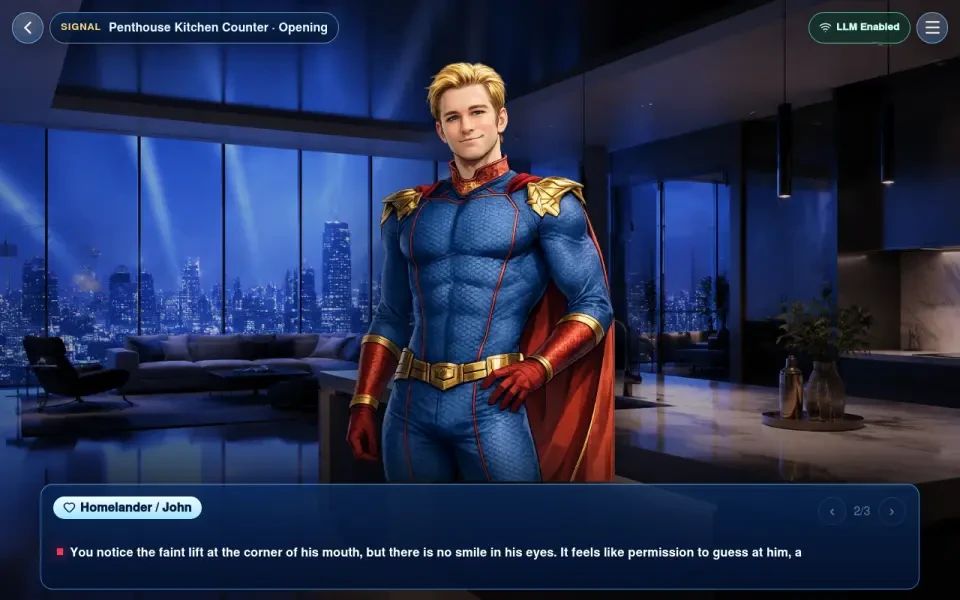
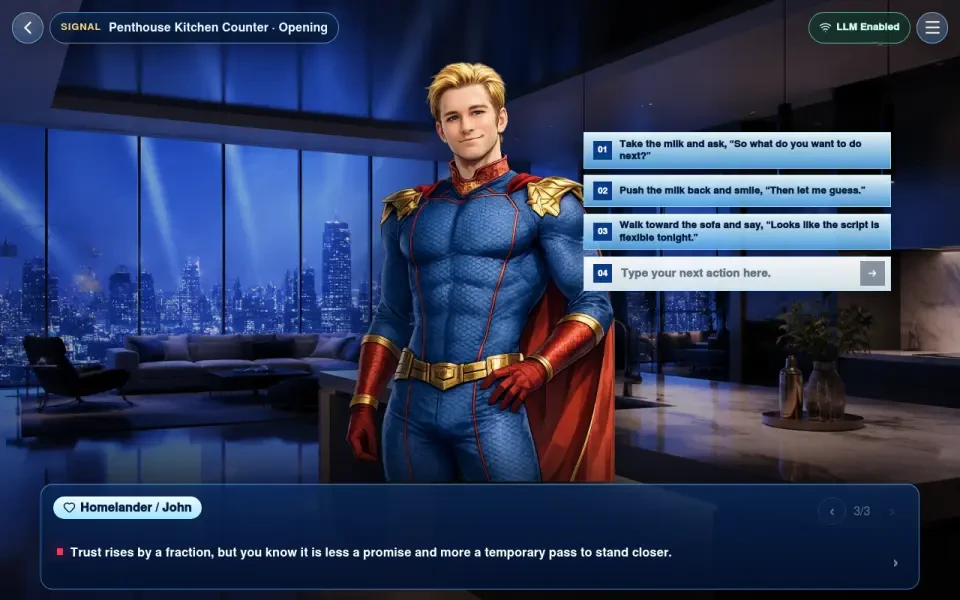
Secret Faces · Four ways through — Hori Kyouko at the school gate, four numbered options on screen, and a Threshold meter already at 8%.Saints of Glass · The opening — Homelander, a glass of milk, and a dialogue box that genuinely expects your review of the date.Signal Failure · Hori at the window — Hori talks about her brother and stepping down as class rep. Three replies, and one of them changes the night.The Long Way Home · Second fork — Hori in the rain with three replies and Closeness at the top of the screen. The story remembers the answer you gave at the gate.

Powered by the create-avg skill

✦Interactive story
Make an interactive story about a night train where the only other passenger knows your name — named cast, illustrated scenes, three tappable choices at every scene, endings that differ by route.
Rain Lanterns · Whose lantern — Three routes on one screen — Su He, Yan Zhou and Bai Heng. Pick a road and the festival rearranges around it.
Rain Lanterns · Su He, first choice — Her lantern is getting soaked. Two answers on screen, and both of them move the night somewhere else.
Rain Lanterns · Su He, ending — The route lands on a line you earned: the festival keeps going for everyone else, and for once it is not ending for you.
Saints of Glass · Three replies — Homelander waits at the kitchen counter with three numbered replies and a milk joke you can dodge.
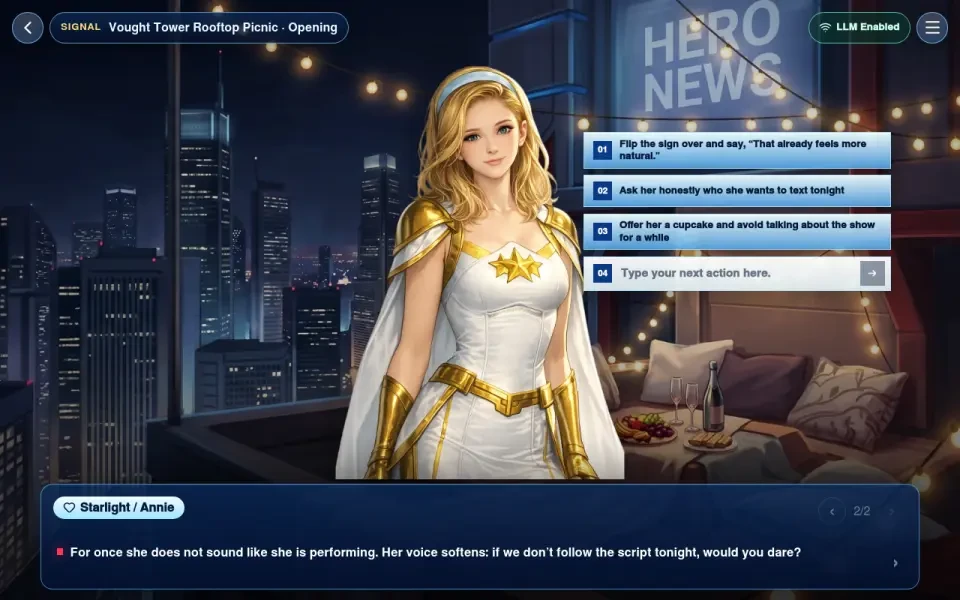
Saints of Glass · Starlight — Same night, different route. Starlight asks whether you would follow the script, and three buttons answer for you.
Saints of Glass · Affection +0, Tension +1 — Two counters move while you talk. Trust and threat are separate numbers, and the scene keeps both on screen.
Signal Failure · The first decision — A typhoon cancels the last train. Three classmates, three ways to spend the first hour, and the choice sits on one screen.
Signal Failure · Ishikawa, the envelope — A named speaker, his portrait in the cast strip, and three ways to react to a letter you were not meant to see.
Signal Failure · Ending 1 of 7 — The ending card names the route, lists every choice that led there, and counts the endings still to find.

One story is a start. The world around it keeps growing.

Neta Studio is an AI world builder: one sentence becomes a living world with characters, maps, roleplay and playable stories. An interactive story is one shape that world can take — the same cast can walk into a sequel, a roleplay thread or another game tomorrow.

  • Choices are buttons — Every scene ends in tappable options, not a blank box, so a reader always sees how many ways the moment can go.
  • Endings name their route — The last card says which path produced it, and the gallery keeps count of the ones you have found.
  • A cast that stays on-model — Portraits, outfits and names carry across scenes and worlds, so the person you met in the first scene is the same person at the end.

Questions, answered.

What makes this interactive, not just generated?

You get a screen, not a page of prose. Every scene ends in on-screen choices, each one opens a different beat, and the ending card says which route you took to get there.

Do I have to script the branches or write code?

No. You describe the premise, the cast and the kind of ending you want. The build writes the scene graph, draws the art and publishes a playable link.

How many choices and endings does one story get?

Three choices at each decision is the default, with at least three endings. Ask for four routes and you get four; each one costs its own scenes.

Can I use characters I already built in a world?

Yes. Build or import the cast first, then make the story inside that world. Names, portraits and relationships carry over.

Is this the same as chatting with an AI character?

No. A chat answers whatever you type. This story has a fixed shape — scenes, choices and endings exist whether or not you reach them.

Can I fix one scene without rebuilding everything?

Yes. Scenes are separate nodes. Rewrite or regenerate the one that feels wrong and the rest of the route stays exactly as it was.

Does it work on a phone, and can I share it?

It is a web page. It opens in a phone browser, the choices stay thumb-sized, and the link works for anyone you send it to.

What should I type in the box?

One sentence with a person, a place and a problem. “A night train where the only other passenger knows your name” is enough to start.

Make the story you keep looking for.

One sentence in, scenes and endings out — playable in the browser and shareable as a link.

×