
Better Call Saul AI World Generator — Build a Strip-Mall Crime Saga from One Sentence
Build a Better Call Saul-style AI world: legal-crime characters, strip-mall offices, foil-lined houses and desert money drops, with GPT Image 2 and Krea 2 key visuals proven on four published works.
Generate a Legal-Crime World
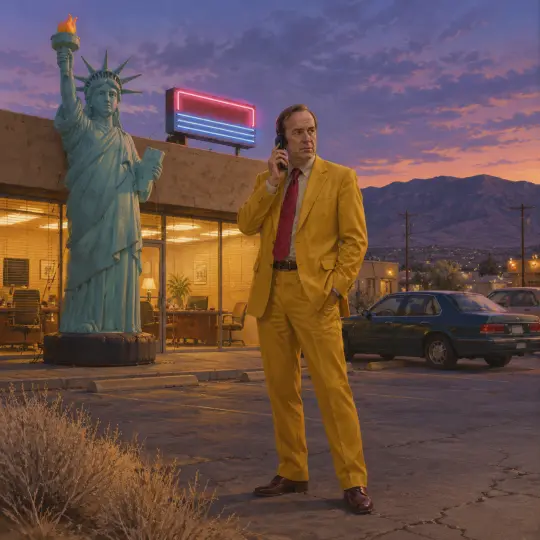
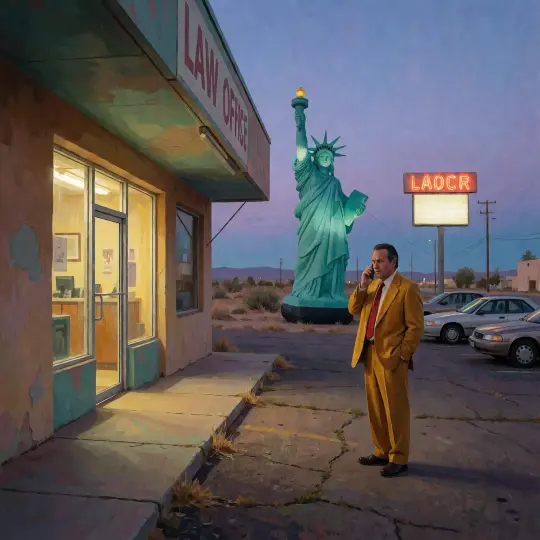
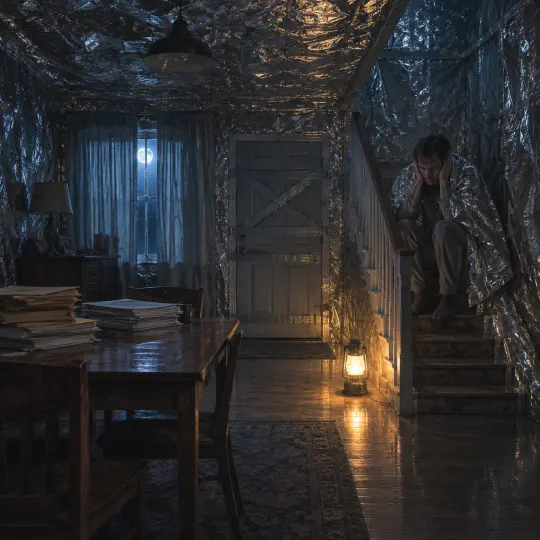
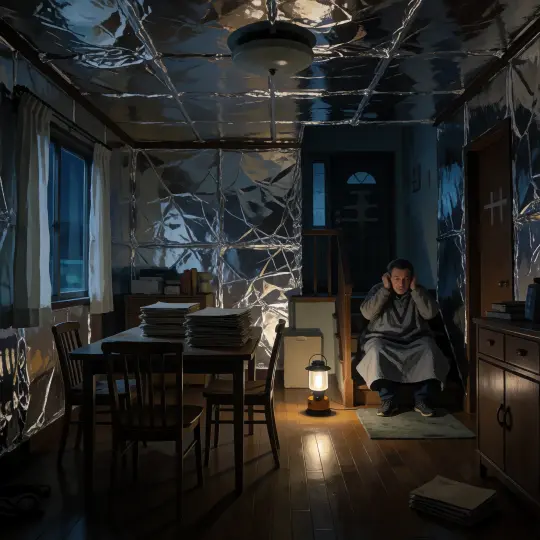
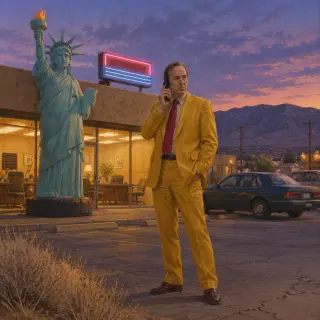
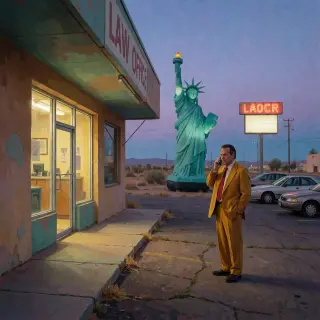
A strip mall, an inflatable monument, a foil-lined house and one man in a mustard suit — one brief, two models, four published key visuals.
What Is a Better Call Saul AI World Generator?
A Better Call Saul AI world generator is a world-building pipeline for legal-crime drama: stories where the weapon is a document, the battlefield is a conference room, and the most dangerous person in the room is the one who knows which form to file. It produces characters, locations, factions, events and poster-grade key visuals from a single premise, then binds them into a canon that other people can fork.
The output is not a script and it is not a mood board. It is a set of atoms with rules: a lawyer who cannot stop performing, a partner who is better than him, a brother who has withdrawn from the electrical grid, a fixer with a granddaughter, and a desert where money changes hands without a receipt. Those atoms are enough to generate a visual novel, a management game, a short film or a season of episode pitches.
Why Legal-Crime Worlds Are Different
Most crime worlds are built on violence. This one is built on procedure. A hearing can be as tense as a shootout if the audience understands what is at stake, and a signature can be as final as a bullet. That changes what the world needs: not more gunmen, but more rooms with rules, more documents with consequences, and more characters who are technically allowed to be there.
Three things separate a legal-crime world from a generic crime world. Jurisdiction, because who has the authority to decide is the real fight. Paper, because a file can save a life or end one. Performance, because everyone in the room is playing a role they can lose.
The Test World: Better Call Saul
Every claim on this page was tested against a real canon: the Better Call Saul world in Neta Studio. It has eight characters, six locations, six events and four factions — Jimmy McGill, Kim Wexler, Chuck, Mike, Nacho, Lalo, Howard and Gus; the strip-mall office, HHM, Chuck's house, the nail salon, the courthouse and the desert. That is enough structure to brief a model precisely and enough ambiguity to keep the frames from looking like stills from one scene.
Era mid-2000s Albuquerque · Tone wry, procedural, slowly tragic · Look semi-realistic painterly strip-mall noir · Palette mustard, oxblood, foil silver, desert ochre
What the Comparison Proves
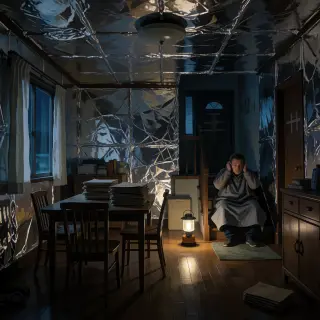
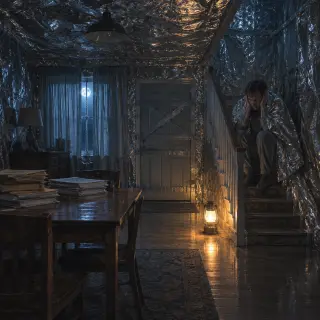
The same two briefs were run through GPT Image 2 and Krea 2. GPT Image 2 produced the structural frame: the wrinkles in the inflatable statue, the cracks in the parking lot, the foil seams around a door, the pages in a stack of legal files. Krea 2 produced the emotional frame: a lavender sky, a wide diagonal canopy, a symmetrical foil room and a small figure carrying the whole story. The lesson is not that one model is better. It is that the genre needs both a document and a poster, and you should choose per surface.
The Six-Part World Brief
A legal-crime world brief works best as six ordered clauses. Order matters more than length because the first clauses set the genre and the last clauses protect the frame from becoming a stock photo. Write the place before the person, the person before the light, and the light before the negative clause.
Medium and genre
Semi-realistic painterly legal-crime key visual, cinematic wide shot. This single clause prevents glossy legal television and cartoon noir at the same time.
Place and scale object
A cheap strip-mall law office at dusk; a suburban house with foil-lined walls. Name the thing that makes the place socially legible.
Subject and costume
A middle-aged man with slicked-back dark hair in a loud mustard-yellow suit and a red tie; a thin man in a grey space blanket. Costume is the fastest way to make a character specific without describing a face.
Evidence in the foreground
A flip phone, a stack of legal files, a camping lantern, a cracked parking lot. One object should imply the last five minutes and the next five.
Light and palette
Violet dusk, neon red and blue, ochre stucco and cold teal shadow; or cold moonlight against one warm lantern. Name one key and one fill.
Negative clause
No text, no logos, restrained film grain. This keeps the frame usable as a poster and stops the model from inventing signage it cannot spell.
Casting the Witness
The human in the frame is not a portrait subject; they are a measuring instrument. A man beside a storefront tells the viewer how wide the parking lot is. A man on a staircase tells the viewer how tall the house is. Keep the face turned away, in profile, or under a hat. The moment the model gives you a heroic close-up, the frame stops being legal crime and becomes a character poster.
Location Grammar: Strip Mall, Tower, Foil House, Desert
Four location types cover the genre, and each demands a different composition. The strip mall is horizontal and bright: a canopy, a plate-glass window, a statue and a parking lot. The tower is vertical and polished: a conference table, a city view, a partner who belongs there. The foil house is sealed and symmetrical: a corridor of silver walls, one lantern, a staircase. The desert is empty and wide: a low horizon, a large sky, one car and one person who should not be there.
A Reusable Prompt Template
Legal-crime key visual, semi-realistic painterly realism, cinematic wide shot. PLACE: [cheap strip-mall law office at dusk / foil-lined suburban house at night / glass-tower conference room / desert outside Albuquerque]. SCALE: [inflatable Statue of Liberty and cracked asphalt / staircase and stacked legal files / floor-to-ceiling windows and a long table / a sedan and a mesa horizon]. SUBJECT: [a man with slicked-back dark hair in a mustard suit and red tie with a flip phone / a thin man in a grey space blanket with his hands over his ears / a woman in a dark suit holding a folder]. EVIDENCE: [a neon tube with no letters / a camping lantern and a stack of files / a settlement binder and a cold cup of coffee / a duffel bag and a car with one door open]. LIGHT: [violet dusk, neon red and blue, ochre stucco / cold moonlight and one warm lantern / fluorescent panels and city glow]. NEGATIVE: no text, no logos, no watermark, restrained film grain.
Swap the bracketed values and the template holds. That is the test of a good template: it should survive a change of scene without collapsing into generic adjectives. If the output still looks like Albuquerque after you replace every noun, the template is doing its job.
Common Failure Modes
Four problems account for most failed generations. The fix is almost always a clause, not a new seed. If the image looks like a car commercial, remove the lens flare and add dust. If it looks like a video game, add a material detail the model has to respect — fabric weight, cracked asphalt, foil creases. If it looks like a stock photo, add evidence in the foreground. If it looks like a character poster, turn the face away and widen the frame.
Wallpaper syndrome: no human witness — add a silhouette in the lower third. Hero drift: too much face — describe role, hat and posture instead. Clean-TV gloss: add heat haze, dust and a real imperfection on the building. Set-dressing clutter: name exactly one foreground object and let the rest be empty.
Detail or Atmosphere: Choosing a Model
Choose GPT Image 2 when the frame must survive a crop: store pages, thumbnails, UI cards, anything where architecture and material need to stay legible at small sizes. Choose Krea 2 when the frame is doing emotional work: a hero image, a share card, a poster where the sky and the silhouette carry the story. For a world page, publish both. The comparison is more persuasive than either image alone, and it gives the reader a reason to trust the pipeline rather than the hype.
The End-to-End Workflow
Start from the world, not from a blank prompt box. Open the Better Call Saul world, read the location entry you want to visualise, and copy its nouns into the six-clause template. Generate the same brief on both models, publish both frames as works of the world, and only then decide which one opens the page. The order matters: publishing first makes the comparison auditable, and the prompt stays attached to the image.
Open the world
Start at the Better Call Saul studio and pick one location: the strip mall, the foil house, HHM, the courthouse or the desert.
Copy the nouns
Use the location's own objects — inflatable statue, plate glass, foil panel, lantern, legal file — as the scale and evidence clauses.
Write six clauses
Medium, place, subject, evidence, light, negative. Keep each clause to one sentence fragment.
Run both models
Generate the identical brief with GPT Image 2 and Krea 2 so the comparison measures the models, not the prompts.
Publish as works
Attach both frames to the world with prompt and model recorded, then compare them in public.
Publishing the World
A world that lives only in a chat window is a dead end. Published as a world with works, it inherits a share link, a gallery and a forkable structure. The four frames on this page are published works with live share links, which means the comparison can be inspected rather than taken on faith. That is the difference between a mood board and a canon: the canon can be opened, copied and changed.
Explore the World
The world is public, the twenty-six atoms are editable, and the four key visuals are already published. Fork it, change the price of a favour, move the practice to a different strip mall, or generate the frame that finally shows what is in the duffel bag. The comparison is live, so your version can sit next to the originals.
Build Your Own Legal-Crime World
Four published key visuals, one world, two models — your turn to add the next frame.