Low Poly 3D Assets — Grass Textures, Characters & How to Make Them
Make your own low poly 3d assets
Free low poly grass textures for Unity and Roblox, plus how to generate low poly 3D characters — with a live low poly world to see them in.
Low poly 3D assets are meshes built from a deliberately small triangle budget, usually with flat-shaded facets and a single texture atlas. The point is not that the model is crude. The point is that each triangle carries visible shape information, so a bush reads as a bush from across the map and still reads as a bush when the player walks up to it. Grass, rocks, characters and props all follow the same constraint: decide the silhouette first, spend polygons only where the silhouette changes.
This page covers low poly 3D assets from the texture side outward. You get a free low poly grass texture you can tile in Unity, Roblox or Godot, the import settings that actually matter in each engine, and a way to turn a written description into a low poly 3D character instead of hunting an asset pack. Everything here is browser-based, and the worlds at the end of the page are running live so you can judge the assets in context rather than in a thumbnail.
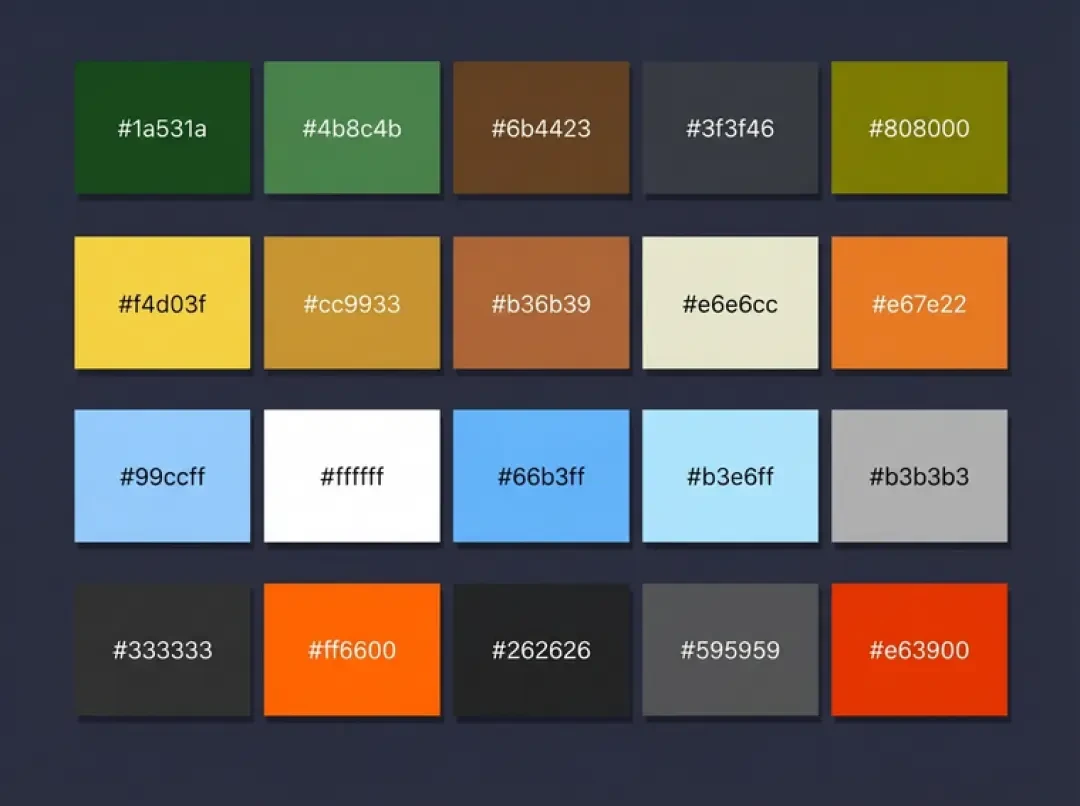
Free Low Poly Grass Textures
A grass texture tiles without a visible seam when opposite edges agree pixel for pixel. If your tile is 64x64, column 0 and column 63 must be adjacent in the real pattern, not identical. Duplicating the last column instead of wrapping it produces a one-pixel vertical stripe that repeats every tile, which reads as a grid lines artifact across a large plane. The same rule applies to row 0 and row 63. In practice you author the tile at 65x65, paint across the boundary, then crop to 64x64 so the wrap is continuous by construction.
For low poly work there are three practical grass texture variants. A tileable texture repeats across a large ground plane or a terrain mesh. An atlas packs several grass states — short, tall, dry, shadowed — into one image so a single material can switch between them by shifting UVs, which matters when you want variety without extra draw calls. A 64x64 standalone tile is the cheapest option and the one that survives compression best on mobile, because each block of four pixels covers a larger area of screen and the block artifacts stay invisible.
Grass blades in low poly worlds are almost never a texture alone. The usual construction is a crossed quad: two vertical planes intersecting at 90 degrees, each carrying a grass-clump texture with an alpha channel. The alpha cutout is what gives you blade shapes without geometry. Keep the cutout hard — a 1-bit alpha — because soft alpha edges on overlapping quads sort badly and produce visible halos when the camera moves.
Why seam-free tiling fails at distance
A tile can be perfectly seamless and still look wrong when repeated across a large area, because the eye picks up the repetition frequency rather than the seam. A single 64x64 tile stretched over 100 metres repeats at a fixed interval the player can see. The fix is not a bigger texture. It is either a second texture at a different scale blended in, or a low-frequency colour variation painted into the vertex colours of the ground mesh.
Vertex-colour variation is the cheaper answer and it fits low poly art direction. You keep one small tile, one material, one draw call, and you break the repetition by darkening and lightening patches of the ground mesh at a scale of several metres. The texture supplies grain. The vertex colours supply the large-scale pattern.
Mipmaps and compression
Generate mipmaps for any texture that will be viewed at an angle or at distance, which is every ground texture. Without them you get shimmer as the player moves. With them, a hard alpha cutout needs a specific setting: use alpha testing rather than alpha blending, and set the test threshold around 0.5. Below that, mip levels blur the cutout into a soft cloud and the grass turns into fog around the quad.
Compression matters more than resolution at this scale. A 64x64 tile with block compression stays legible because the compression blocks are a meaningful fraction of the image and the GPU reconstructs them at full size. A 512x512 tile carrying the same visual information costs more memory and compresses worse per visible feature. If a texture looks fine at 64x64, ship it at 64x64.
| Variant | Typical size | When to use it | Import cost |
|---|---|---|---|
| Tileable texture | 64x64 or 128x128 | Large ground planes, terrain base layer | One material, one draw call, tiles cleanly |
| Atlas sheet | 256x256 or 512x512 | Several grass states in one material | UV math per instance, larger memory footprint |
| Standalone 64x64 | 64x64 | Crossed-quad grass clumps, mobile targets | Cheapest to compress, block artifacts stay hidden |
| Alpha cutout clump | 64x64 with 8-bit alpha | Individual blade silhouettes on quads | Requires hard alpha and correct sort order |
Grass in Unity / Roblox / Godot
Each engine treats a grass texture differently, and the import settings that matter follow from that. Unity has a terrain grass system and a shader-based detail system; Roblox gives you a Decal or a Texture inside a SurfaceGui or on a MeshPart; Godot has a MultiMeshInstance for scattering and a shader for the material. The texture you hand each one should be authored for the slot it is going into.
Before tuning anything, decide whether your grass is a texture on a plane, a billboard that faces the camera, or a mesh. Billboards are cheapest and work for distant clumps, but they rotate as the camera moves and a hard alpha cutout makes that rotation visible on the silhouette. A mesh clump holds its shape and sorts correctly but costs triangles. Textures on planes are the middle ground and the most common choice for a low poly look.
Unity
For a crossed-quad clump, import the texture with Texture Type set to Default, Alpha Is Transparency on if you are blending, and Wrap Mode set to Repeat for tileable ground. Generate Mip Maps on. If you use a hard cutout, disable Alpha Is Transparency and rely on the shader's alpha clip threshold instead, because transparency sorting on overlapping quads is where Unity grass visibly breaks.
For a terrain ground layer, set the texture to Repeat wrap and enable mipmaps, then check the terrain's detail density and the draw distance on the grass detail. Detail distance below roughly 30 to 50 metres is where the pop becomes noticeable as the player moves; raise it until the transition is hidden or fade the detail out with a distance fade rather than cutting it off.
Roblox
In Roblox a grass texture usually becomes a Texture object on a part or inside a SurfaceGui, or a Decal. Set the face explicitly and set StudsPerTileU and StudsPerTileV to control the tiling scale rather than scaling the part, because scaling the part changes collision and physics behaviour along with the visual. For a 64x64 tile covering roughly four studs, set StudsPerTileU and StudsPerTileV to 4.
Roblox uploads textures at reduced resolution unless you upload an appropriate size, and the platform converts to its own internal format. Square power-of-two dimensions upload and tile most predictably. If your grass looks like a solid colour at distance, the texture is being sampled at a mip level where the detail has averaged out — increase StudsPerTile so the tile is physically larger on screen, or add a second, lower-frequency colour layer.
Godot
In Godot 4, a ground material is typically a StandardMaterial3D with the grass texture in the albedo slot, UV1 scale set to tile, and the texture's import preset set to Repeat. For scattered clumps, use a MultiMeshInstance3D with one mesh resource and one material, and set the multimesh's instance count rather than creating separate nodes per clump. Thousands of individually noded clumps will stall the scene tree before the GPU notices.
For a hard alpha cutout, set the material's transparency mode to Alpha Scissor rather than Alpha, and set the scissor threshold around 0.5. Alpha Scissor keeps the clumps in the opaque pass, which means no depth sorting problems between overlapping quads. That is the single setting that most often turns a broken-looking grass field into a clean one.
| Engine | Typical slot | Setting that matters most | Common failure |
|---|---|---|---|
| Unity | Terrain detail or shader on crossed quads | Mipmaps on, alpha clip threshold ~0.5 | Soft alpha blending on overlapping quads causes halos |
| Roblox | Texture object or SurfaceGui on a part | StudsPerTileU / StudsPerTileV for scale | Tiling by scaling the part breaks collision |
| Godot | StandardMaterial3D albedo, MultiMesh for clumps | Transparency mode set to Alpha Scissor | Per-clump nodes stall the scene tree |
| All three | Tileable ground layer | Wrap mode set to Repeat | Non-wrapping edges show a repeating stripe |
Generate a Low Poly 3D Character
The 3D game builder on Neta Studio takes a written description and returns a low poly 3D character as an actual mesh — blocky facets, flat shading, a small triangle budget — not a rendered image of a character. You write what the character is, and the system builds geometry you can drop into a scene, rotate, and look at from any angle. That distinction is the whole point of this section, and it is the thing to verify before you invest time in a prompt.
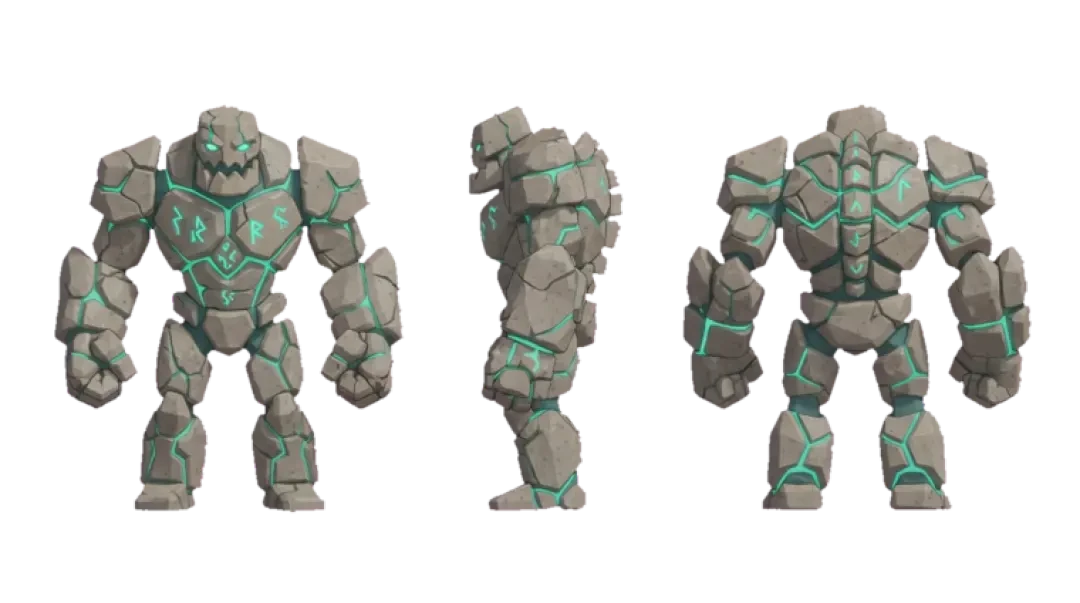
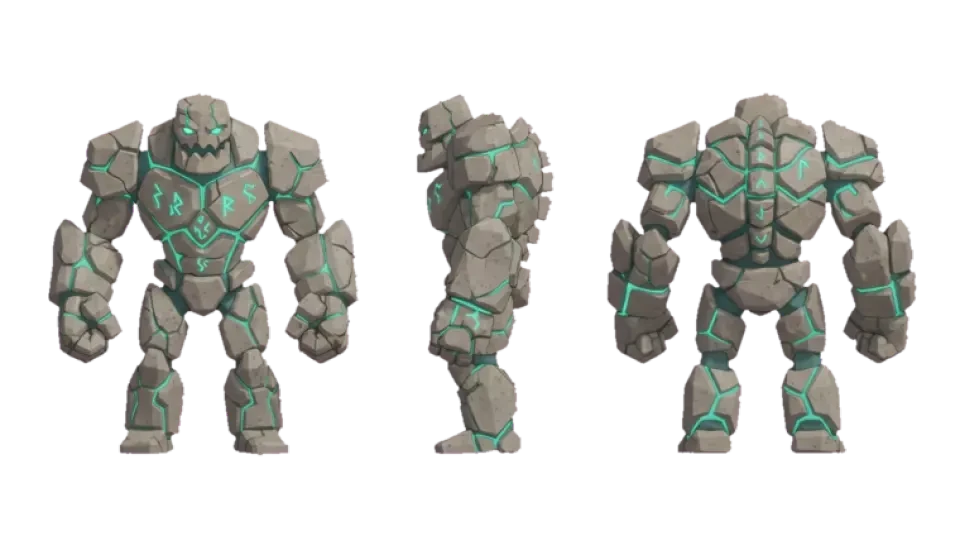
Describe the character in terms of shape and role rather than mood. A prompt like a squat stone golem with a wide chest, short legs, and one oversized arm reads better than an intimidating guardian of the deep. The builder needs geometry-relevant words: proportions, body parts, materials, held objects. Colour helps, but shape decides whether the result is usable in a low poly scene.
01
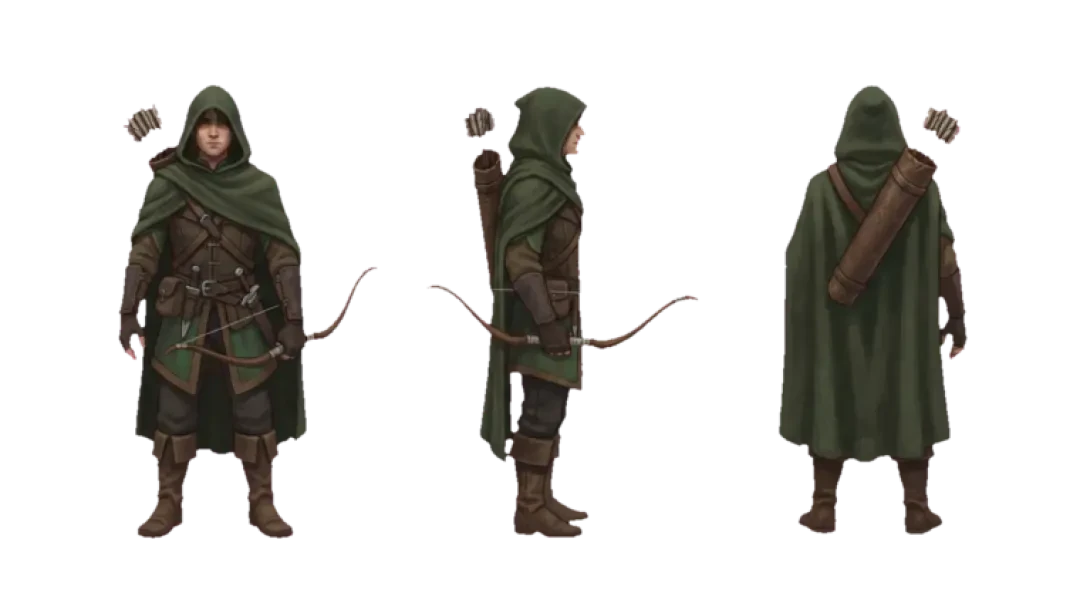
Write one sentence naming the character's role and silhouette: a tall thin scout in a hood, a round armoured brute, a four-legged desert creature.
02
Add the geometry-relevant details you care about: number of limbs, held objects, head shape, whether it has a cape or wings.
03
Name the material palette in plain terms: bone, rusted iron, dry grass, dark blue cloth.
04
Generate and rotate the result before you accept it. Check the silhouette from the side and from behind, not just the front view.
05
Regenerate with one changed detail rather than rewriting the whole prompt, so you can tell which phrase produced which change.
06
Bring the character into a world and walk the camera around it. A mesh that reads well in isolation can lose its silhouette against a busy background.
07
Export or reference the result in the engine you are targeting, and confirm the scale against your existing assets before you build around it.
Low Poly Characters vs 2D Generators
There is a specific mismatch worth naming. Some tools advertise 3D character generation but return a flat render — a picture of a character, shaded to look dimensional, saved as a PNG. It is a 2D image of a 3D-looking thing. You cannot rotate it, you cannot light it differently, and you cannot export a mesh from it. In a low poly scene the difference shows up immediately, because flat-shaded geometry responds to your scene's lighting and a baked render does not.
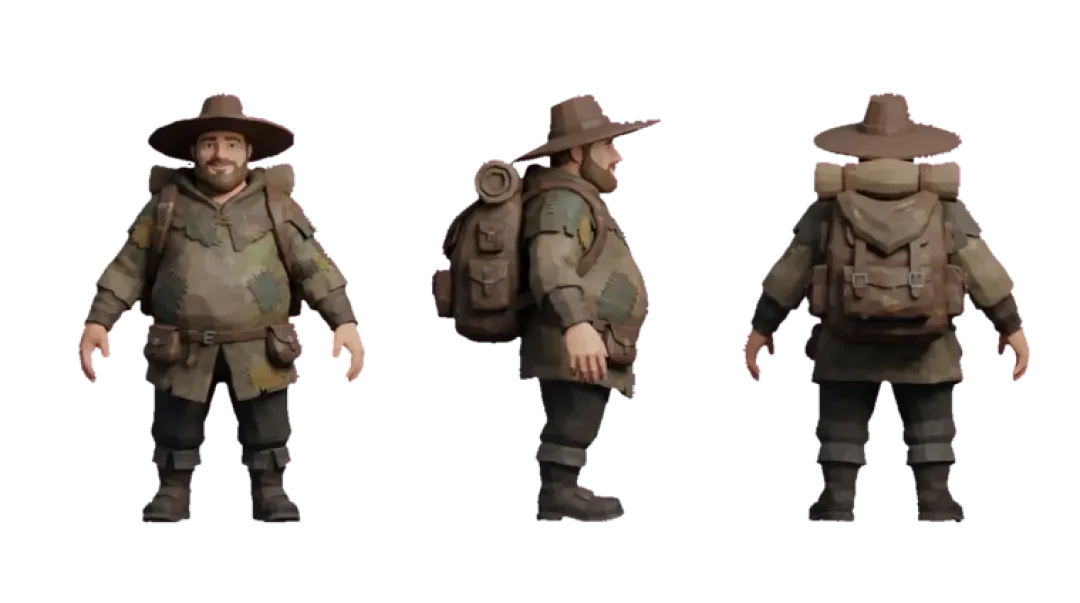
The test is simple and takes seconds. Ask the tool for the same character from two different angles. A real 3D generator returns two consistent views of one mesh, because the mesh exists. A flat generator returns two unrelated images that share a style but not a body — the shoulder shapes will not line up, the belt buckle will move, a held object will switch hands. Consistency across views is the evidence.
The second test is what you can get out. If the output is a raster image, there is no triangle count, no UV set, and no mesh to export. If the output is geometry, it has a polygon budget and can be exported as GLB. Ask before you build a workflow around it, because discovering the answer after you have authored twelve characters is expensive.
- Multi-view consistencyGenerate the same subject from front, side and back. Real geometry holds a consistent silhouette and limb count across all three; a flat render drifts in proportion between views.
- Rotatable outputOrbit the result in the viewport. If the surface shading does not change as the light direction changes, you are looking at a baked image, not a mesh.
- Exportable geometryCheck for a triangle count and a GLB export before committing. No mesh, no export — a PNG can be a texture but it cannot be a character.
- Scale in a real scenePlace the result next to a known asset. Flattened renders usually arrive at an arbitrary size with no defined origin, which you only notice at build time.
See Them in a Live Low Poly World
A low poly asset is never judged alone. A grass texture that looks good in an image editor can disappear entirely under your scene's lighting, and a character silhouette that reads cleanly on a neutral background can vanish against a busy hillside. The worlds below run live in the browser, built with the same builder described above, so you can move the camera and look at the assets in situ instead of trusting a render.
Two of our own worlds are useful reference points. Mini World is a small low poly scene where the ground tiling and the vegetation density are visible at normal play distance — useful for judging whether a 64x64 grass tile holds up or turns into a flat colour. The Cyclops' Island is larger and shows how low poly characters read against terrain and props at range, which is the test that flat renders fail. Agent Sprite Forge demonstrates the same asset pipeline applied to 2D character sprites.
When you are checking your own assets, watch the transition distances rather than the hero shots. Walk the camera backward until the grass detail stops resolving, and note where that is. If the ground visibly changes character at that distance, the mip or the detail fade needs work, and no amount of texture resolution fixes a transition problem.
Walk into the world it belongs to
A sprite is a character with nowhere to stand. The last step is the one nobody else offers: take the sheet you just built and put it in a world someone can walk around in — a small island, a planet, a rainy street corner. Every world on this site was made from one written description and published as a page you can play.
FAQ
Are the low poly grass textures free? +
Yes. The grass tiles described on this page are free to use in Unity, Roblox, Godot and other engines. There is no attribution requirement and no account needed to download them.
How do I make a grass texture tileable without a seam? +
Author at one pixel larger than your target size, paint across the boundary so the pattern continues, then crop to the target. For a 64x64 tile, work at 65x65 and crop. Column 0 and column 63 must be adjacent in the pattern, not identical, or you get a repeating stripe.
How do I set up a grass texture in Unity and in Roblox? +
In Unity, set Wrap Mode to Repeat and enable mipmaps for ground; for crossed-quad clumps use an alpha clip threshold near 0.5 instead of alpha blending. In Roblox, place the texture on a part or SurfaceGui and control tiling with StudsPerTileU and StudsPerTileV rather than scaling the part, since scaling changes collision.
How do I generate a low poly 3D character? +
Write a description that names the silhouette and the geometry-relevant details — proportions, limbs, held objects, materials — and let the 3D game builder produce the mesh. Then rotate it in the viewport to check it from several angles before you build around it.
What polygon count should a low poly character have? +
Aim for a budget, not a target: a few hundred to a couple of thousand triangles for a character that shares a screen with terrain and props. The deciding factor is whether the silhouette holds at play distance after the triangle reduction. If it does not, the geometry is wrong, not the budget.
Can I export the generated characters as GLB? +
Yes. Generated characters come out as geometry with a polygon budget, which is what makes GLB export possible. Confirm the triangle count and the export before you commit to a workflow, since flat image generators cannot produce either.
What texture size should I use for low poly grass? +
64x64 or 128x128 for most cases. A small tile compresses better, hides block artifacts at distance, and costs less memory. Only move to 256x256 or an atlas if you need several distinct grass states in one material, and check the result in the destination engine before you decide.
Back to the 3D Game Builder
All 31 finished 3D worlds, games and scenes live on one page — every one of them playable.