
Metal Gear AI Tactical Espionage Art — Key Visuals for a Soldier’s World
How to generate tactical espionage key visuals with AI: a six-clause prompt recipe, two full example prompts, a GPT Image 2 vs Krea 2 comparison and four published works from the Metal Gear: The Patriots’ Shadow world.
Generate Tactical Espionage Key Art
Describe the room, the machine and the one person in it. Get a grounded military-thriller key visual — not a poster of a generic soldier.
What Tactical Espionage Art Actually Is
Tactical espionage art sits between a war photograph and a product shot of a weapon. The subject is almost never the battle. It is the infrastructure of the battle: a hangar, a corridor, a rig, a fence line, a server room — and one operator inside it who is outnumbered by the room. The genre reads as credible because the props are specific and the light is motivated. It fails the moment it becomes a poster of a man with a gun.
That is why it is a good test for an image model. You cannot fake it with style words. The model has to hold scale (a four-storey machine next to a human), material (wet steel, salt, cable trunks), and staging (two bodies in a corridor with a clear relationship). If any of the three slips, the frame stops being a thriller and becomes a screensaver.
Why the Genre Is Harder Than It Looks
- Scale is fragile. A walker only reads as four storeys tall if there is a railing, a ladder or a person at the right distance. Miss the human reference and the machine becomes a toy.
- Material carries the credibility. Concrete has to be wet, cable has to sag, stencils have to be worn. Clean surfaces read as sci-fi illustration, not as a place where people work.
- Two bodies need a relationship. Cover, distance, eyeline and who is holding the weapon. Models love merging two figures into one silhouette, which erases the whole scene.
- Light must have a source. Sodium work lamps, red hazard strobes, a rotating beacon, a codec LED. Unnamed lighting returns grey fog.
- Restraint is the style. The moment the frame becomes painterly or anime, it stops being espionage art and becomes fan art of a different genre.
What Every Frame in This Genre Needs
Six elements do most of the work. Write them explicitly and the model stops improvising a mood and starts building a place.
| Element | What to write | Why it matters |
|---|---|---|
| Rendering system | 35mm film still, photoreal, visible grain, restrained palette | Disqualifies illustration and anime drift before the model starts |
| Composition | Wide establishing shot, high or low camera, one-point perspective | Decides whether the room or the person dominates |
| Place | Hangar, corridor, rig, bunker, mine — plus one structural detail | Gives the frame a floor, a ceiling and a reason to exist |
| Human reference | Operative from behind, full body, on a catwalk or behind cover | Makes the machine’s scale legible and gives the viewer a position |
| Wrong-physics detail | Snow through a torn roof, steam from a floor grate, sparks from a conduit | Turns a static set into a moment with time in it |
| Negative clause | No text, no watermark, no logo, no illustration, no anime | The cheapest quality control in the whole prompt |
The Six-Clause Prompt Recipe
Order matters, because each clause constrains the next. Put the rendering system first so the model commits to photography, then the camera, then the room, then the person, then the detail that implies time, then the exclusions.
Rendering system
35mm anamorphic film still, photoreal, visible film grain, cold steel-blue and sodium-orange, deep soft shadows.
Composition
Wide establishing shot, high camera looking down — or a tight low one-point corridor for a standoff.
Place
A black-site hangar carved out of a frozen mountain, a flooded service bay, a torn roof panel, crane gantries.
Subject
A lone operative in a dark grey sneaking suit, seen from behind, one hand on the catwalk rail, codec earpiece glowing.
Wrong-physics detail
Snow blowing in through the tear and landing on a machine that is standing in black water.
Negative clause
No readable text, no watermark, no logo, no illustration, no painterly style, no anime.
Example 1 — The Flooded Hangar
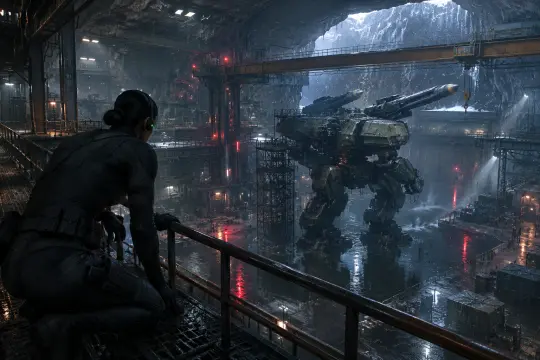
This is the exact brief behind the world key visual above. It is deliberately long: the room, the machine, the person and the weather each get their own clause, so the model cannot satisfy one by sacrificing another.
35mm anamorphic film still, photoreal, visible film grain, cold steel-blue and sodium-orange palette, deep soft shadows. Wide establishing shot, high camera looking down into a vast underground hangar of a black-site military base carved out of a frozen mountain: a four-storey bipedal walking tank with nuclear-tipped rail cannons stands in a flooded service bay at the centre, surrounded by scaffolding, crane gantries and cable trunks, snow blowing in through a torn roof panel, red hazard strobes reflected in the still black water. A lone operative in a dark grey sneaking suit and a headset crouches on a catwalk in the left foreground, seen from behind, one gloved hand on the rail, a tranquilizer pistol holstered at the thigh, a codec earpiece glowing faint green. Wet concrete, oil drums, stencilled crates, drifting steam, volumetric searchlights, quiet observational framing, low contrast haze. Restrained military-thriller realism, cinematic depth of field. No readable text, no watermark, no logo, no illustration, no painterly style, no anime.
Why That Frame Works
- Three planes. Catwalk, flooded bay and rock ceiling are separate, so the eye can measure the room.
- A human ruler. The operative is full-body and back-lit; without that figure the walker would read as a tank with legs.
- Water as evidence. Reflections under the machine prove it is standing in the bay instead of floating in front of it.
- Weather in the room. Snow entering through a torn roof tells you the base is damaged and still running.
Example 2 — The Corridor Standoff
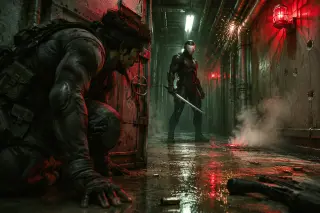
The second brief is harder because two bodies, a prop and a single corridor can collapse into a blur at once. Give each body a fixed relationship to the architecture and the frame holds.
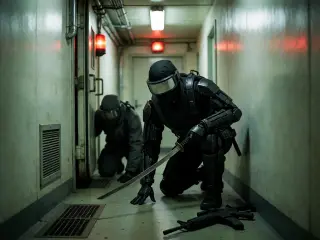
35mm film still, photoreal, visible film grain, crimson emergency light against cold fluorescent green, heavy shadow. Tight corridor composition, low camera, one-point perspective down a narrow service corridor of a nuclear disposal facility: a lone operative in a dark grey sneaking suit kneels behind an open blast door, one hand pressed flat to the wet floor, while a cybernetic ninja in a matte-black exoskeleton and a cracked white visor blocks the corridor ahead, a long katana held low, sparks falling from a severed ceiling conduit. Steam venting from a floor grate, fresh bullet impacts in the wall, a discarded rifle on the floor, a red rotating beacon strobing across both figures. Handheld documentary framing, tense stillness between moves, shallow focus on the ninja’s visor. Grounded military science-fiction realism, cinematic grain. No readable text, no watermark, no logo, no illustration, no painterly style, no anime.
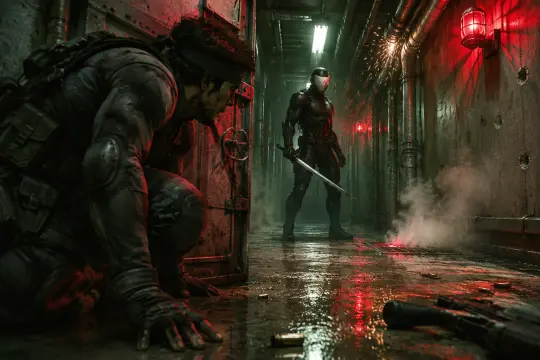
GPT Image 2 vs Krea 2 on the Same Brief
Both models received identical prompt text and produced one comparison pair per scene. Nothing was rewritten between models, which is the only way the test means anything.
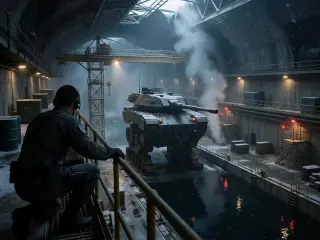
- GPT Image 2 — the room explains itselfDepth, water, reflections, secondary light sources and props that imply history. Slower and more expensive per image, and the better choice when the viewer must understand the situation.
- Krea 2 — the frame advertises itselfCleaner silhouettes, colder flatter palette, one clear subject. Faster and roughly one-seventh the cost, and the better choice for thumbnails, cards and title frames.
- Hangar verdictGPT Image 2 for the establishing shot; Krea 2 for the poster cut. The difference is water and secondary props, not genre understanding.
- Corridor verdictGPT Image 2 wins clearly. Krea 2 merged the operative and the cyborg into one armoured figure, which deletes the human-versus-machine idea the scene exists for.
The Workflow, End to End
Pick an operator and a fortress
The operator sets the silhouette, the fortress sets the light rig. Write both names into the prompt instead of describing a generic soldier.
Write the six clauses
Rendering system, composition, place, subject, wrong-physics detail, negative clause — in that order, no style-word soup.
Render the hero on GPT Image 2
1536×1024, quality high, PNG. Give it the long brief and let it spend the budget on material and depth.
Render the poster on Krea 2
1024×768 or 1024×1024 on the identical text. Compare silhouettes, not detail.
Fix the brief before the seed
If the scale slips, add a railing or a ladder. If the bodies merge, name their cover and their distance. Re-rolling rarely fixes a missing clause.
Publish inside the world
Attach the work to the world with its prompt and model, so the frame becomes reusable material instead of a one-off image.
Common Failure Modes and Fixes
- A toy machine. The walker has no human ruler. Add a railing, a ladder, a person on a catwalk at a stated distance.
- Dry, clean concrete. The genre lives in wet steel. Keep the flooded bay, the steam and the strobe reflections.
- Merged bodies. Name who is behind what. “Kneels behind the open blast door, left foreground” beats “facing a cyborg”.
- Unmotivated glow. If every surface glows, nothing does. Assign one red beacon and one sodium lamp and make the rest fall off.
- Illustration drift. Move the 35mm film clause to the front and repeat the negative clause verbatim.
- A poster with no room. If the frame is only a figure, you have made a character portrait. Put the architecture back in.
How This World’s Cards Feed the Prompt
The Metal Gear: The Patriots’ Shadow world is built so you never have to invent a plausible detail from scratch. Each card gives you a look, a position and a pressure point, and those three things are exactly what a prompt needs.
Start With a Room, Not a Soldier
The fastest way into this genre is to describe the room first and let the operator walk into it. Pick a fortress, name three materials, choose one light source that fails, and put one person at the edge of the frame. That is already a tactical espionage key visual — the models will do the rest.
Start Creating
Two scenes, two models, four published works — now build the room only you would choose.
This use case was written against the Metal Gear: The Patriots’ Shadow world and its four published works. Every example prompt on this page is the real prompt used for the image above it. Metal Gear is a fan-built world in Neta Studio and is not affiliated with Konami. Open the studio to reuse the cards.