
Metroid AI World Generator — Build a Sci-Fi Hunting World From One Brief
Use Neta Studio as a Metroid AI world generator: turn one sentence into a sci-fi hunting world with characters, locations, events and factions, then render key visuals with GPT Image 2 and Krea 2.
Generate a Metroid-Style World From One Sentence
Describe the containment failure at the centre of your story and Neta Studio builds a world with factions, rooms and a timeline behind it, then renders the key visual that proves the world exists.
What a Metroid AI World Generator Actually Does
A prompt gives you a picture. A world generator gives you the argument underneath the picture: who wants the thing, who is guarding it, who is lying about it, and what it costs to walk into the room. For Metroid-style science fiction that distinction matters more than usual, because the canon is not really about a monster. It is about a containment system that everyone keeps trying to turn into a weapon.
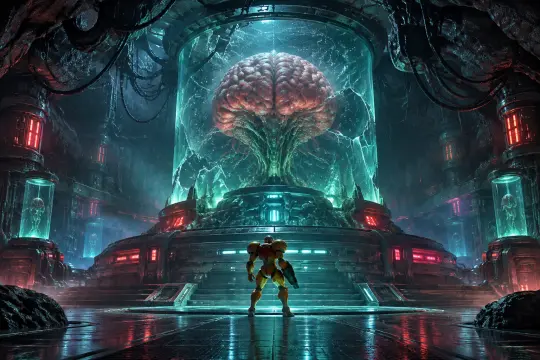
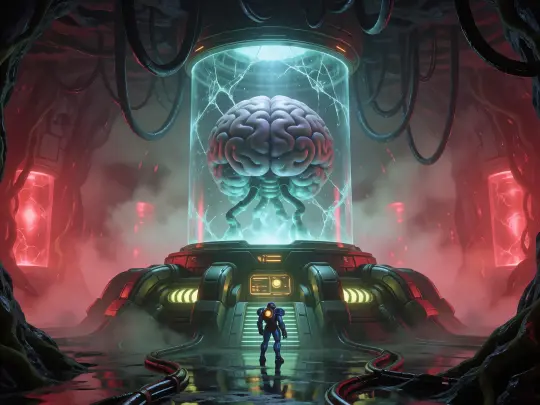
On Neta Studio you describe that system in one sentence, and the studio expands it into atoms — characters, locations, events and factions — that stay editable. Render key visuals from those atoms, compare models on the same brief, and publish the result as a world other people can fork. The four images on this page were generated inside this world and linked back to it.
The practical difference shows up on the second frame. With a prompt library you rewrite everything to change the room. With a world you change one card — the planet, the faction in charge, the thing being contained — and the palette, the politics and the props stay consistent. That is what makes a set look authored instead of sampled.
Why This IP Works Better Than a Generic Sci-Fi Prompt
“Sci-fi planet” is a mood. “A quarantine world where the predator was bred to contain a parasite, and both escaped” is a premise. The Metroid canon has an unusually clean causal chain — a species builds a guardian, the guardian decides its makers are the problem, an army moves in, a government copies the research, the copy fails — and every link suggests a location, a character and a scene. It also carries a visual grammar that survives prompting: carved stone against welded steel, wet floors, one warm subject in a cold room, magenta alarms, and machinery that is grown rather than assembled.
- A premise with a cost. Every faction wants the same object for a different reason, which means every conversation is a negotiation.
- Places that are arguments. A cathedral built to house a computer, a station that simulates biospheres it does not own, a floating city still polished by its makers' machines.
- An heir, not a hero. Samus inherits her armour, her enemies and a debt; that gives a generated world a protagonist with a stake before you write a line.
- A clock. The timeline gives you six events that already happened and one that is about to.
The Three Things Every Metroid-Style World Needs
Strip the canon to its load-bearing parts and three things remain. Get them right and the world generates plot on its own; miss one and you get a monster with no politics, or a politics with no monster.
Start From the Canon, Then Change One Variable
A generated world gets boring when everything is canon and useless when nothing is. The productive middle is to keep the structural relationship — guardian, contained thing, institution — and change exactly one variable. Change the planet and you get a new biosphere. Change the institution and you get a new politics. Change what is contained and you get a new genre inside the same visual language.
| Canon element | Change this | What it generates |
|---|---|---|
| Chozo containment system | What is being contained | A new horror: a memetic signal, a self-replicating metal, a dead god's maintenance routine |
| Galactic Federation | Who runs the research division | Corporate science, a military faction, a religious order with a budget |
| Space Pirates | What they trade instead of salvage | Labour, data, bodies, weather — each one produces a different kind of raid |
| Tourian | What the cathedral is built around | A reactor, a choir, a seed vault, a prisoner that is also the building |
| Samus | What the suit inherits | A debt, a bloodline, a language, a war that has not started yet |
Build the World in Five Moves
Write the containment sentence
One sentence with three nouns: the thing contained, the guardian built for it, and the institution that wants it opened. That sentence is your world seed.
Let the studio expand it
The studio proposes characters, locations, events and factions. Read the cards in order — rules first, then factions, then places, then people.
Cut to twenty-six atoms
Eight characters, six locations, six events and four factions is enough for a world and small enough to hold in your head. Delete anything that does not create a scene.
Render two frames on two models
Write one character brief and one location brief. Send each to GPT Image 2 and to Krea 2 without rewriting between models. Publish all four as works of the world.
Publish, compare, fork
Attach the frames to the world with their prompts, share the world, and let the next person fork it. The comparison is the marketing and the documentation at once.
Example Briefs You Can Paste
- The quarantine moon. A moon where a gelatinous parasite copies the crew of a mining station, and the only creature that can hunt it was bred by a vanished civilisation and is now illegal to own.
- The maintenance city. A floating Chozo city whose drones still enforce a curfew nobody remembers voting for, and the salvage crew that wakes a district to strip it.
- The salvage fleet. Space pirates recover a containment vessel with the lid still sealed, and discover the seal was a warning rather than a lock.
- The homecoming. A bounty hunter returns to the colony that sold her to the fleet that burned it, carrying the last suit her makers ever finished.
- The clean station. A federation research platform simulates six biospheres it does not own; by the time the alarm sounds, four of them are already inside the crew.
Case Study: Samus Aran in the Varia Suit
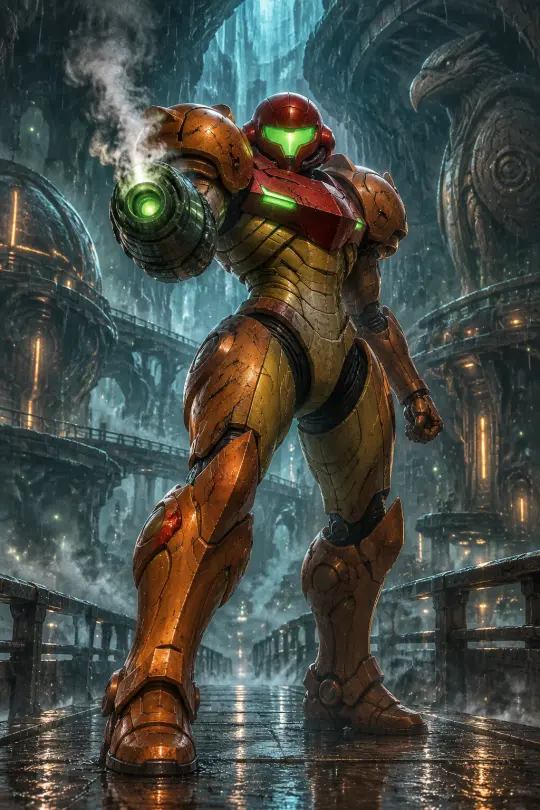
The character brief is six clauses long and names an object in almost every clause: the Varia suit, the green visor, the arm cannon, the steam vent, the segmented pauldron, the ribbed Chozo corridor. That density is deliberate. A character generated from adjectives becomes a generic armoured figure; one generated from equipment becomes a specific one. The pose matters as much as the costume — cannon raised, barrel venting — because an action already in progress is what separates a poster from a costume test.
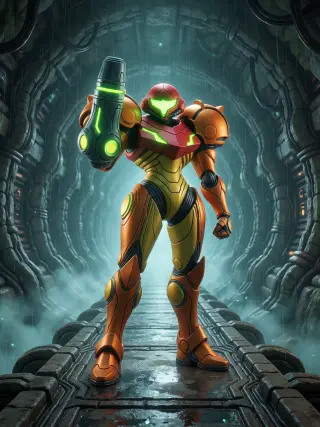
GPT Image 2 produced the world-bible frame: the corridor has depth and the armour has repairs. Krea 2 produced the cover: the figure holds at thumbnail size and the light does the storytelling. Both are correct answers to the same brief, which is why both are published.
Case Study: Tourian and the Machine at the Bottom
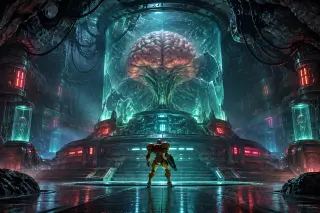
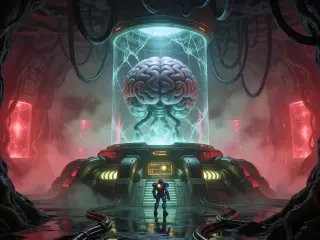
The second brief tests the opposite skill. No human subject fills the frame; the subject is a room with an institution inside it. A cracked containment cylinder, a circular dais, red alert strips, cabling that hangs like roots, and one armoured figure small enough to be a unit of measurement. This is where a world earns its keep: the location card already knows Tourian was built to house a computer and converted into a throne, so the brief can ask for a cracked glass cylinder instead of an “evil sci-fi lab”.
Keeping a Set Consistent Across Dozens of Frames
- Two materials only. Carved Chozo stone and welded Pirate steel. If a third material appears, it must be water.
- One warm subject. Orange-and-red armour, amber lanterns, or a single warning light. Never two competing warm keys.
- Wet floor, cold room. Reflections come from water and mist, not from polished chrome.
- Scale object. A human-sized silhouette at the bottom of the frame so the architecture can win.
- Fixed negative clause. No text, no watermark, no HUD, no signage. The same sentence at the end of every brief.
Model Choice: GPT Image 2 or Krea 2
The honest answer is “both, for different jobs”. GPT Image 2 is the better world-builder because it resolves objects: a cracked cylinder stays cracked, a cable has a route, a pauldron has a seam. Krea 2 is the better cover-maker because it resolves meaning: it decides what the frame is about and commits, which is exactly what a thumbnail needs.
| What you need | GPT Image 2 | Krea 2 |
|---|---|---|
| A room that feels physically real | Strong: depth, materials, object count | Softer: rooms become stages |
| A cover that reads at thumbnail size | Good with a simple composition | Strong: contrast, silhouette, mood |
| Small narrative props | Strong: vents, cracks, cables, scars | Selective: keeps four shapes, drops six |
| Cost per usable frame | Higher per attempt, fewer re-rolls for detail | Low, fast, good for exploration |
| Best role in a set | World bible, location plates | Covers, posters, mood tests |
From World to Playable Scenarios
Publishing and Remixing
Publishing is part of the workflow, not an afterthought. The world is public, its works are attached to it, and every work keeps the prompt and the model that produced it, so the page becomes a working document. Forking is the point: these four renders are one argument about how Metroid should look, and a fork can argue the opposite by changing the palette, the planet or the model while keeping the world's shape.
One sentence → atoms → character and location briefs → two models, four works → world page → fork
Metroid AI World Generator FAQ
Do I need to know the Metroid canon to use this? +
No. You need three nouns: something contained, a guardian built to contain it, and an institution that wants it opened. The canon is a very good worked example of that structure.
How many atoms should a world have? +
Twenty to thirty is a good working range. This world uses twentysix: eight characters, six locations, six events and four factions. More than that and nobody can hold the world in their head.
Which model should I start with? +
Start with Krea 2 to find the mood cheaply, then use GPT Image 2 for the frame you will publish. Publish both if the page is about the comparison.
Can I publish a world with one image? +
You can, but a pair is more convincing. Two models on one brief proves the world is a set of decisions rather than a lucky render.
Is this affiliated with Nintendo? +
No. It is a fan-built world using publicly known canon, published to document a generation workflow.
Build a Metroid-Style World
Start with a lock, an heir and an institution that wants the lock open. Twenty-six atoms later you have a world you can render, play and fork.