Piskelapp Alternative — A Free Browser Sprite Tool That Also Builds 3D
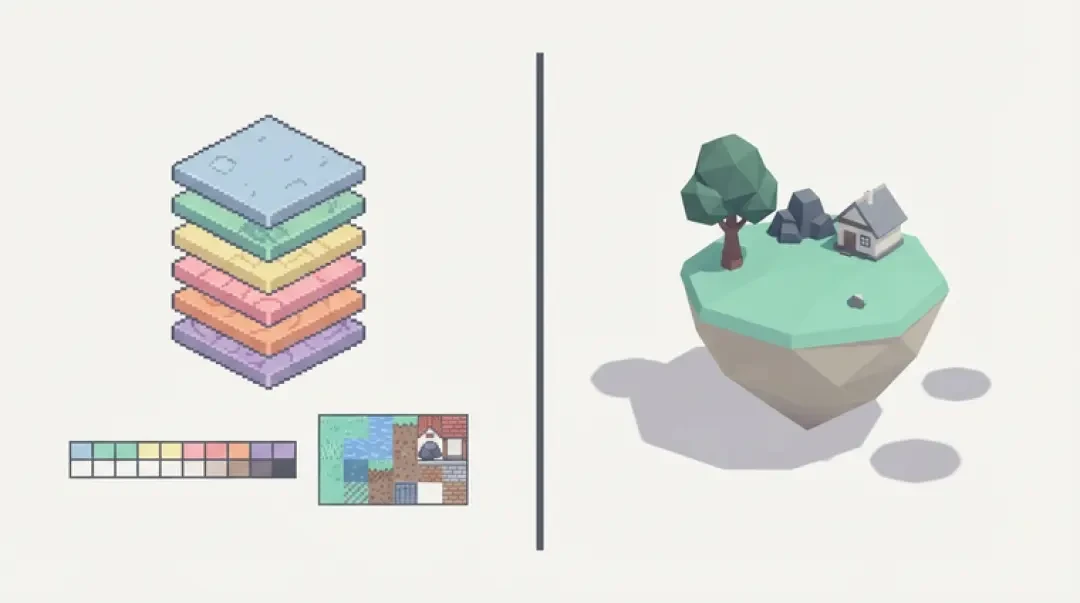
Make your own piskelapp alternative
Searching piskelapp? That is the Piskel domain — the free browser pixel editor. Here is what it does, what it does not, and a browser sprite tool that also gives you a 3D world.
If you typed piskelapp into an address bar, you already found Piskel: piskelapp is the domain of the free browser pixel-art editor. So 'piskelapp alternative' and 'piskel alternative' are the same question asked two ways. There is no separate product called PiskelApp. The name people remember is the address.
This page is the honest version of the answer. What Piskel does well on a fixed pixel grid. Where it stops. What a browser sprite tool adds when the sheet has to stop being a picture and become a material in a scene you can walk around in. No rankings, no download counts, no invented benchmarks — the mechanism, the file settings, and the failure modes.
Quick Answer
piskelapp is the domain of Piskel, the free browser pixel-art editor — so 'piskelapp alternative' and 'piskel alternative' are usually the same question. Nothing about the tool changed when the domain became the name people remembered. The app is Piskel. The query is a hostname.
The question behind the query is almost always one of two things. Either you want the same job done in a tool that has moved on — a faster canvas, more layers, a save that follows you to another machine — or you want something Piskel was never built to be: a generator that produces frames, and a scene builder that gives those frames somewhere to live.
Those are different uses of your time. If you draw every pixel by hand and you like Piskel's grid, switching editors costs you muscle memory and gains you very little. If your bottleneck is that a walk cycle eats an afternoon, no 2D editor fixes it, because the bottleneck is drawing, not the editor.
What 'piskelapp alternative' is really asking
Strip the domain out and the sentence is 'I need a sprite tool.' That splits into three requirements that get confused constantly: drawing, where a human moves pixels; generation, where a model draws frames from a written description; and assembly, where frames become a sheet, the sheet becomes an animation, and the animation becomes a scene. Piskel covers the first well and part of the third. It has no opinion about the other two.
Decide which one is your bottleneck before you switch anything. Most people who leave Piskel for another 2D editor come back, because the second editor is also a grid and a toolbar.
What piskelapp (Piskel) Is
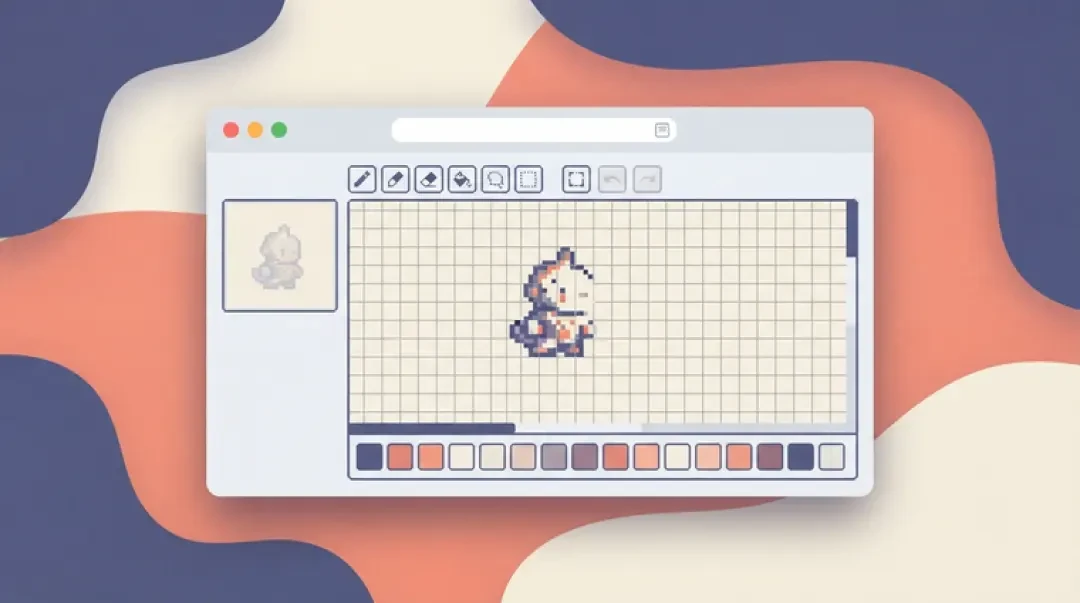
Piskel is an in-browser editor for pixel art. You open the page, set a canvas size — 32×32 is the default and still a reasonable choice — and draw on a zoomed grid with a pencil, a bucket, a dither, a lighten and a handful of other tools. Nothing installs. No account is created. The editor runs client-side, so once the page has loaded, drawing does not wait on a network round trip.
The parts that earned it its position are the ones people name in the same breath: onion skinning, so you can see the previous and next frames behind the current one at reduced opacity while you animate; palette controls, so you can build a fixed set of colours and keep every frame inside it; a preview pane that plays the animation at a set frame rate and size; and a small layer stack per frame.
Export is where it is genuinely useful, and it is the part most worth understanding if you are shopping for a replacement. You can export the current frame or all frames as individual PNGs, export an animated GIF, export a sprite sheet as one PNG at a chosen column count, row count and integer scale, or save the project as a .piskel file, which is a JSON document describing frames and palette.
- Onion skinDraws the previous and next frame behind the current one at low opacity. You control the opacity and which neighbours show. This is the single feature that makes hand-animated loops possible rather than guesswork.
- PaletteCreate or import a palette, then keep every frame inside those swatches. The index order matters later: it is what you carry into a shader or a palette-swap routine.
- Sprite sheet exportOne PNG, your column count, your row count, an integer scale. This is the file an engine or a 3D scene actually consumes.
- GIF exportAnimated GIF with a per-frame delay. Good for sharing a loop, awkward for games: GIF caps at 256 colours per frame and 1-bit transparency, so soft edges come back either hard or gone.
- .piskel project fileThe save format is JSON holding frame data and the palette. It reopens in Piskel. It does not open in other editors.
- No accountThere is nothing to log into. The project lives in the tab, in browser storage, and in whatever files you download.
Why People Search the Domain Instead
Because the product name is a domain. People who half-remember the tool type the thing that looks like an address, and the browser or the search box completes it. A brand that is also a hostname generates domain-shaped queries indefinitely, and those queries stay stable even when nobody is writing about the product.
The second reason is that the tool has changed very little. The grid, the toolbar, the onion skin controls, the export dialog: they are recognisably the same as they were years ago. That stability is exactly why people still recommend it. It is also why there is little to write about. New features generate new pages; a stable editor generates a stable, slowly aging set of pages, and the domain query keeps arriving with nothing new behind it.
The practical effect is that a search for the domain returns a mix of the app itself, old tutorials, and listicles written before the current state of browser tooling existed. That gap is the reason this page exists. It is not that Piskel got worse. It is that the surrounding category grew a generation step and a 3D step, and Piskel did not, because it was never pointed at them.
Where Piskel Stops
These are checkable limits rather than complaints. Each one is a thing you can verify in an afternoon.
The limit that matters most is the missing path from a finished sheet to a running scene. Piskel hands you a PNG. From there you are in engine territory: import settings, filter mode, atlas padding, pivot points, frame rectangles, animation clips, collision boxes. That work is real, and it is where a two-hour art task turns into a two-day integration task.
- No generation stepPiskel draws what you draw. There is no prompt field, no reference upload, no model proposing frames. If you need a walk cycle in eight directions, you are drawing eight directions.
- No 3D outputThe output is raster frames. There is no mesh, no camera, no scene graph and no lighting. A sheet used in 3D is a texture you attach, cut and align yourself.
- No cloud projectNo account means no server-side project. Move to another machine and you are importing a downloaded file. Clear the wrong browser storage and the tab-local copy is gone with it.
- No runtimePiskel plays your animation in a preview pane at a fixed frame rate and stops there. It does not run input, physics, collisions or a camera.
- Integer-only scalingExport scale is an integer multiplier for a reason. A 32×32 sprite drawn at 1.5× produces pixels that are alternately one and two screen pixels wide. The editor cannot fix that; the fix is nearest filtering plus an integer zoom at display time.
Piskel vs a Browser Sprite Tool
The table compares the two on the rows that decide a project. Every cell describes a mechanism, not a score. If a row does not affect how you work, ignore it.
Read the rows in order of how much they cost you. Animation is cheap to compare, because both tools animate. Cloud save and 3D output are the rows that change the shape of the work, because they decide whether you can hand art to someone else and whether the art has anywhere to go once it is finished.
When a piskelapp alternative is worth the switch
Switch when the blocking step is generation or integration. That means one of two situations: you cannot draw the volume of frames the project needs, or you can draw them but the sheet never reaches a scene because nobody wants to hand-configure an atlas, pivots and clips for every character.
Do not switch when you enjoy drawing and you only need a GIF or a sheet. Piskel's grid is good and its export dialog does what it claims. Time spent evaluating a replacement for a tool that already fits your hands is time you did not spend animating.
| Dimension | Piskel (piskelapp) | Browser sprite tool with 3D |
|---|---|---|
| Platform | Browser, client-side, no install, no account | Browser, no install; project tied to an account |
| Generation | None. Every pixel is drawn by hand | Describe a sprite or a sheet in one sentence and generate frames |
| Animation | Frame-by-frame timeline, onion skin, GIF and sheet export | Frames drawn on a shared grid, exported as sheet plus atlas data |
| Cloud save | None. Tab storage plus downloaded .piskel and PNG files | Projects stored server-side, reopenable from another machine |
| 3D output | None. Raster frames only | The sheet is emitted as a material into a 3D scene you can walk in |
| Cost | Free and open source | Free in the browser, no install step |
Generate a Sprite Here
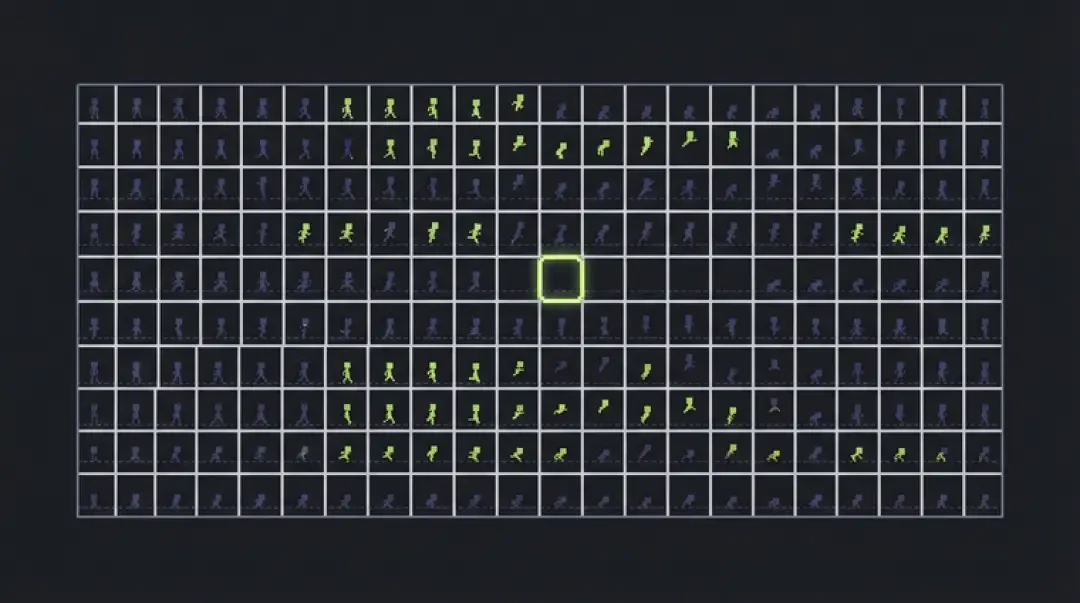
Generation is the half that does not exist in Piskel, so it is worth being specific about what actually happens. You write one sentence. Agent Sprite Forge resolves it into a subject, a view, a palette and a frame count, then rasterizes each frame onto the same grid at the size you selected. Because every frame shares one grid and one palette, the results pack into an atlas without per-frame nudging.
The failure modes are predictable, which is useful. Ambiguous view words produce frames that flip between two readings — 'facing forward' on a character that also has a walk direction will do it. High frame counts at small canvas sizes leave very little room per frame: eight frames at 16×16 gives you roughly a hundred pixels of drawing area each, so detail turns into noise. Sheets that mix silhouettes generated under different palettes look like two characters stapled together. In all three cases the fix is the sentence, not the model.
Export mirrors what you already expect from a sprite tool: individual PNGs, one packed sheet with a column and row count, an animated GIF for review, or an atlas carrying frame rectangles, pivots and a suggested frame rate. From there the sheet goes either into your own engine or straight into the world editor on the same page.
- PNG sheetOne image, frames laid out at your column and row count. This is what an engine or a texture loader wants first.
- Atlas dataFrame rectangles, pivot points and a suggested frame rate, so the animation plays without anyone hand-building a clip.
- Per-frame PNGsFor when you want to retouch one frame in a pixel editor and re-pack the sheet yourself.
- GIFA quick review artefact. It carries the same 256-colour and 1-bit transparency limits as any GIF.
01
Write one sentence with three parts: subject, action, view. 'A one-eyed crab knight, side view, idle and walk' beats 'crab knight sprite' every time.
02
Choose frame size and frames per animation. 32×32 is a workable default for a top-down or isometric tile; go to 64×64 only when the character needs readable hands or a weapon.
03
Generate with Agent Sprite Forge. Every frame is drawn on the same grid and inside the same palette, so nothing has to be realigned afterward.
04
Review frame by frame. Regenerate the individual frames that read wrong instead of the whole sheet — a full re-roll moves the good frames too.
05
Lock the palette before you add the next animation, so idle and walk do not drift apart in hue after a second pass.
06
Export: individual PNGs, one packed sheet PNG with columns and rows, a GIF for review, or an atlas with frame rectangles, pivots and a frame rate.
From Sheet to World
A sheet is not art yet. It is a texture. In an isometric scene the sheet is uploaded once, the frames are cut into UV rectangles, and those rectangles are what the renderer swaps as the animation advances. Two settings do most of the work. Texture filtering stays nearest so pixels stay square, and the atlas gets one or two pixels of padding around each frame so that any filtering at distance does not pull a neighbouring frame's colours into the edge pixels — the usual cause of a coloured fringe on a character's outline.
The camera is the second half. Pixel art reads correctly under an orthographic camera at an isometric angle, roughly 2:1 — a 32×16 tile footprint at about 30 degrees of pitch. Switch to a perspective camera and sprites in the distance shrink faster than the ground grid, which looks wrong even when nothing is technically broken. Zoom in integer steps: 1×, 2×, 4×. A 1.5× zoom will show you one-pixel and two-pixel rows inside the same sprite.
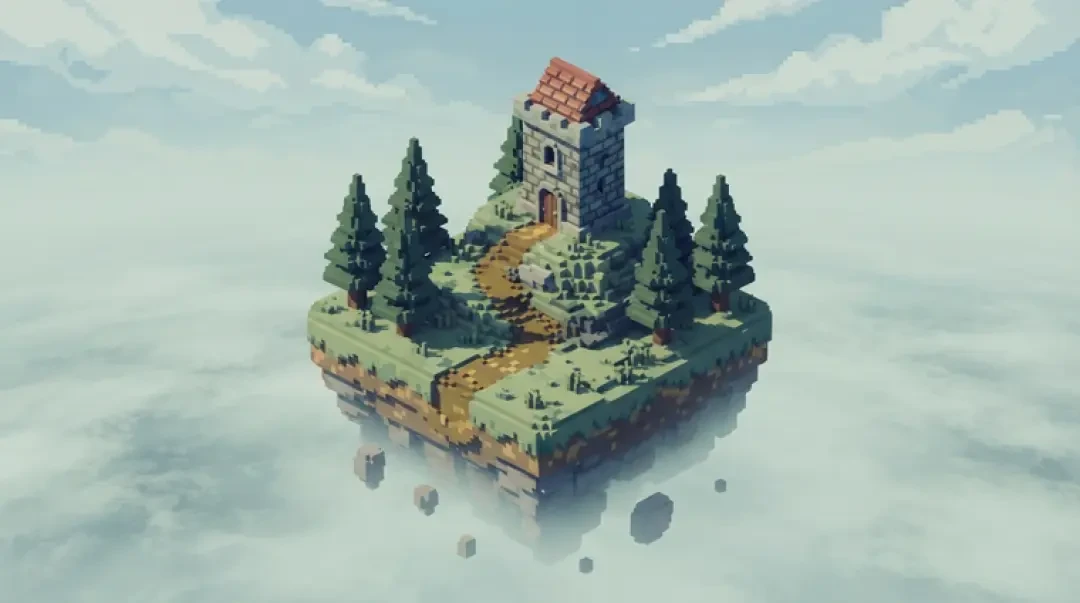
Physics and shadows are the parts people underestimate the first time. A billboarded sprite is a flat quad that always faces the camera, so it cannot receive a real projected shadow; the ground contact is a separate soft blob decal drawn under the character. Collisions are cheaper as a grid of blocked tiles than as mesh colliders — the agent walks a path across the grid and the tile it stands on decides whether the step is allowed. The Cyclops' Island in Neta Studio is built this way, and Mini World is the smaller version of the same loop: generate a sheet, drop it into a tiled scene, walk around it.
- Nearest filteringKeeps sprite pixels square. Bilinear filtering on a 32×32 sprite gives you soft, muddy edges that nothing downstream can recover.
- Atlas paddingOne to two transparent pixels of extrude around each frame prevents colour bleeding at the edges once mipmaps are enabled.
- Orthographic cameraMatches the pixel grid at every distance. A perspective camera breaks the relationship between sprite scale and tile size.
- Blob shadow decalA billboard cannot receive a projected shadow, so the ground contact is drawn rather than simulated.
- Tile-grid collisionBlocked-tile lookups are fast and predictable. Mesh colliders on a tiled world cost more and buy nothing.
Walk into the world it belongs to
The domain question has a short answer and a long one. The short one is: it is Piskel, and it is a 2D editor. The long one is what happens after the sheet is finished — open a world built from the same pixels and see the step an editor stops before.
FAQ
Is piskelapp the same as Piskel? +
Yes. piskelapp is the domain the editor is served from, not a second product. Searching either term lands on the same free browser pixel editor.
Is Piskel still free? +
Yes. It is free and open source, with no account and no install. There is no paid tier to upgrade into.
Is Piskel discontinued? +
No. Development is slow and the feature set has been stable for years, so treat it as finished rather than abandoned. It keeps working and it keeps not gaining new capabilities.
Can I open my Piskel file in another tool? +
Not directly. The .piskel save file is a JSON project document specific to Piskel. Export frames or a sprite sheet as PNG and import that instead; our builder accepts PNG sheets and atlas data.
What is the best free alternative to Piskel? +
It depends on your bottleneck, not on a ranking. If you only need to draw pixels and export a GIF or a sheet, Piskel does that job and switching buys you little. If you need frames generated from a description, or you need the sheet to end up inside a 3D scene, use a browser sprite tool that generates frames and a 3D game builder that accepts them — that combination is what Agent Sprite Forge and the builder here are for.
Can I make a 3D game from 2D pixel art? +
Yes. The common approach is billboards: flat quads that always face the camera, inside a 3D scene with an orthographic camera, so the pixel grid survives. The sheet becomes a texture, frames become UV rectangles, collisions live on a tile grid, and the ground shadow is a drawn decal because a billboard cannot receive a projected one.
Back to the 3D Game Builder
All 31 finished 3D worlds, games and scenes live on one page — every one of them playable.