
Princess Mononoke AI Art Generator — Forest Gods, Iron Towns, and Wolf-Girl Key Visuals
How to generate Princess Mononoke-style key visuals with a real world behind them: character and location prompt recipes, a reusable skeleton, five failure modes, a 20-minute workflow, and a GPT Image 2 vs Krea 2 comparison on identical prompts.
Princess Mononoke AI Art Generator: Make the Forest and the Forge Look Like One World
Most "anime forest" prompts produce the same four things: a torii gate, a lantern, a fox, and fog. They do not produce a place with an economy. This page is about making art from a built Mononoke-style world instead — a setting where the forest is a deity with a legal claim, the town is a factory with a waiting list, and every image has to show which one is winning.
Everything here comes from one world: 26 editable materials, four published key visuals, and two models run on identical prompts. You can copy the prompt skeleton, steal the palette, or start from the studio and change the characters. The point is not to imitate a film frame. The point is to make a frame that could only come from this setting.
What You Can Make With This World
The world supports six kinds of image without any extra invention. Each one uses a different pair of cards, which is why the results do not collapse into the same picture.
Three Style Pillars That Keep It From Looking Generic
Pillar one is hand-painted cel animation: flat colour fields, visible brush edges, a deliberately limited palette, and no photoreal skin. If the model gives you glossy rendering, the world stops reading as a drawn place. Say "hand-painted anime cel" early in the prompt, not at the end.
Pillar two is earth palette plus one impossible light. Moss green, iron black, clay red, undyed cloth — and then a single pale blue-white source that does not belong to the sun. That light is the god. If you light the whole image evenly, you lose the argument between the natural and the sacred.
Pillar three is scale inequality. A human should never be the largest thing in a forest frame. Put a figure at the base of a cedar, a wolf behind a girl, a god behind a pool. The moment the person fills the frame, the world becomes a portrait and the forest becomes wallpaper.
A Mononoke-style image is not a picture of nature. It is a picture of two systems competing for the same square of ground.
Why a Built World Beats a One-Line Prompt
A one-line prompt can give you a girl in a wolf hood. It cannot tell you that the hood is a kill, that the wolves are her siblings, that the spear is for a town she has never entered, or that the town burns wood because people live there. Those facts are what make the next image different from the last one.
Choose a card
A character, a location, an event. Read the description. It contains the costume, the light and the social stake in plain language.
Choose a beat
Decide what is happening in the next ten seconds. Arriving, hiding, striking, refusing. A card plus a beat is a scene.
Prompt the contradiction
Name the two things that do not fit: the rifle and the bow, the furnace and the moss, the human face and the antlers. That is your composition.
Write back what you learned
If the image shows San standing a certain way, put that in her card. The world accumulates specificity; a prompt library only accumulates styles.
Character Prompts That Hold the Line
Do not describe a mood. Describe a body in a place with a job. The four leads need different prompt ingredients because they belong to different visual systems.
Location Prompts: Iron Town vs the Sacred Pool
The two locations are the world's thesis in visual form, so prompt them as opposites. Iron Town is dense, warm, horizontal, made of wood and smoke. The Sacred Pool is open, cold, vertical, made of water and light. If you use the same adjectives for both, you get two postcards from the same resort.
The Model Comparison, Read Properly
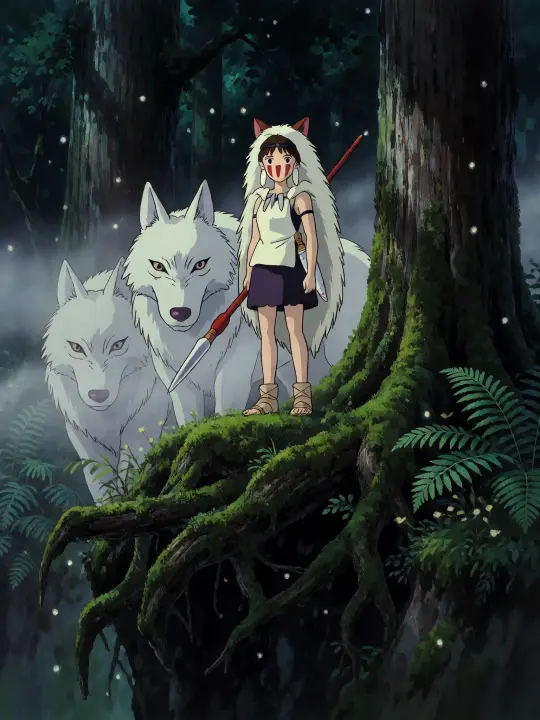
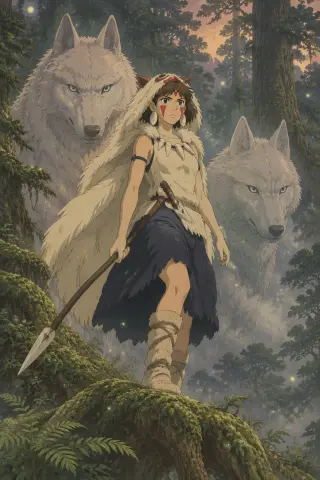
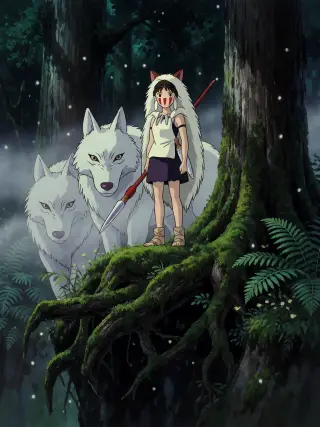
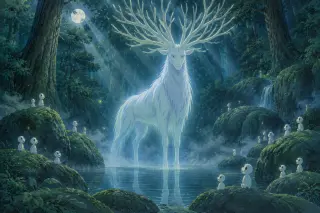
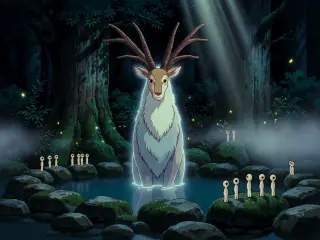
The same two prompts were run on GPT Image 2 and Krea 2. On San, GPT Image 2 produced a three-plane dusk scene with a detailed pelt, a wrapped spear grip and two wolves held in mist; Krea 2 produced a flatter night poster with clean cel shapes, a red spear shaft and glowing mushrooms. On the pool, GPT Image 2 built a wide landscape with the god deep in the frame and kodama scattered across the rocks; Krea 2 moved the camera closer, simplified the antlers, and lined the kodama up like a choir.
- When GPT Image 2 winsScenes that need to explain a place: a town with a gate and a furnace, a pool with a waterfall and a far bank, a costume with seams and fastenings. It is the better illustrator of a described space.
- When Krea 2 winsImages that need to work at thumbnail size: a centred figure, a strong silhouette, two or three values, a graphic prop. It is the better poster designer and it is an order of magnitude cheaper per image.
- The tell on facesGPT Image 2 holds the human face on the Forest Spirit, which is the unsettling part of the design. Krea 2 tends to soften it into a gentle animal. If the human face matters, say so twice and check the result.
- The tell on scaleGPT Image 2 keeps the god inside the landscape; Krea 2 makes the god the landscape. Decide whether you want a place with a god in it, or a god with a place around it.
A Prompt Skeleton You Can Reuse
Fill the brackets from the world's cards. Keep the order: the model weights early clauses more heavily, and style must arrive before subject or it will be overridden by detail.
Princess Mononoke [character or location] key visual, hand-painted anime cel style, muted earth palette: [subject + costume + props]; [companion or crowd]; [environment and weather]; [one impossible light source]; [composition and camera height]; [aspect and exclusions].
A filled example, using San: "Princess Mononoke character key visual, hand-painted anime cel style, muted earth palette: San, the wolf-raised girl, white wolf-pelt hood and cloak, red war paint, bone dagger, spear; two white wolves in the mist behind her; moss-covered cedar root above a ravine at dusk; warm last light at the horizon and cold green shadow under the canopy; low camera, vertical poster; no text, no watermark." That is the prompt that produced both San images on this page.
Five Mistakes That Make It Look Generic
A 20-Minute Workflow
Minute 0–3: pick the argument
Choose two cards that disagree — Iron Town and the Great Forest, San and Eboshi, the god and the hunters. The image is the space between them.
Minute 3–7: write the ten clauses
Style, subject, costume, props, companion, environment, light, palette, composition, exclusions. Do not write paragraphs.
Minute 7–12: run both models
Identical prompt. Portrait 1024×1536 for characters, landscape 1536×1024 for places. Compare at thumbnail size first, then full size.
Minute 12–17: repair one thing
Pick the single worst element — a hand, a wolf's eye, a missing stump — and rewrite only the clause that controls it. Do not rewrite the whole prompt.
Minute 17–20: file it back into the world
Note what the image established. A new detail in a card is worth more than a folder of unused variations.
Questions About Making Mononoke-Style Art
Do I need a reference image?
No. Both models here worked from text only, and Krea 2 does not accept references at all. A reference helps when you need a specific face or costume repeated, but the world cards are doing the consistency work that a reference folder usually does.
Can I make a whole comic this way?
Yes, if you keep the palette and the scale rule fixed and change only the beat. The usual failure is letting each panel pick its own light. Decide the time of day for the sequence before you generate panel one.
What if the model adds modern objects?
Add an exclusion clause: "no modern objects, no plastic, no electric light, no text". Then check the frame for a zipper. This world has rifles and iron, so the error is usually a modern firearm shape rather than an anachronism in the clothing.
Make the next frame from the world
The forest is built, the town is lit, and the wolves are already in the mist. Generate your own key visual — or open the studio and change who is standing on the root.
These key visuals were generated from this world's materials and published inside it. Princess Mononoke is an independent, fan-built world in Neta Studio and is not affiliated with Studio Ghibli. The key visuals on this page were generated inside this world; every character, place and event is an editable material rather than canonical text. Open the studio to read every card.