
The Best AI Underwater Survival World Generator for Ocean-Planet Settings
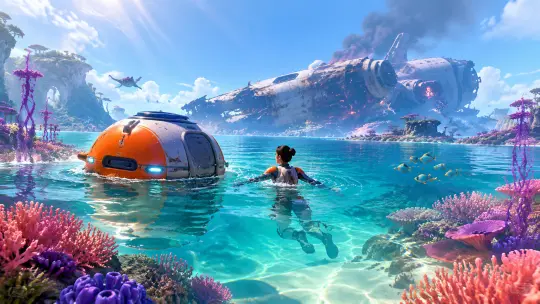
Build an ocean-survival world with AI: the water column, vertical difficulty curve, survival loops, leviathan scale and a two-model key-visual workflow, using Subnautica: 4546B and four published frames as the worked example.
The Best AI Underwater Survival World Generator for Ocean-Planet Settings
Most “underwater world” prompts produce the same image: blue water, a diver, a whale, some god rays. It is beautiful and completely unusable, because nothing in the frame implies a game, a story or a decision. An ocean-survival world needs a water column you can descend, a surface you cannot trust, a resource loop that forces movement, and one creature large enough to make the map feel like a body.
This page is the working method behind Subnautica: 4546B, rebuilt as an editable AI world on Neta Studio. It covers what to specify, what to leave out, which model does which job, and how to tell that a generated ocean is a setting rather than a wallpaper.
An ocean world is not a background. It is a pressure system with a story in it — and every good one can answer three questions: how deep am I, what do I need, and what is down there that knows I am here?
Why Ocean Survival Is the Hardest World to Generate
Land worlds have landmarks. Oceans have gradients. A model asked for a forest will give you trees, a path and a horizon; a model asked for an ocean will give you an even field of blue and then fill the emptiness with fish. The result looks correct and has no spatial information in it. You cannot tell where the floor is, which way is up, how far the light reaches, or what would happen if you swam ten meters in any direction. The fix is to prompt the water as architecture: specify the surface relationship, the bottom material, the visibility and the light source before you specify a single creature. Once those four are fixed, the model has a room to put things in, and the image starts behaving like a place.
What a Good Underwater World Has to Ship With
A usable ocean setting is a small machine with five moving parts. Miss one and the world collapses into scenery.
A surface relationship
The player must know how far help is. A lagoon with the sky in reach is a tutorial; a shelf with no floor is a commitment. State it in the prompt and in the world rules.
A vertical map
At least three depth bands with different light, pressure and resources. Depth is the pacing device; if everything is at the same level, there is no plot.
A survival loop
Oxygen, water, food, power, hull integrity. Pick two to be scarce and make every route between them cost something. Four scarce resources is a spreadsheet, not a game.
One scale creature
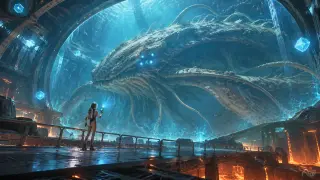
A leviathan that is larger than the room it is in. Scale needs a witness: put a human body at the rail so the player understands how small they are.
A reason not to surface
A quarantine, a storm, a radiation belt, a debt. If going up solves the problem, the ocean is just a level, not a world.
Build the Water Column Before You Build the Monster
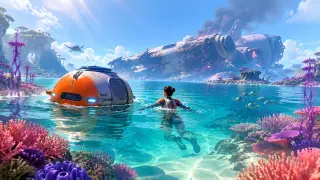
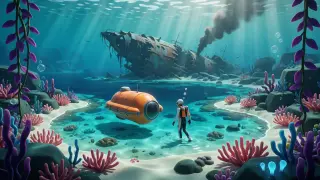
The water column is the single most useful prompt structure in underwater work. It has four named layers: surface (sky, swell, glare), sunlit zone (god rays, caustics, readable color), twilight zone (blue-grey, silhouettes, particles), and dark zone (bioluminescence, lava seams, nothing else). Describe which layers are in frame and where the camera sits inside them. Only then add the subject: a creature placed in a described column inherits the column's physics — it is lit from above, hazed at distance and scaled by the particles around it, while a creature placed in generic blue is a sticker. This is also why the two published Safe Shallows frames read so differently: GPT Image 2 keeps the camera at the surface layer, Krea 2 drops it into the sunlit zone and rebuilds the scene around that decision.
The Five Layers of a 4546B-Style World
This is the order we use when building a new ocean world. Each step produces something the next step can stand on, and each one can be forked independently.
Layer one: the planet rule
One sentence that explains why the ocean is the whole map. On 4546B it is a quarantine platform that destroys anything entering or leaving, which turns “go up” into a lethal plan.
Layer two: the vertical map
Name three to six biomes by depth and function, not by color. Nursery, wreck, shelf, channel, vault, ice cap. Function first; the palette follows.
Layer three: the survival loop
Choose two scarce resources and one escalating cost. Oxygen and power, with depth as the cost, is enough to generate an entire game of decisions.
Layer four: the residents
One ecology, one intelligence, one infection. The ecology makes the map alive, the intelligence makes it personal, the infection makes it urgent.
Layer five: the exit
The ending must be a place, not a button. On 4546B the exit is a rocket built from a wreck, launched through a gap in a machine that has to be cured first.
Depth Is a Difficulty Curve, Not a Color Palette
The most common mistake in AI ocean worlds is treating depth as a filter: shallow equals cyan, deep equals navy. That produces a gradient, not a game. Real depth changes what is possible: light stops reaching the bottom, so navigation becomes local; pressure limits equipment, so the vehicle becomes a prerequisite; resources change with the biome, so the player is forced to travel. Write the map as a list of permissions instead. The shallows permit breathing, building and mistakes. The reef permits travel but not repair. The lost river permits passage but not retreat. The lava zone permits arrival but not survival without preparation. Once the map is a list of permissions, the prompts practically write themselves.
Survival Loops, Not Set Dressing
A survival loop is a circle the player is willing to run. Oxygen sends you up; power sends you down; food sends you sideways; hull damage sends you home. The world only becomes a game when those circles overlap and the shortest path through one costs progress in another.
Generating the world and writing the loop are the same act if you prompt for affordances instead of objects. “A fabricator bolted to a flooded habitat wall, one empty water bottle beside it” is a loop. “A futuristic underwater base” is set dressing. The image should imply the next action.
Prompt affordances
Ask for the object plus its state: a half-charged battery, a patched hull, a locker already open. State is what makes a prop interactive.
Leave one route visible
Every establishing shot should show a way forward and a reason to hesitate. A tunnel, a hatch, a lit corridor with something moving at the end of it.
Keep the surface in one frame
Players need a reminder of what safety looks like. One surface shot per biome set keeps the descent legible.
Make failure visible
A cracked visor, a dead beacon, a habitat with the lights still on and nobody inside. Failure states teach the rules faster than success states.
Isolation Without Boredom
Isolation is the genre's signature emotion, and it is also the fastest way to lose an audience. A world with nobody in it is a screensaver. The trick is to keep one voice present: a radio that only receives, a log left by someone who did not make it, a leviathan that speaks inside your skull. Company does not have to be friendly to be company. 4546B uses three kinds of voice: the Degasi logs are the past talking, the radio and the Sunbeam are the present failing to arrive, and the Sea Emperor is the future asking a favour. Between them, the player is never alone and never safe, which is the exact emotional register an ocean world should aim for.
The Leviathan Rule: Scale Needs a Witness
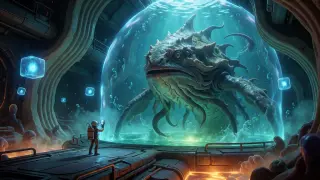
A giant creature is only giant if something normal is in the frame. Every leviathan image needs a human body, a vehicle, a doorway or a known object at the correct distance. Without a witness, the model renders a big animal and the viewer renders no fear.
The rule also governs composition. Put the witness low and small, let the creature occupy the upper two-thirds, and let the environment cut the creature off at the frame edge. A leviathan that fits entirely inside the image is a diagram. A leviathan that continues past the border is a presence.
Prompting an Ocean World in One Pass
This is the full structure we use for a single establishing frame. It is long because it is complete; once you have it, the variations are one-line edits.
Medium and ratio
Stylized semi-real 3D game key visual, 16:9, clean geometry, semi-realistic material detail, non-photographic surfaces.
Camera and layer
Say where the camera is: at the surface, just below it, on a shelf edge, inside a vault. The layer determines the light.
Water column
Surface swell or ceiling, god rays, caustics, particle density, visibility distance. Name the color of the water at three distances.
Place from nouns
Pink coral, purple creepvine, white sand, torn hull plating, ribbed alien arches, floating ion cubes. Five to seven nouns is a scene; fifteen is a catalog.
One body and one fact
A lone diver chest-deep beside a lifepod; a tiny figure at a rail with a scanner raised. Then the fact: the ship is still burning, the shield is still holding.
Exclusions
No text, no logos, no interface elements, no HUD, no watermark. Underwater prompts attract fake readouts; remove them explicitly.
Which Model for Which Job
We run every brief through GPT Image 2 and Krea 2 because they fail in opposite directions. GPT Image 2 is a cinematographer: it builds depth, keeps the horizon, respects scale and renders materials with weight; it is slower and more expensive, and it will happily overpopulate a frame with particles and fish if you let it. Krea 2 is a graphic designer: it composes for the thumbnail, simplifies geometry, moves the camera to the strongest angle and gives you ten ideas for the price of one GPT Image 2 frame; it is also weaker on incidental text and less interested in physical accuracy. That is a feature during exploration and a problem during final art.
Explore with Krea 2
Generate eight to ten compositions of the same brief. Pick the silhouette that reads fastest. Do not judge detail at this stage.
Finish with GPT Image 2
Take the winning composition, rewrite it as a precise physical brief, and generate at the final ratio. Add the witness, the light and the exclusion clause.
Never compare different prompts
If the two models get different words, you learn nothing about the models. Keep the prompt identical and change one variable at a time.
Publish both
A paired set is more useful than a single hero image: it shows the range of the world and gives the audience a real choice about which direction to fork.
Publishing, Remixing and Keeping the Canon Straight
An ocean world grows by accretion: one biome, one creature, one event at a time. Keep a short canon file — the planet rule, the depth bands, the palette, the names — and check every new atom against it. The moment two frames disagree about how deep the light reaches, the world stops feeling like a place and starts feeling like a mood board.
Then publish the prompts alongside the images. A world that shows its working is forkable; a world that only shows the result is a gallery. The four frames in this set are published with their model and brief so anyone can run the same experiment and get a different ocean.
Generate Your Own Ocean World
Four published frames, two models, one vertical map. Start from 4546B or build a planet of your own.