
The Best AI Akira Anime Key Visual Generator — Neo-Tokyo from One Sentence
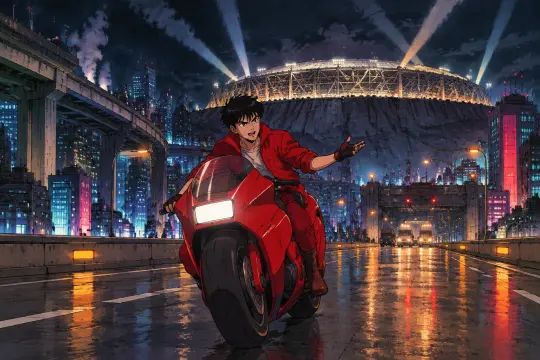
The best AI Akira anime key visual generator: render Neo-Tokyo highways, crater stadiums and psychic awakenings with GPT Image 2 and Krea 2. Proven on the Neo-Tokyo 2019 world with four published works.
Generate an Akira Anime Key Visual
A city on a crater, a stadium that should not exist and a boy who has stopped obeying the room — one brief, two models, four published key visuals.
What Is an Akira Anime Key Visual Generator?
An Akira anime key visual generator is a text-to-image pipeline that produces poster-grade art for stories about a rebuilt megacity, a military experiment and a teenager who wakes up with enough power to erase the skyline. The subject is not a fantasy kingdom and not a generic cyberpunk street. It is recognisable 1980s theatrical anime — hand-painted backgrounds, cel characters, hard highlights — pointed at one impossible event in a place that looks like it has a municipal budget.
Why Neo-Tokyo Is Hard to Prompt
Most models fail in one of two directions. Either they produce generic neon cyberpunk — purple haze, rain, kanji signage, a lone trench coat — which reads as a stock wallpaper and not as Akira. Or they produce a perfectly ordinary city with the word anime in the prompt and no visual argument at all. The first is decoration; the second is a photograph with a filter.
Neo-Tokyo needs a third thing: a specific piece of infrastructure under a specific pressure. An elevated highway with a stadium on the horizon. A hospital corridor with a gurney that has stopped touching the floor. A crater that the city has paved around but not filled. The model needs objects it can hold, not adjectives it can style.
Three things separate an Akira key visual from a generic cyberpunk still. Legibility, because the viewer must be able to name the impossible thing in one glance. Material, because the road has to look wet and the steel has to look painted. Scale, because a rider must be small against a stadium and a boy must be small against a corridor.
The Test World: Neo-Tokyo 2019
Every claim on this page was tested against a real canon: the Neo-Tokyo 2019 world in Neta Studio. It has eight characters, six locations, five events and four factions — Kaneda, Tetsuo, Akira, Kei, Lady Miyako, Colonel Shikishima, Kaori and Joker; the elevated highway, the Olympic Stadium, the Old Tokyo Crater, Harukiya, Lady Miyako’s Temple and the Nursery; the Fall, the Reconstruction, the Akira Project, Tetsuo’s Awakening and Akira Reborn.
Era 2019, thirty-one years after the Fall · Tone loud, wet, elegiac · Look 1980s theatrical anime, hand-painted cel · Palette sodium orange, cyan neon, wet slate, red jacket · Atoms 23 editable cards
What the Comparison Proves
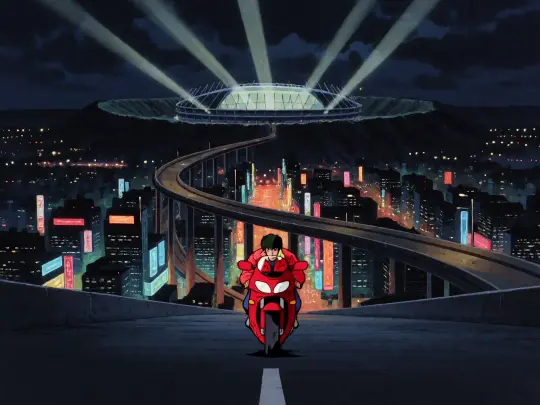
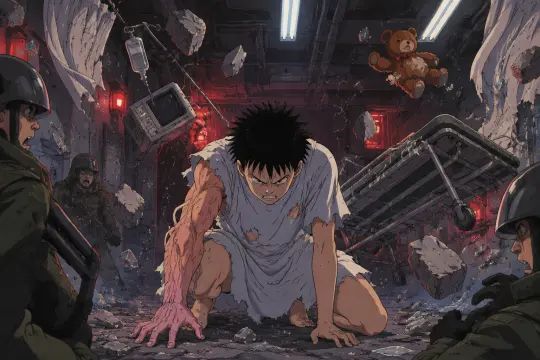
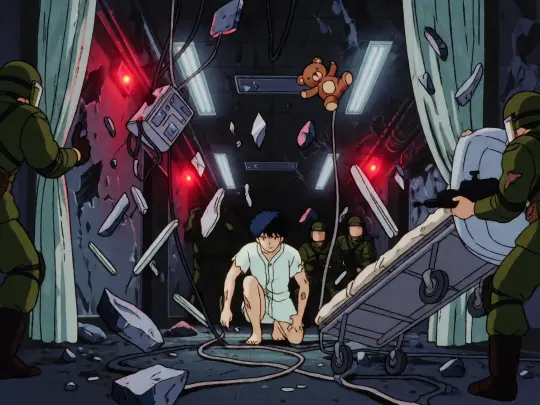
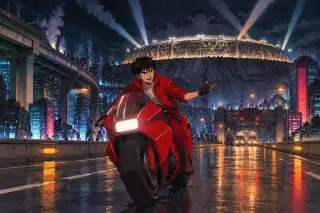
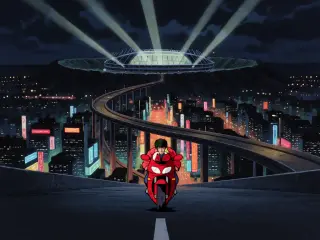
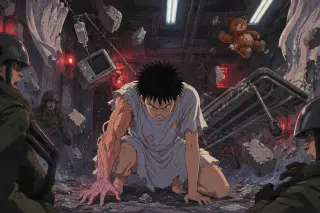
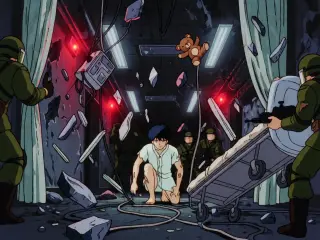
The same two briefs were run through GPT Image 2 and Krea 2. GPT Image 2 produced the document: lane paint and guardrails that survive the wet reflection, a stadium truss with individual members, cargo trucks stopped at a checkpoint, veins in Tetsuo’s arm, a teddy bear with a torn seam. Krea 2 produced the poster: a road reduced to one clean ribbon, a stadium reduced to a glowing ring, a corridor reduced to a symmetrical stage with soldiers as framing devices.
The Six-Part Brief
Every prompt in this world is built from the same six clauses in the same order. The order is not decoration; it is how you keep a comparison honest. If the structure never changes, the differences you see belong to the model rather than to your wording.
Medium and genre
1980s theatrical anime key visual, hand-painted cel animation, cinematic wide shot. This locks the rendering system before anything else is described.
Place
Name a real piece of infrastructure and a real building type: an elevated concrete highway, a floodlit Olympic stadium on a crater rim, a sealed hospital corridor.
Subject
One person, one vehicle or one body. A nineteen-year-old in a red jacket on a red motorcycle; a pale sixteen-year-old in a torn gown.
Operation
State the one broken law: the stadium sits on the crater it was built to hide, the corridor has lost gravity, the arm has become a pressure vessel. One verb, no adjectives.
Physics and light
Wet asphalt reflecting sodium lamps, steam from vents, red emergency light against cold fluorescent tubes, torn curtains lifted by pressure.
Negative clause
No text, no watermark, no logos, no modern glossy rendering. Removing the wrong century is what keeps the frame in 1988.
Clause by Clause: The Elevated Highway
The first test frame used the highway because it is the most legible establishing shot in the canon. A road is a direction. Put a stadium at the end of it and the whole image becomes an argument about where the city thinks it is going. The trick is to keep everything on that road: lane paint, guardrails, overhead gantries, wet reflections, a checkpoint with actual vehicles.
Working prompt. 1980s theatrical anime key visual, hand-painted cel animation with hard specular highlights and dense hand-painted backgrounds, cinematic wide shot: Neo-Tokyo at night in 2019, a rebuilt megacity of elevated concrete highways and neon canyon streets standing on the crater of the old capital; a nineteen-year-old gang leader in a bright red jacket rides a red sport motorcycle down the elevated highway toward camera, lean and cocky, one hand off the bars; behind him the floodlit Neo-Tokyo Olympic Stadium rises over the crater rim, searchlights sweeping the clouds; steam from vents, wet asphalt reflecting sodium orange and cyan neon, distant military checkpoint lights, a vast dark sky; 1980s anime film cel, visible paint texture, strong rim light, high contrast, dramatic perspective, epic scale, no text, no watermark, no logos.
GPT Image 2 answered with a road you could drive: the lane markings continue under the bike, the guardrail catches the lamp light, the stadium is planted on a rock face rather than floating in a skybox, and the checkpoint has trucks in it. Krea 2 answered with a composition you could print: a dark hill, a ring of light, a swooping road and a rider reduced to a red shape at the bottom of the frame. Both are correct; they are doing different jobs.
Clause by Clause: The Awakening Corridor
The second test frame used the awakening because it tests the body rather than the city. A hospital corridor is a container for one direction; take that direction away and the human figure becomes the only stable object in the frame. The prompt must describe contact precisely — knees on the floor, one hand planted, a gown torn at the shoulder — or the model produces a boy flying, which belongs to a different genre.
Working prompt. 1980s theatrical anime key visual, hand-painted cel animation with hard specular highlights, cinematic interior: Tetsuo Shima, a pale sixteen-year-old in a torn white hospital gown, crouched in the center of a wrecked military laboratory corridor beneath the hospital; his right arm is swollen with veined psychic energy, a halo of broken concrete, glass and medical equipment floating around him, wires and torn curtains lifted by pressure; red emergency lights and cold fluorescent tubes, soldiers in riot gear frozen at the edges of the frame, one gurney overturned, a shredded teddy bear drifting; 1980s anime film cel, visible paint texture, deep shadows, strong rim light, claustrophobic composition, no text, no watermark, no logos.
The word crouched is doing most of the work. It implies weight, contact and effort, which is exactly what separates an Akira frame from a superhero frame. The teddy bear is the second signal: it is cheap, familiar and clearly a child’s object, so the audience instantly understands that the thing in the middle of the room is still a kid.
Common Failures and Fixes
Most failed Akira prompts fail for one of four reasons, and each has a specific repair. None of them require a better model; they require a more concrete sentence.
Cyberpunk drift: purple haze and rain-slick trench coats — add 1980s theatrical anime, hand-painted cel, and name the municipal infrastructure. Nostalgia blur: a soft retro filter with no readable subject — add one operational verb and one witness at human scale. Superhero pose: the boy floats instead of crouching — specify knees, palms and contact with the floor. Empty city: a beautiful skyline with no story — add a checkpoint, a gurney, a bar or a temple, and put a person in front of it.
Detail or Atmosphere: Choosing a Model
Choose GPT Image 2 when the frame must survive a crop: store pages, thumbnails, UI cards, reference sheets, anything where architecture and material need to stay legible at small sizes. Choose Krea 2 when the frame is doing emotional work: a hero image, a share card, a poster where the gesture and the colour block matter more than the bolts on the guardrail.
The practical rule is to generate the establishing shot on both models and let the smaller crop decide. If the story is still readable when the image is 400 pixels wide, the poster model won. If the story needs the gurney wheels and the torn seam on the bear, the document model won.
The End-to-End Workflow
Start from the world, not from a blank prompt box. Open the Neo-Tokyo 2019 world, read the location entry you want to visualise, and copy its nouns into the six-clause template. Generate the same brief on both models, publish both frames as works of the world, and only then decide which one belongs on the page. The comparison is the content; the single hero image is just the winner.
Open the world
Start at the Neo-Tokyo 2019 studio and pick one location: the elevated highway, the Olympic Stadium, the Nursery, the crater, Harukiya or the temple.
Use the location’s own objects
Copy the nouns from the atom card — guardrails, gurney wheels, IV stand, teddy bear, searchlights, checkpoint barriers — into the place and physics clauses.
Write the six clauses
Medium, place, subject, operation, physics and light, negative clause. Keep the order identical for both models.
Render both models
Generate at the final ratio, publish both as works of the world, and record the prompt and model on each work.
Decide in public
Compare the two frames at thumbnail size, then keep both. The losing frame is the best argument for the winning one.
Explore the World
The world is public, the twenty-three atoms are editable, and the four key visuals are already published. Fork it, change the price of a mistake, move the stadium to a different crater, or generate the frame that finally shows what Kaneda sees when he looks at Tetsuo and decides to keep riding. The comparison is the invitation: add the next frame and let someone else argue with it.
Build Your Own Neo-Tokyo Frame
Four published key visuals, one world, two models — your turn to add the next frame.