
The Best AI Anime Esper Key Visual Generator — What Actually Works
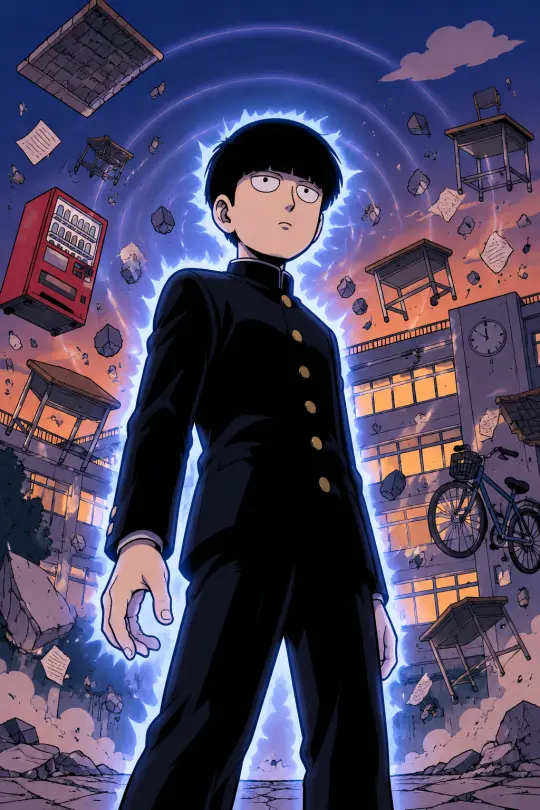
A practical evaluation of AI anime esper key visual generators using the Mob Psycho 100 world: prompt criteria, GPT Image 2 vs Krea 2, four published works, and a repeatable publishing workflow.
What an Anime Esper Key Visual Actually Has to Do
An esper key visual is not a picture of a person with glowing eyes. It is a picture of a person who is trying not to do something. The power is interesting because it is emotional, and the frame has to show the effort of restraint before it shows the release. That is a different brief from a superhero poster, and most generators fail it in the same way: they render the explosion and forget the boy.
The Four Criteria That Matter
Legibility at thumbnail
Can you name the impossible event in one second at 300 pixels wide? If not, the frame is a wallpaper, not a key visual.
Human scale
Is there a body in the frame that tells you how large the event is? A floating building means nothing without someone standing under it.
Material honesty
Do the uniform, the concrete, the vending machine and the roof tiles each behave like their own material? Flat colour is a style; mush is a failure.
Restraint
Does the frame avoid glow, particles and haze long enough to look like a place? The best esper images are brightly lit and deeply wrong.
Why Mob Psycho 100 Is the Right Test Case
Mob Psycho 100 is unusually demanding for an image model because its power moments are quiet. The canonical 100% event is not a beam of light. It is a schoolyard where the furniture has started to drift. The palette stays ordinary, the sky stays a flat comic blue, and the horror comes from the fact that nobody in the frame is screaming.
That gives us a clean test. A generator that can make a floating desk look heavy, a black gakuran look like wool, and a boy’s blank face look like a decision is doing real work. A generator that can only make glow is not.
Criterion One: Legibility at Thumbnail Size
Most key visuals are consumed at card size. A world page, a share link, a gallery tile, a search result: all of them crop the frame down to a rectangle the size of a business card. If the impossible event is a thin aura around a small figure, it disappears. If it is a vending machine floating above a boy, it survives.
Criterion Two: Human Scale
An esper image needs a witness. The witness can be the esper, a bystander, a rival, or a pair of shoes at the edge of the frame. What matters is that the viewer gets a ruler. Without one, the image becomes abstract and the power stops being frightening.
Criterion Three: Material Honesty
Flat cel shading is not an excuse for mush. The best frames in this world keep materials separate even when the palette is reduced: wool uniform, painted concrete, plastic vending machine, chrome bicycle, paper. A reader does not need photorealism. They need to believe that the objects would make different sounds if they hit the ground.
Criterion Four: Restraint
The fastest way to ruin an esper key visual is to ask for an aura. The word pulls in glow, particles, lens flares and a colour grade from a completely different franchise. The fix is to describe the effect physically: air distorted into concentric rings, dust suspended, objects lifted, shadow unchanged. Those are visible facts, and they keep the frame in the world.
GPT Image 2 vs Krea 2 on the Same Brief
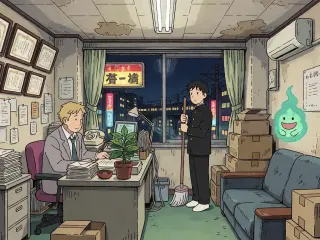
We ran two prompts through both models. The prompts were identical. The aspect ratios were matched to each model’s native range. The results are published as four works, so the comparison is inspectable rather than asserted.
Fix the world
Same 28-atom Mob Psycho 100 world, same character cards, same style preset (bold line comic).
Fix the prompt
One character poster, one interior scene. Same six-clause structure, same negative clause.
Match the surface
Portrait ratio for the character frame, landscape for the office. Compare like with like.
Publish both
Every result becomes a public work of the world, with prompt and model attached.
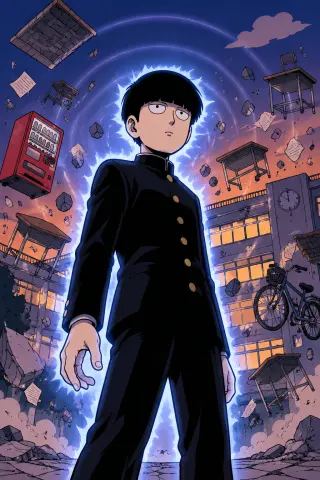
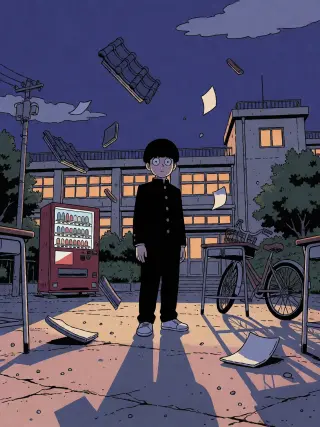
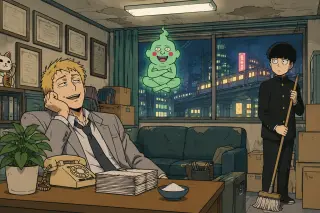
What GPT Image 2 Is Best At
GPT Image 2 is the documentarian. It is the better choice when the frame has to survive inspection: a world cover, a store page, a print, a thumbnail that will be cropped from the centre. It holds architecture, contact, material and shadow, and it follows a long prompt without dropping clauses. Its weakness is over-rendering; flat cel shading is not its native language, so the negative clause has to be strict.
What Krea 2 Is Best At
Krea 2 is the poster artist. It is faster, cheaper and more willing to flatten a scene into graphic bands. It is the better choice for mood boards, rapid iteration, gallery tiles and any frame where the silhouette matters more than the object count.
The Prompt That Produces a Usable Frame
The working template has six clauses, in a fixed order. It is not creative writing. It is a specification, and its job is to make the next frame comparable to the last one.
Style lock
Anime key visual in a bold-line comic style. State the rendering system first and do not revisit it.
Character spec
Age, hair, eyes, expression, uniform details. In this world: black gakuran, high collar, gold buttons, bowl cut, flat stare.
Place spec
Name the specific room or yard. Salt Middle School courtyard, cracked concrete, windows glowing orange, one flat comic cloud.
Event spec
One impossible thing, stated as a fact: desks, tiles, a bicycle and a vending machine lifted in a slow radial explosion.
Light and palette
Cold blue-white against deep indigo and orange windows; or fluorescent beige, teal upholstery and neon through glass.
Negative clause
No text, no logo, no watermark, no photorealism. Keep the shadow hard and the colour flat.
Sizing, Quality and the Two-Pass Rule
Generate the composition cheaply and the detail expensively. The first pass answers one question: does the event read? Use a square or a fast ratio at medium quality. Once the composition works, re-render at the final ratio and quality. For a world cover, 1536x1024 landscape; for a character poster, 1024x1536 portrait; for a gallery tile, a square.
Common Failure Modes and Their Fixes
Generic glow boy
The model rendered an aura and forgot the place. Fix: remove the word aura, add three ordinary objects and a hard shadow.
Floating nothing
Debris with no weight. Fix: name each object and its material. A desk, a roof tile, a bicycle, a vending machine.
Anime doll
The face becomes a generic moe mask. Fix: specify dull round eyes, flat mouth, no blush, no highlights, deadpan.
Neon drift
The city turns into cyberpunk. Fix: state the time of day, the school building, the flat comic cloud and the absence of rain.
Over-render
Texture and bloom crawl in. Fix: add flat cel-shaded colour blocks, two hard value steps, minimal texture, no gradient.
Text artefacts
Signage invents itself. Fix: no text, no logo, no watermark, and keep signage out of the prompt entirely.
From Frame to Published Work
A key visual is not finished when it renders. It is finished when it has a home. Publishing the frame as a work of the world gives it a permanent share link, attaches the prompt and model, and places it in a gallery where the next person can compare it. That is the difference between a folder of images and a body of work.
Select
Keep the frame that answers a question before the caption does.
Attach
Record the prompt, the model and the world atom it came from.
Publish
Create the public work and copy its share link.
Compare
Publish the sibling model output next to it. Let the difference be the argument.
A Short Buying Guide
If you only want one model: choose GPT Image 2 when the frame must survive inspection and cropping; choose Krea 2 when you need volume, speed and graphic mood. If you can afford two passes, use Krea 2 to explore the composition and GPT Image 2 to finish the frame that wins. And if you are building a world rather than a single image, the model matters less than the atom library.
What This Use Case Is Not
It is not a prompt for a generic anime boy with lightning hands, and it is not a shrine to a single model. The tool is good at producing a legible, consistent frame from a written brief. The taste — which frame, which crop, which silence — is still yours. The useful mental model is a studio with a very fast illustrator and no memory. You supply the memory: the world, the atoms, the style, the rule.
Start with the schoolyard. It is the hardest frame in the world to fake, because it has no spectacle to hide behind. If your generator can make a floating vending machine look heavy and a boy’s blank face look like a decision, it can handle everything else in Seasoning City.
Build Your Own Esper Key Visual
Four published frames, two models, one world — your turn to add the next impossible schoolyard.