
The Best AI Anime Space Western Key Visual Generator — Jazz-Noir Posters from One Prompt
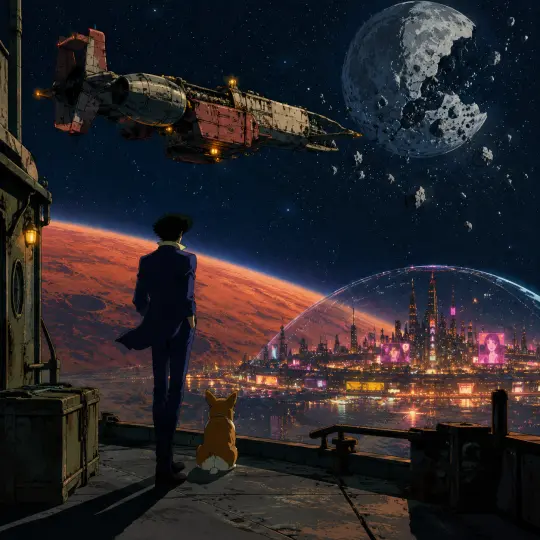
The best AI anime space western key visual generator: render jazz-noir posters of ships, ports and hunters with GPT Image 2 and Krea 2. Proven on the Cowboy Bebop world with four real published key visuals.
Generate a Space Western Key Visual
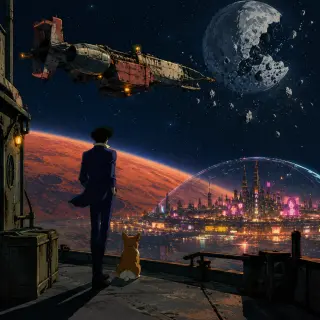
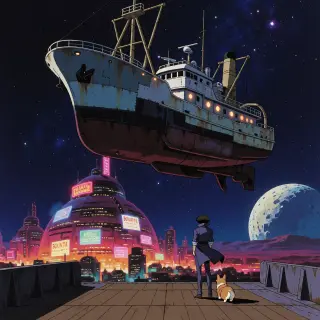
A jazz-noir solar system, a broken Moon and a trawler full of debts — one prompt, two models, four published key visuals
What Is an Anime Space Western Key Visual Generator?
An anime space western key visual generator is a text-to-image pipeline that renders the single frame a show would sell itself with: a ship against a planet, a hunter in a doorway, a neon port at midnight. The genre is a blend — frontier loneliness, jazz-noir cool, and science fiction hardware — and a good key visual has to carry all three at once without turning into generic cyberpunk.
Why Space Western Key Visuals Are Hard
Most models default to either clean sci-fi concept art or moody neon noir. A space western needs both, held in a cel-shaded frame, with a human subject small enough to be lonely and large enough to be the anchor.
- Scale — the ship and the planet must both read, without the figure disappearing.
- Genre drift — without a style lock, prompts slide into photoreal sci-fi or generic anime.
- Palette — teal-and-amber is a cliché unless it is limited and repeated across the set.
- Canon — a key visual for an existing world must match its established cast and locations.
The Test World: Cowboy Bebop
Every claim on this page was tested against a real world: Cowboy Bebop, rebuilt on Neta Studio as 22 atoms — seven characters, five locations, six events and four factions. The world supplies the canon and the palette; the prompts only have to point at it. Four key visuals were then generated from two prompts, each run through GPT Image 2 and Krea 2.
What the Comparison Proves
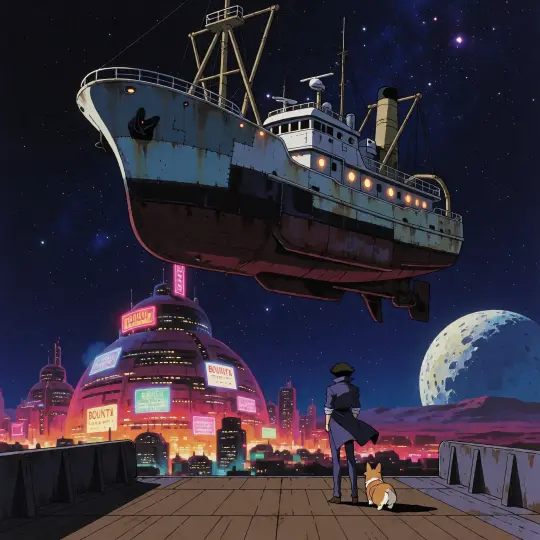
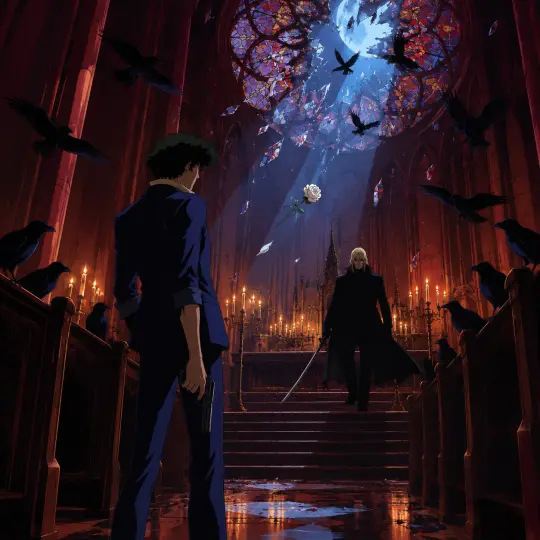
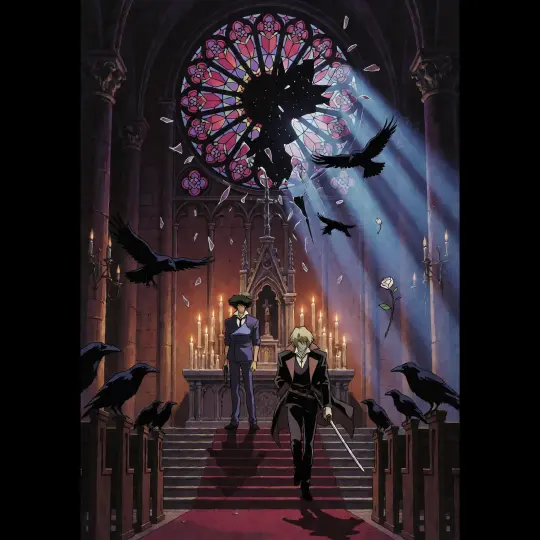
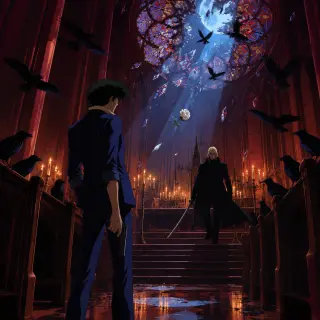
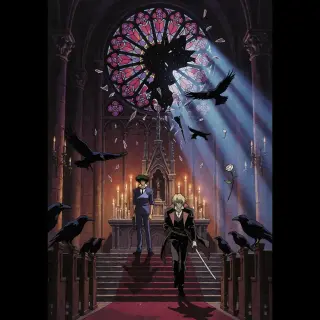
The same paragraph produced two legitimate but different posters. GPT Image 2 rendered the ship as a machine: patched hull, deck plating, running lights, a city with readable signage beneath it. Krea 2 rendered the ship as a mood: silhouette, magenta bloom, one warm amber note, the city reduced to colour. For a key visual you usually want both — which is why the studio publishes both as works.
The Five-Part Brief
A space western prompt works best as five ordered clauses. Skip one and the model fills the gap with genre averages; include all five and the frame arrives almost on-canon on the first try.
Style lock
Open with the medium: 1998 anime cel-shaded style, hard-edged contours, flat local colour, two-step shadows.
Place
Name the location from canon — New Tijuana’s neon dome, a cathedral on Mars, a Callisto jazz bar.
Subject
One figure, identified by silhouette and prop: a lanky hunter in a blue suit, a blond man with a katana.
Moment
State what is happening now — the coat pulling in solar wind, the rose window breaking inward.
Light and palette
Fix the key light and limit the colours: warm amber against cold blue, magenta neon, candle-amber in burgundy shadow.
Subject Casting: One Figure, One Silhouette
The genre lives on silhouettes. A lanky man in a blue suit with his back to camera reads as a hunter before any detail resolves; a pale blond man descending choir steps with a katana reads as the antagonist. Keep the cast small, keep the props specific, and let the costume do the characterisation.
Location Grammar: Ports, Moons and Ruins
Three location types cover the genre. The port is vertical, crowded and lit by signage. The moon is horizontal, cold and lit by work lights. The ruin is flat, silent and lit by debris-reflected sunlight. Naming the type in the prompt stops the model from inventing a generic city.
Lighting and Palette Control
Cel shading needs a single light logic. Pick one key direction and one accent colour, then repeat both across the set. In the world image the key is the neon city from below and the accent is the warm amber of the ship; in the cathedral the key is moonlight through the rose window and the accent is candle-amber. Two lights, no more.
A Reusable Prompt Template
<world> key visual, 1998 anime cel-shaded style, jazz-noir space western: <subject + prop> in <canon location>, <moment>; <key light> against <accent light>; clean hard-edged contours, broad flat local colour with two-step shadows, <limited palette>, film grain, cinematic <wide|vertical> hero composition, no text, no watermark.
Fill the placeholders from the world’s atoms, not from imagination. That single discipline is what keeps a set coherent.
Common Failure Modes
Four problems account for most failed generations. The fix is almost always to remove choice, not add detail.
- Genre drift — the model renders photoreal sci-fi. Fix: restate the style lock at the end of the prompt.
- Neon soup — every surface glows. Fix: name one key light and one accent, and forbid others.
- Lost subject — the ship eats the figure. Fix: specify foreground placement and relative scale.
- Off-canon costume — invented armour or cybernetics. Fix: name the garment and the prop explicitly.
Detail or Atmosphere: Choosing a Model
Choose GPT Image 2 when the poster must survive a crop — store pages, banners, thumbnails with text beside them — because its architecture, props and signage stay legible. Choose Krea 2 when the poster must sell a feeling in one second — title cards, social crops, mood boards — because its colour and silhouette do the work. Running both is cheap insurance.
The End-to-End Workflow
Start from the world, not from a blank prompt box. Open the Cowboy Bebop world, pick the atom you want to visualise, write the five-clause brief, and generate. The studio attaches the output to the world, publishes it as a work, and gives it a share link — so the next prompt can start from a frame instead of a sentence.
Start With the Bebop
The world is public, the atoms are editable, and the four key visuals on this page are already published as works you can open, compare and remix. Fork the canon, change one character, and generate the frame that is missing.
Start Creating
Four published key visuals, one world, two models — your turn to add the next frame.