
AI Co-op Fairytale Key Visual Generator — One Prompt, Two Dolls
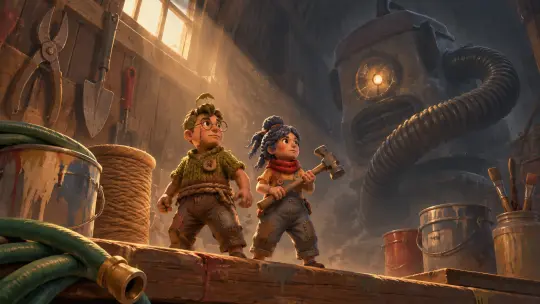
Generate co-op fairy-tale key visuals from one sentence: the six-part prompt, two-model comparison, and four published frames from the It Takes Two world on Neta Studio.
Generate a Co-op Fairytale Key Visual with GPT Image 2
Two dolls, one workbench, one blade of light. Start from the It Takes Two world and render a frame that keeps both of them in it.
What Is a Co-op Fairytale Key Visual Generator?
A co-op fairytale key visual generator is a text-to-image pipeline that produces a poster frame for a story about two people who cannot finish anything alone. The frame has a specific job: it must hold both characters, one shared obstacle and one readable world, without letting either figure become the hero and the other a prop. That is a different composition problem from a solo poster, and most models fail it in predictable ways.
The genre is not simply "fantasy". A co-op fairy tale is domestic in its materials and mythic in its scale: a workbench becomes a cathedral, a garden trellis becomes a ruin, a vacuum cleaner becomes a monster. The image has to keep both readings alive at once — toy and architecture, marriage and quest.
Why Two-Subject Frames Are Hard
Most image models are trained toward a single focal subject. Ask for a couple and you often get one figure in focus with a second figure dissolving at the edge, or two portraits pasted together with no shared space. A co-op frame needs equal weight, a shared axis and a visible problem between them.
- Equal weight — both figures at the same focal distance, neither cropped by the other.
- Shared axis — a bench, a table, a door, a rope, a tool that physically connects them.
- Visible obstacle — the thing that needs two pairs of hands, legible in silhouette.
- One light — a single source that falls across both faces, so they belong to the same moment.
The Test World: It Takes Two
Every claim on this page was tested against a real canon: the It Takes Two world on Neta Studio, rebuilt from 23 atoms — 7 characters, 6 locations, 6 events, 4 factions and 3 laws of the house. The world is public, the atom cards are editable, and the four key visuals used here are published works with their own share pages.
- Premise — two parents on the edge of divorce are turned into clay dolls by their daughter's tear and must cross their own house together to become human again.
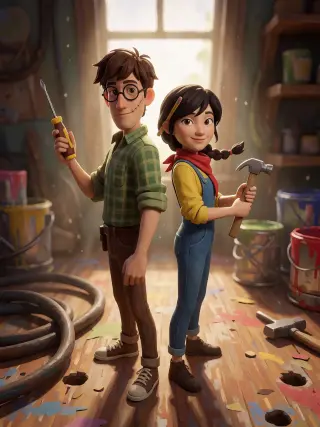
- Cast — Cody (father, screwdriver), May (mother, hammer), Rose (daughter), Dr. Hakim (the Book of Love), Hoover (the vacuum), the Cuckoo, the Squirrel General.
- Places — the Shed, the Tree, Rose's Room, the Snow Globe, the Cuckoo Clock, the Garden, with the Attic as the final room.
- Rule — every tool is halved. No door opens for one person alone.
What the Comparison Proves
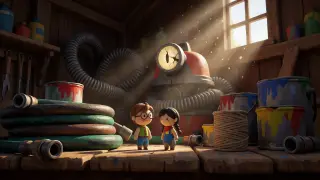
The same two briefs were run through GPT Image 2 and Krea 2 with no edits. GPT Image 2 produced a lit interior with material history: the hose has weight, the paint cans are dented, and Hoover's headlamp actually lights the dust. Krea 2 produced a poster: cleaner colour blocks, a toy-bright palette, the dolls centred and instantly legible at thumbnail size.
The Six-Part Brief
A co-op fairytale prompt works best as six ordered clauses. Order matters more than adjectives: the medium locks first, the room second, the pair third, the shared object fourth, the light fifth, the negative sixth.
Medium and genre
"Cinematic co-op fairytale key visual, hand-painted game 3D." Locks the rendering system before any content.
Place with a rule
One named room and what it teaches: the Shed (cooperation), the Tree (alliance), the Clock (punctuality), the Garden (memory).
The pair, by prop
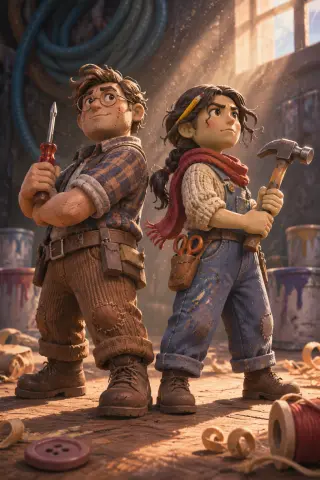
Both figures, both props, one posture each. "Cody with wire glasses and a screwdriver; May with a red scarf and a hammer."
The shared object
The thing neither can finish alone: a two-hand latch, a jammed door, a mechanism that needs nails and a hammer at once.
One light, one weather
A single hard blade of window light through dust. No second source, no rim-light show.
Negative clause
"No text, no watermark, no logo, no border, no third character." Last line, every time.
Casting the Two Witnesses
In a co-op frame neither figure is a portrait subject; they are two halves of one measuring instrument. Give each one prop that is useless without the other — nails and a hammer, a match and a fuse, a key and a lock. The prop does the storytelling, so the faces can stay quiet.
Location Grammar: Shed, Tree, Clock, Garden
Four location types cover the genre, and each demands a different composition. Choose the room before you write the sentence; the room decides where the camera stands.
- The Shed — a low camera, a wall of tools, and a machine in the dark. Vertical scale, foreground clutter, one blade of light.
- The Tree — a vertical country. Bark roads, a fort of bottle caps, a paper nest. Use depth stacking, not a flat backdrop.
- The Cuckoo Clock — a brass-and-wood town of gears. Symmetry, repeating arches, a bird about to strike.
- The Garden — sunflower trunks and mushroom umbrellas. Wide horizontals, warm dusk, a trellis as the emotional anchor.
Lighting the Marriage
Co-op lighting is moral, not decorative. A single hard source that crosses both faces says "same moment, same problem". Two competing sources say "two separate stories", which is the opposite of the genre. Keep the background one value darker than the pair and let dust carry the light.
A Reusable Prompt Template
The template below is the exact structure used for the Shed key visual. Swap the bracketed values; keep the order.
Cinematic co-op fairytale key visual, hand-painted game 3D, modelled silhouettes with painted diffuse texture. [ROOM] at cathedral scale: [THREE FOREGROUND OBJECTS]. Two tiny clay dolls, [CHARACTER A + PROP], [CHARACTER B + PROP], standing on [SHARED SURFACE] around [SHARED OBSTACLE]. One hard blade of [LIGHT SOURCE] falls across both of them, dust motes in the air. [THREAT] in the deep background, readable but not dominant. Controlled warm-cool planes, visible directional brushwork, restrained game light, readable silhouettes, epic miniature scale. No text, no watermark, no logo, no border, no third character.
The template is intentionally narrow. It forbids a third character, names both props, and asks for one light — the three clauses that most often decide whether a co-op frame works.
Common Failure Modes
Four problems account for most failed generations. The fix is almost always a clause, not a new model.
- One hero, one blur — add "both figures at equal focal distance, neither cropped" and name both props.
- Pasted couple — add a shared surface and a shared obstacle; the bench is what makes them a pair.
- Lost miniature scale — say "cathedral scale" and list household objects as architecture: hoses, cans, spools.
- Two-light poster — reduce to one source and one weather; delete every mention of rim light or glow.
Detail or Atmosphere: Choosing a Model
Choose GPT Image 2 when the frame must survive a crop: store pages, thumbnails, print, anything inspected at 100%. Choose Krea 2 when the frame must win a feed at small size: cleaner colour, stronger silhouette, faster variation. The honest answer for a world is to publish both and let the pair become the canon.
The End-to-End Workflow
Start from the world, not from a blank prompt box. Open the It Takes Two world, read the atom cards for the room you want, copy the props exactly, then render the same sentence in two models and publish both as works.
Open the world
Read the character and location cards so the prompt quotes the canon instead of inventing it.
Write six clauses
Medium, room, pair, shared object, one light, negative clause.
Render GPT Image 2
Use a wide or portrait size that matches the poster; keep quality high for inspection.
Render Krea 2
Same prompt, no edits. The comparison is only honest if the brief is identical.
Publish both
Attach each frame to the world as a work with its own share page, then fork the world for the next room.
Explore the World
The world is public, the 23 atoms are editable, and the four key visuals are published works with share pages. Fork it, rewrite the room, and add your own pair to the comparison.
Build Your Own Co-op Fairytale Frame
Take the six-clause brief, point it at a world with real atoms, and publish the frame that holds both of them.
All four frames above are real router-hosted works from this world. Open a share page for the full-size image, or start from the world studio and generate the next room.