
The Best AI Death Stranding Key Visual Generator — Timefall, Porters and the Beach
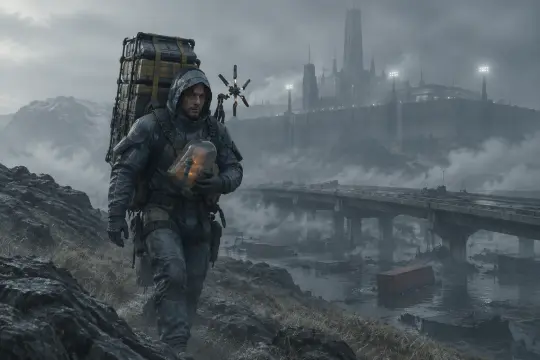
The best AI Death Stranding key visual generator: render timefall ridges, walled Knot Cities and the Beach with GPT Image 2 and Krea 2. Proven on the Death Stranding world with four published works.
Generate a Death Stranding Key Visual
A country of walled cities, a rain that ages everything it touches and a shore where the dead wash up — one brief, two models, four published key visuals.
What Is a Death Stranding Key Visual Generator?
A Death Stranding key visual generator is a text-to-image pipeline that produces poster-grade art for stories about a broken America held together by couriers: walled Knot Cities, a chiral network that only extends where a living person has walked, timefall rain that ages whatever it touches, and an invisible dead that surfaces wherever the living gather. The subject is not generic post-apocalypse and not a cold sci-fi wasteland. It is a specific, melancholy logistics world — cargo, rain, scanners, ropes, and the enormous distance between people who need each other.
The useful output is not a mood board. It is a single frame that can open a world page, a store card or a share link, and still explain the premise after it has been cropped to a thumbnail. That is a harder brief than it sounds, because the genre has two opposite failure modes: art that is too clean to be a survival story, and art that is too grey to be legible.
Why Post-Stranding America Is Hard to Prompt
Most models fail in one of two directions. Either they produce generic apocalypse — ash, ruins, a lone figure in a gas mask — which reads as a stock wallpaper and not as Death Stranding. Or they produce a perfectly ordinary hiking photo with the word sci-fi in the prompt and no visual argument at all. The first is decoration; the second is a postcard.
The world needs a third thing: a specific piece of infrastructure under a specific pressure. A tower of strapped cargo on a living back. An odradek scanner folded on a shoulder. A highway that is now a river. A walled city burning through fog. A black beach littered with things the sea has returned. The model needs objects it can hold, not adjectives it can style.
Three things separate a Death Stranding key visual from a generic survival still. Load, because the viewer must see what the person is carrying. Weather, because timefall is a physical threat, not a filter. Distance, because a courier must be small against a walled city and a figure must be small against the Beach.
The Test World: Death Stranding
Every claim on this page was tested against a real canon: the Death Stranding world in Neta Studio. It has eight characters, six locations, six events and four factions — Sam Porter Bridges, Amelie, Bridget Strand, Cliff Unger, Fragile, Higgs Monaghan, Deadman and Die-Hardman; Capital Knot, Central Knot, Lake Knot, Mountain Knot, Edge Knot and the Beach; the Death Stranding, the Manhattan voidout, Cliff Unger's last stand, Amelie's westward expedition, the chiral network activation and the Central Knot voidout; Bridges, Fragile Express, Homo Demens and the MULEs.
That matters because a key visual is only as specific as the world behind it. If the prompt has to invent the city, the model reaches for the nearest apocalypse reference. If the world already contains a drowned highway, a warm crater, a port with weather and a shore on the other side of life, the prompt can spend its words on the thing that actually matters: what the frame is looking at.
Era thirty years after the Stranding · Tone overcast, elegiac, physical · Look psychological film still, 85mm, fine grain, desaturated · Palette charcoal, slate blue, sodium orange, bone · Atoms 28 editable cards
What the Comparison Proves
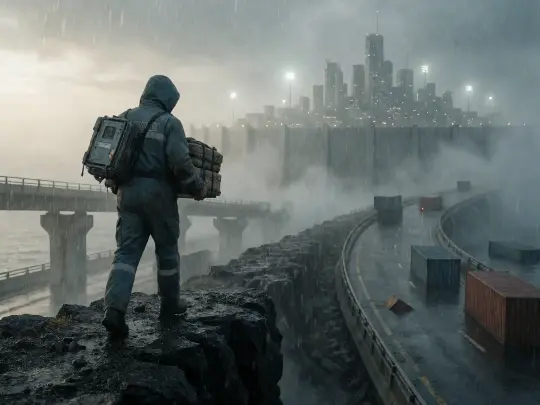
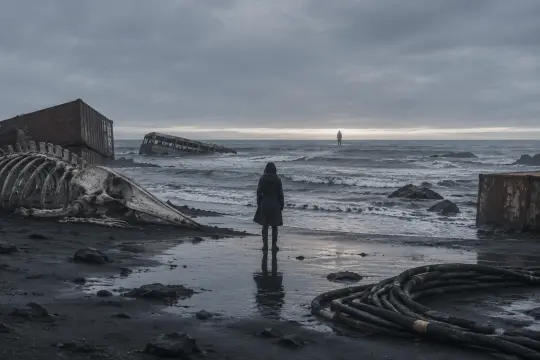
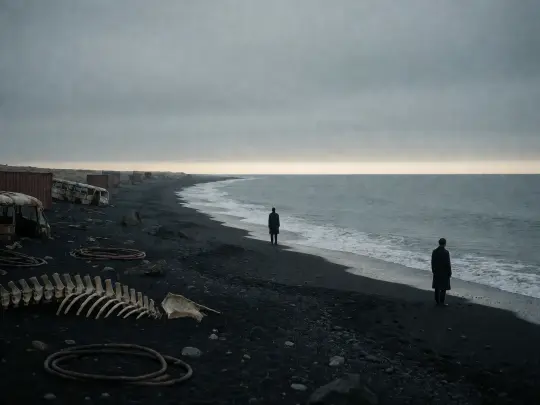
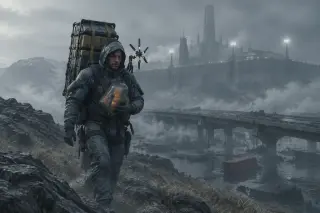
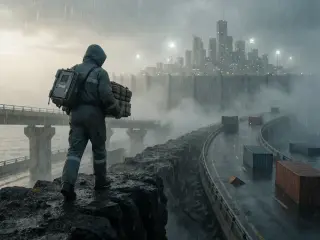
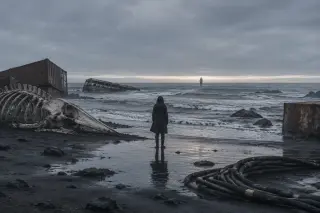
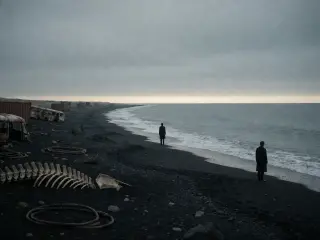
The same two briefs were run through GPT Image 2 and Krea 2. GPT Image 2 produced the document: rain on black rock, water in the drowned road, container stacks half-sunk in tar, a scanner with real hardware, a baby pod glowing at the chest, veins of city light through fog. Krea 2 produced the poster: one courier on a clean cliff, one road curving away, one band of city light, a colder flatter palette and fewer props.
That difference is consistent across both scenes, which is what makes it useful. GPT Image 2 is the better choice when the frame must be inspected or cropped; Krea 2 is the better choice when the frame must stop a scroll and explain the premise before the caption loads. Neither model is “more Death Stranding”. They are two different editorial positions on the same world.
The Six-Part Brief
Every prompt in this world is built from the same six clauses in the same order. The order is not decoration; it is how you keep a comparison honest. If the structure never changes, the differences you see belong to the model rather than to your wording.
Medium and genre
Cinematic film still, psychological science-fiction drama, 85mm lens, shallow depth of field, fine film grain, desaturated palette. Locks the rendering system before anything else is described.
Place
Name a real piece of infrastructure and a real building type: a drowned elevated highway, a walled Knot City on a crater rim, a black volcanic shore.
Subject
One person, one load, one posture. A hooded porter with a tower of cargo and a bridge baby pod; a figure in a dark coat at the water's edge.
Operation
State the one broken law: the highway is now a river, the dead surface where the living gather, the city is a wall with a heart. One verb, no adjectives.
Physics and light
Timefall streaking the air, grass ageing where drops land, sodium terminal lamps, floodlights hazed by fog, a thin seam of pale light on the horizon.
Negative clause
No readable text, no watermarks, no logos, no clean post-apocalypse styling. Removing the wrong century is what keeps the frame in this world.
Clause by Clause: The Ridge
The first test frame used the ridge because it is the most legible establishing shot in the canon. A road is a direction. Put a walled city at the end of it and the whole image becomes an argument about where the country thinks it is going. The trick is to keep everything on that road: lane paint, guardrails, container stacks, wet reflections, a checkpoint with actual vehicles.
Working prompt. Cinematic film still, psychological science-fiction drama, 85mm lens, shallow depth of field, fine film grain, desaturated palette, unretouched skin. A lone porter in a weathered blue-grey Bridges uniform, hood up, a folded mechanical odradek scanner on his shoulder, walks a narrow ridge of black rock above a drowned highway, carrying a tower of strapped cargo and a bridge baby pod against his chest; behind him a walled Knot City rises out of fog, floodlights hazy, a ruined overpass and shipping containers half-sunk in black tar; timefall rain streaks the air, grass ageing to grey where the drops land, cold flat overcast side light from the left, no fill, hard shadow, joyless grey and teal tones, epic scale, no readable text, no watermarks, no logos.
GPT Image 2 answered with a road you could walk: the lane markings continue under the ridge, the guardrail catches the lamp light, the city is planted on real rock rather than floating in a skybox, and the containers sit in actual water. Krea 2 answered with a composition you could print: a dark cliff, a glowing city, a swooping road and a courier reduced to a blue-grey shape at the bottom of the frame. Both are correct; they are doing different jobs.
Clause by Clause: The Beach
The second test frame used the Beach because it tests space rather than load. A shoreline is a container for one direction; remove the horizon and the human figure becomes the only stable object in the frame. The prompt must describe contact precisely — feet on wet sand, coat hanging heavy, a second figure at a distance no living person should reach — or the model produces a couple on a holiday beach, which belongs to a different genre.
Working prompt. Cinematic film still, psychological science-fiction drama, 85mm lens, shallow depth of field, fine film grain, desaturated palette. A vast black volcanic beach under a flat pewter sky, a lone figure in a dark coat stands at the water's edge, very small against an ocean of slate-grey tar; the shoreline is littered with beached things — a whale skeleton, rusted cargo containers, a drowned bus, coils of umbilical cable — and far out a second figure stands perfectly still, facing away; a thin seam of pale light along the horizon, cold overcast light, wet reflective sand, oppressive stillness, muted charcoal and bone palette, no readable text, no watermarks, no logos.
The word very small is doing most of the work. It implies scale, distance and helplessness, which is exactly what separates a Death Stranding frame from a superhero frame. The whale skeleton is the second signal: it is enormous, dead and clearly returned by something, so the audience instantly understands that the shore is a place where the sea gives things back.
Palette as Level Design
The world runs on four palettes and each one tells the audience where they are. Charcoal and slate blue for the ridge. Sodium orange and floodlight white for the Knot Cities. Cold operating-theatre white for Bridges interiors. Bone, tar and a thin horizon light for the Beach. Colour is the level indicator; the audience learns to read it within two frames, which means a prompt can spend fewer words explaining the location.
Common Failures and Fixes
Most failed Death Stranding prompts fail for one of four reasons, and each has a specific repair. None of them requires a better model; they require a more concrete sentence.
Apocalypse drift: ash, gas masks and ruins — add psychological film still, 85mm, overcast, and name the municipal infrastructure. Hiking-brochure blur: a beautiful trail with no threat — add timefall, a scanner, a pod and one walled city. Superhero pose: the porter stands heroically on the skyline — specify load, posture and contact with the rock. Empty shore: a beautiful beach with no story — add whale bone, containers, cable and a second figure at an impossible distance.
Detail or Atmosphere: Choosing a Model
Choose GPT Image 2 when the frame must survive a crop: store pages, thumbnails, UI cards, reference sheets, anything where architecture and material need to stay legible at small sizes. Choose Krea 2 when the frame is doing emotional work: a hero image, a share card, a poster where the gesture and the colour block matter more than the bolts on the guardrail.
The practical rule is to generate the establishing shot on both models and let the smaller crop decide. If the story is still readable when the image is 400 pixels wide, the poster model won. If the story needs the pod glow and the half-sunk containers, the document model won.
Working With the World's Characters
A key visual is strongest when it carries one character's position. Sam is the load; Amelie is the broadcast; Cliff is the search; Fragile is the wager; Higgs is the door; Deadman is the procedure; Bridget is the debt; Die-Hardman is the mask. Pick one position and the frame stops being a landscape and becomes a scene.
- Sam — the deliveryFrame him from behind, load high, pod low, city ahead. The audience reads the job before they read the man, which is exactly his tragedy.
- Cliff — the searchA pod cradled in both arms, a corridor of emergency light, tar at the edges. The frame should feel like he has been walking the same corridor for thirty years.
- Fragile — the wagerA waystation rooftop at dusk, a delivery case, a cigarette, a scarred hand. She is the only character who looks like she chose this life.
- Higgs — the doorA gold mask, a black duster, tar bleeding from his hands, a burning horizon. He should look like the end of the world already has his name on it.
The End-to-End Workflow
Start from the world, not from a blank prompt box. Open the Death Stranding world, read the location entry you want to visualise, and copy its nouns into the six-clause template. Generate the same brief on both models, publish both frames as works of the world, and only then decide which one belongs on the page. The comparison is the content; the single hero image is just the winner.
Open the world
Start at the Death Stranding studio and pick one location: the drowned highway, Central Knot crater, Lake Knot port, Mountain Knot cliff, Edge Knot fortress or the Beach.
Use the location's own objects
Copy the nouns from the atom card — odradek scanner, cargo tower, pod, guardrails, half-sunk containers, whale bone, cable coils — into the place and physics clauses.
Write the six clauses
Medium, place, subject, operation, physics and light, negative clause. Keep the order identical for both models.
Render both models
Generate at the final ratio, publish both as works of the world, and record the prompt and model on each work.
Decide in public
Compare the two frames at thumbnail size, then keep both. The losing frame is the best argument for the winning one.
Explore the World
The world is public, the twenty-eight atoms are editable, and the four key visuals are already published. Fork it, change the cost of a delivery, move the walled city to a different crater, or generate the frame that finally shows what Sam sees when he looks at the Beach and decides to keep walking. The comparison is the invitation: add the next frame and let someone else argue with it.
Build Your Own Death Stranding Frame
Four published key visuals, one world, two models — your turn to add the next frame.