Suma Uzui: The Wife Who Wasn’t a Fighter

Suma is Tengen Uzui’s third wife: a kunoichi who cries at everything, runs a Yoshiwara house as a courtesan, and still says she is not a fighter.


Who Suma is, before the crying
Suma is a supporting character in Demon Slayer: Kimetsu no Yaiba, a kunoichi, and one of the three wives of Tengen Uzui — alongside Makio and Hinatsuru. She is short, pale, with shoulder-length black hair and blue eyes, and she spends most of the Entertainment District arc in a state of visible distress. Her own introduction to the audience is a wail. In Chapter 79 she tells Inosuke, flatly, “We’re Uzui’s wives! We’ll do what we can but… I’m not a fighter!”
That line is true and also a lie, which is the whole character. She is not a swordswoman; she never fights an Upper Rank. But she infiltrates the most dangerous district in Taisho-era Japan as a courtesan, becomes the face of her house, and when the battle turns she leads the evacuation of Yoshiwara beside Makio. The crying is real. So is the competence underneath it, and the story is careful to show the second thing without ever letting her stop being soft.
| Source | Demon Slayer: Kimetsu no Yaiba — Entertainment District arc onward |
| Identity | Kunoichi; one of Tengen Uzui’s three wives |
| Skill | Undercover courtesan — successful enough to become the face of her house |
| First seen | Entertainment District arc, Chapter 79 (“Air Hole”) |
Put her in the room when the plan falls apart
Suma is at her best when she is frightened and still doing the job. The roleplay skill will keep her voice — the panic, the sudden steel, the embarrassing honesty — instead of turning her into a swordswoman she never was.
The marriage that was not arranged
The detail that makes Suma more than a comic wife is how she got there. Makio and Hinatsuru were chosen for Tengen through arranged marriages; Suma volunteered — in place of her younger sister — and according to the wiki she crashed through the door during the marriage interview to make the offer. All four later left the ninja clan together and travelled to Kagaya Ubuyashiki to ask to fight as part of the Demon Slayer Corps.
- She chose it — Nobody assigned her. She put herself forward, loudly, at the worst possible moment — which is the same way she does everything.
- Tengen’s rule — He taught all three wives his order of priority: their own lives first, then respectable humans, then himself. Suma’s panic is not cowardice; it is the rule working.
- The house — Undercover as a courtesan she becomes the face of her house — the job is performance, and she is better at performance than she admits.
- The evacuation — When the Upper Rank fight escalates, she and Makio get Yoshiwara’s civilians out. No sword, no credit, the actual work.
What she is like when nothing is trying to kill her
After the Entertainment District, Suma retires from the front lines and helps Tengen with his section of Hashira Training by cooking. The wiki is explicit that she is calmer there: serving meals, gossiping with her co-wives, laughing at her husband verbally shredding the trainees because she knows the harshness comes from worry. The emotional weather is still there — she dotes on Nezuko after the final battle and cries to Tengen and Hinatsuru when Makio hits her for it — but the volume is lower. It is a rare thing in a shonen epilogue: a character who gets a quieter life and is allowed to be better at it.
Two trivia notes worth keeping. Her name is written with the kanji for “ought, by all means” and “grind, polish.” And she is stated to like both men and women, which makes her the only known queer character in the series — a single line in a character book, but the kind of detail that changes how her marriage reads.
Why “not a fighter” is the interesting part
Demon Slayer runs on escalation: every arc introduces someone stronger, and the women of the Corps are measured by their blades. Suma is the counter-example. Her contribution is intelligence work, cover identities, logistics and nerve, and the story never retroactively turns her into a combatant to justify her place in the cast. That makes her the easiest character in the series to write badly — she becomes the crying wife — and the most rewarding to write well, because her courage has to be shown in a domestic key: holding a stranger’s hand down a burning street, keeping a cover story straight while terrified, choosing a marriage out loud in front of a room.


Where that kind of courage already lives
These are real stories on Neta Studio with the same shape: people without the strongest weapon in the room, doing the job anyway.



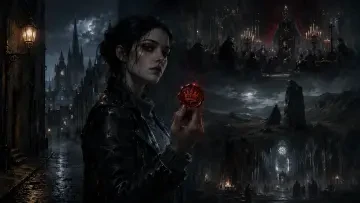
A district that has to be evacuated
Final Selection: Night of Wisteria drops you into the Corps’ entrance exam, which is the same test Suma never took — nerve instead of technique. Demon Slayer Interactive Map lays out Taisho-era Japan including Yoshiwara, so you can see the streets she has to clear.
Or a role that is all performance
After the Nocturne is built on the gap between what a character says and what they are doing, which is the courtesan’s entire craft. Night Over the Isles puts a quiet character in charge of a loud room.
Writing her without the caricature
Let her cry and keep working
The tears are not a pause in the action. She cries while counting heads, while lying to a client, while dragging someone out of a doorway.
Give her a cover story to protect
Put her undercover and the scene writes itself: every sentence has two jobs, and one wrong word exposes the house.
Save the steel for one moment
She lunges at Nezuko believing Tengen is being cremated alive — and then wails in relief when the poison burns away. One burst, then back to softness.
The cast, briefly










Take the quiet job in the loud arc
Most Demon Slayer scenes go to whoever has the best breathing technique. This one goes to the person keeping the street calm. Open the roleplay hub and take the unglamorous role on purpose.
Built with the roleplay skill
roleplay keeps a character’s register steady across a long scene — Suma’s panic, her courtesan voice and her sudden courage are three different tones, and the skill holds all three. character-sheet writes the file behind her if you are building a kunoichi of your own: what she is good at, what she is not, and who she chose.
Suma Uzui FAQ
Is Suma a demon slayer?
She is not a combatant. She is a kunoichi and one of Tengen Uzui’s wives who works undercover in Yoshiwara; she never fights an Upper Rank and says so herself in Chapter 79.
How did she marry Tengen?
Makio and Hinatsuru were chosen through arranged marriages. Suma volunteered in place of her younger sister and, per the wiki, crashed through the door during the marriage interview to make the offer.
Which arc does she appear in?
She debuts in the Entertainment District arc and returns through the Swordsmith Village, Hashira Training, Infinity Castle and Sunrise Countdown arcs.
What does she do after retiring?
She helps Tengen with his Hashira Training section by cooking, and stays close to her co-wives. The wiki notes she is noticeably calmer in that period.
Is Suma queer?
The wiki states she likes both men and women, describing her as the only known queer character in the series.
Can I roleplay a scene with her?
Yes. The roleplay hub opens a Demon Slayer scene with her, keeping her voice and her limits — including the fact that she is not going to win a sword fight.
Keep reading
Platform: Neta Studio · Type: Character · Hub: neta.art/app/roleplay · Works: Final Selection: Night of Wisteria · Demon Slayer Interactive Map · Jujutsu Kaisen World Portal · After the Nocturne · Night Over the Isles · Death Note: First Judgment