AI DnD App: What It Replaces at the Table

An AI DnD app can run a session alone, but only if you know what it replaces: the DM, the rulebook, the scheduling. What works, what breaks, and how to start.


What an AI DnD app is actually for
The problem an AI D&D app solves is not “I want to play alone.” It is “I want to play tonight, and the group cannot meet until the 14th.” A tabletop session is four to six people agreeing on a time, a dungeon master who prepared, and a ruleset nobody wants to look up mid-scene. An app removes the scheduling, then has to earn the rest.
That is the honest framing. What you get is a dungeon master that never cancels, a rulebook that answers in a sentence, and a memory of what your character promised three sessions ago. What you do not get is the table: the argument about whether a grapple is an action, the friend who does the voice, the moment everyone realises the plan is terrible at the same time. If you go in expecting a session, you will be disappointed. If you go in expecting a solo campaign that runs at the speed of your own reading, it delivers.
| Replaces | Scheduling, prep, rules lookup |
| Does not replace | The other players |
| Best for | One player, one sitting |
| The tell | Whether it remembers last session |
Roll a character, not a campaign
Describe a class, a grudge and one thing your character is bad at. The roleplay skill runs the scene, keeps the NPCs consistent and lets you argue with the dungeon master — which is the part a table does best.
Five jobs a dungeon master does
A DM is not one role, which is why replacing one is harder than it looks. Break the job into five and you can see exactly where an app earns its place and where it quietly gives up.
- Prep — A place, three NPCs and a reason to go there. This is where an app is strongest: it generates the map, the innkeeper and the rumour in one pass, so the session can start in a minute instead of a week.
- Arbitration — What happens when a player tries something the rules did not anticipate. A person says “roll it” and moves on. An app tends to either refuse or over-explain — the good ones answer in one line and keep the scene moving.
- Voices — The innkeeper, the guard, the thing under the bridge. This is where text-based play quietly wins: you hear them perfectly, and nobody has to do an accent.
- Consequences — The part most solo tools miss. A DM remembers that you burned the bridge, and the next town has heard about it. Ask the app to hold one debt from the first scene and pay it off in the third.
- The clock — A session ends because people are tired, not because the plot resolved. A solo campaign has no clock unless you set one — decide up front that the session ends when you leave the dungeon, or you will never leave.
Dice or no dice: the choice that decides the feel
Some solo apps roll for you; some replace the roll with a decision. Both are legitimate, and they produce different games. With dice, you get the tabletop feeling of a plan collapsing — the swing, the critical failure, the story you retell. Without dice, you get momentum: every scene advances because you chose it, and the tension comes from what the choice costs rather than from luck. The mistake is mixing them badly — asking for a roll and then narrating around a bad result. Pick one contract at the start and hold it, and tell the app which one you picked.


Six campaigns built for one player
These are complete worlds and sessions rather than rulebooks: each one gives you a place, a stake and a reason to make a decision in the first minute.





A campaign that fits in one sitting
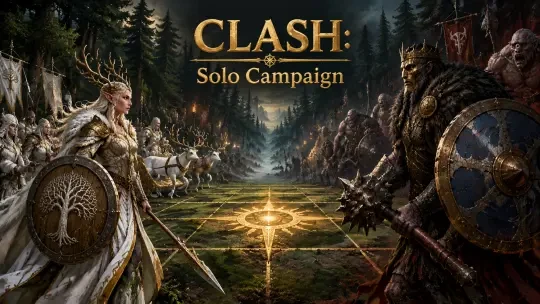
CLASH: Solo Campaign is structured like a strategy game rather than a module: the ruleset is the interface, so there is nothing to look up. Curse-Road goes the other way: a dark-fantasy road where the price of the journey is the thing that makes each decision matter.
The oath is the encounter
Dragonborn Oath is built around a single moment — swearing in front of a dragon — which is the encounter type tabletop does better than any app: a promise made under pressure that the rest of the campaign has to honour. Night Over the Isles takes the same idea into gothic noir, where the pressure comes from what your character will admit out loud rather than from a dice roll.
Three steps to a session tonight
Decide the contract first
Dice or no dice, one sitting or a campaign, and what the session ends on. Say all three in your first message. An app will happily run forever; without a clock you will stop mid-scene and never come back.
Ask for a debt, not a quest
“Give me one NPC who wants something from me and will bring it up later” produces a better session than “give me a quest”. Debts create consequences, and consequences are what a campaign is made of.
Close the loop in the third scene
Before you stop, ask the app to call in the debt. If it remembers, you have a campaign. If it greets you like a stranger, you have a chatbot with a fantasy font — start the next session by restating the three facts it must keep.
Six worlds to play tonight











The group cannot meet tonight. You can.
Open the roleplay hub, roll a character and start in a tavern. If you want to see how a full campaign is structured before you commit, read one of the portals first.
Built with the roleplay skill
Three named skills do the work. roleplay runs the table: it holds the NPCs, the debt you were given and the tone of the world across a long session, which is what makes consequence possible. world-builder makes the place first — factions, a map and a reason for the dungeon to be where it is — so the session does not open on a blank page. character-sheet pins your character’s sheet: class, weakness, the one thing they will not do. Set those three and the app stops guessing.
FAQ
Can an AI app really run D&D?
It can run a session: narrate a place, voice the NPCs, adjudicate most actions in a sentence and remember what happened. What it cannot do is be a table — the negotiation between players, the shared joke, the ruling everyone argues about. Treat it as a solo campaign in the same genre, not as a replacement for your group.
Do I need the rulebooks?
No, and that is the point. Describe what your character tries and the app resolves it. If you want real dice and real modifiers, bring them and state the result yourself — most apps will narrate around a number you give them.
Is this the same as solo D&D?
Solo D&D usually means one player running a published module with an oracle or a DM emulator. An AI app replaces the module and the emulator with a conversation, which is faster to start and looser on rules.
How do I stop it from being too easy?
Give it a constraint it must honour: a resource, a clock, or a promise. “I have three torches and the exit is four rooms away” produces tension that no amount of monster description will. Then refuse the easy way out when it offers one.
Will it remember my character between sessions?
Inside a saved conversation, yes — it keeps the facts you established. Across a new session, restate three things: your name, your debt and your weakness. Anything not restated is a rumour.
Can I play with friends?
Not as a shared table in this format. One option is to play the session solo and bring the transcript to your group as a recap; another is to use it as a DM’s prep tool and run the real session yourself.
Keep reading
Platform: Neta Studio · Type: Use case · AI DnD app · Hub: neta.art/app/roleplay · Works: CLASH: Solo Campaign · Dragonborn Oath · Night Over the Isles · Blood-Oath Golden Crown · Westward Voyage · Curse-Road