Lorebook: The File That Keeps a Roleplay Consistent

A lorebook is a keyword-triggered dictionary of your world: entries that arrive only when they matter. How the format works, how to write an entry, and how to keep it small.

What a lorebook actually is
In roleplay tooling, “lorebook” is the common name for a very simple idea: a list of entries, each with trigger keywords, and a body of text that gets inserted into the model’s context only when those keywords appear in the conversation. People also call it world info or a memory book. The point is the same — you are not writing one enormous prompt, you are writing a dictionary that opens at the right page.
That design solves the problem every long scene runs into. A world has more facts than any single prompt can hold: who owns the ford, what the garrison is owed, which captain has a grudge. A lorebook lets you keep all of it and pay for only the part the scene is currently touching, which is why it is the difference between a model that remembers your world and one that improvises over it.
| What it is | A keyword-triggered dictionary of world facts |
| Other names | World info, memory book, lore file |
| What triggers it | Keys found in the current message text |
| What never gets sent | The keys and titles — only the entry body |
Write the world, then let it answer
The world-builder skill turns a setting into named entries — people, places, factions, events — each with a one-line summary and a body. It is the same structure a lorebook expects, built as a world you can add to instead of a block of text you have to rewrite.
Anatomy of an entry that works
Six fields decide whether an entry helps or bloats. Get the first three right and the rest is tuning.
- Keys: the words people actually type — Include the name, the short name, and the noun someone would use in passing — “the Keep”, “the garrison”. Miss the casual form and the entry never fires.
- Content: standalone and complete — Keys and titles are not sent to the model; only the body is. An entry that begins “as mentioned above” arrives with nothing above it. Write each one as if it is the only thing the model will read.
- One subject per entry — A single entry covering the Keep, its captain and the ford will fire on all three and bury the scene in detail it did not ask for. Split it: one place, one person, one obligation.
- Order and priority — When several entries fire at once, order decides what survives truncation. Put the facts the scene cannot run without at the top.
- Constant vs triggered — A handful of entries deserve to be always on: the rules of magic, the tone of the world. Everything else should earn its tokens by being mentioned.
- Recursion, used sparingly — Some tools let an entry trigger another through a link. It builds a real world quickly and it can also cascade a whole archive into one message. Cap it.
One entry, annotated
{
  "keys": ["Hollow Keep", "the Keep", "garrison"],
  "secondary": ["Captain", "oath"],
  "content": "The Hollow Keep sits above the ford and has held it for
  forty years. Its garrison is nine people and one cannon. Captain
  Ines Vey commands it and has never been paid on time; she mentions
  the arrears before she mentions anything else.",
  "constant": false,
  "order": 40
}
The shape most lorebook tools use: keys that trigger the entry, optional secondary keys, the text that gets inserted, and a flag for entries that should always be present. What is above is an example, not an export format.
The failure mode is always the same
Most lorebooks die of generosity. Forty entries, all marked constant, all two hundred words, and the model spends its whole context on background before it reads your last line. The fix is boring and effective: keep entry bodies to a few sentences, let triggers do the work, and test by writing a scene that mentions nothing — if the answer still recites the world, too much is always on. A good lorebook feels like a world that happens to know things, not a wiki that interrupts.


Worlds that behave like lorebooks
Each of these keeps a place, a cast and a history in one structure. Walk one and you can feel where the entries are — the moments when a detail arrives because the scene asked for it.



Factions need addresses, not adjectives
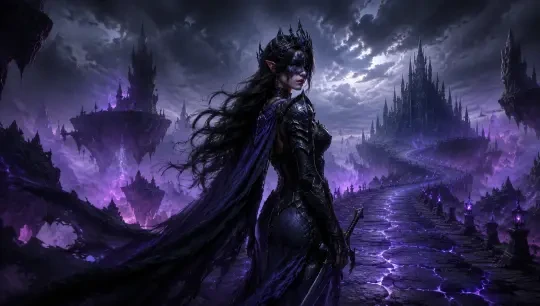
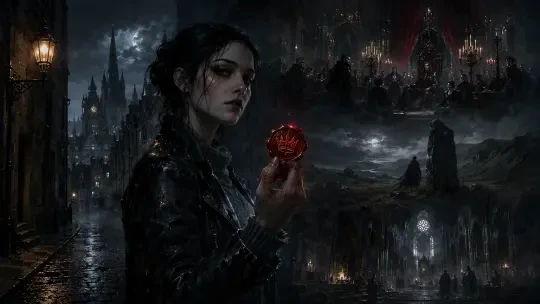
Blood-Oath Golden Crown is a succession crisis you can walk through: every claimant has a name, a claim and a place to stand. That is what an entry should look like. Night Over the Isles does the same for debts — the city remembers who owes whom, which is a lorebook doing its job.
Order is part of the writing
The Descent reveals its underworld one layer at a time, and the sequence is the story. A lorebook has the same lever: order decides what the reader meets first. Curse-Road keeps a ledger of prices, which is the cleanest example of an entry that must be accurate to be useful.
How to build one in an evening
List the ten facts the scene cannot run without
Not the whole world — the ten things a stranger would need to say one true sentence about it. Those are your first entries.
Write each body in three sentences
What it is, what it costs, one detail that could only be true here. If a fourth sentence does not change a decision, cut it.
Test with a scene that names nothing
Write three lines that mention no entry. If the reply recites background, your always-on set is too big; if it feels empty, a key is missing.
The worlds, as an index









Keep the world, or walk it
The world-builder skill builds the structure this page describes. The roleplay hub is where those entries get used by someone with a voice and a grudge.
Built with the world-builder skill
The world-builder skill produces the structure a lorebook needs: named entries for people, places, factions and events, each with a summary and a body, all addressable and all editable. The roleplay skill is the other half — it is what decides which entries a scene actually pulls in, because it is writing a character who lives there.
FAQ
Is a lorebook the same as world info?
Yes. Different tools use different names — world info, memory book, lore file — for the same mechanism: keyword-triggered entries inserted into the prompt.
Do I need one for a short scene?
No. Under a dozen facts, you can hold the world in the character description. A lorebook pays off when the world is bigger than one prompt and the scene keeps returning to it.
Why does my entry never fire?
Almost always a key problem: the entry uses the formal name and the conversation uses the casual one. Add the short form and the noun someone would actually say.
How long should an entry be?
Three or four sentences. Everything that is not needed to make the next decision is tokens you spent on background instead of story.
What should always be on?
The rules of the world and its tone — a handful of entries at most. If everything is constant, the model is reading a manual before every reply.
Can I build one without a tool?
Yes — a table of names, triggers and three-sentence bodies is a lorebook. The format is a convenience; the discipline of writing it is the actual work.
Keep reading
Platform: Neta Studio · Type: Lorebook · Hub: neta.art/app/agent-skills · Works: Curse-Road · Night Over the Isles · Dragonborn Oath · Blood-Oath Golden Crown · The Descent · Wizarding World Atlas