Surname Generator: Names That Sound Like They Belong

A surname generator only helps if the name fits the world. How surnames are built — patronymic, trade, place, clan — and how to test one before you commit to it.


What you are actually picking
A surname is not a decoration. In most of the world it is a record of something — a father, a trade, a village, a clan — and that record still shows through the word. Ask a generator for a name and you get a string; ask it for a name that fits the world and you get three hundred years of history compressed into two syllables. The second thing is what makes a character feel like they came from somewhere.
This page is not a randomiser with a button. There is no surname tool on this site, and pretending otherwise would waste your time. What follows is the mechanism: the four engines that produce surnames, the traps that make a name read as fake, and a method for generating a coherent set for one family, one region or one whole setting using an AI skill that can hold the rules.
| What it is | A method for choosing surnames that fit a world |
| Four engines | Patronymic, trade, place, clan |
| What breaks a name | Mixing engines or cultures in one family |
| The real test | Say it in a sentence someone would shout |
Generate a family, not a name
The character-sheet skill takes a region and a century and produces names that follow the same rules: a family that shares a stem, siblings that vary, a village with a naming habit. Surnames come out consistent instead of sampled.
The four engines
Almost every surname in the world comes out of one of these four machines. Pick the engine first; the syllables will follow.
- Patronymic: the father’s name — English -son (Johnson, Williamson), Spanish -ez (Rodríguez from Rodrigo, Pérez from Pedro), Slavic -ov/-ev (Ivanov), Arabic ibn or bin, Scandinavian -son and -dóttir. Icelandic still uses it instead of a family name, which is why a brother and sister there do not share a surname.
- Trade: what the family did — Smith, Baker, Taylor, Cooper, Fletcher, Mason. It is the most legible engine and the easiest to overuse — a village with four Smiths is realism, a kingdom with forty is a shrug.
- Place: where they were from — Hill, Wood, Green, Atwood; the French de and German von for land; the Japanese -mura (village), -yama (mountain), -kawa (river). A place name says the family arrived from somewhere and wants you to know it.
- Clan: who claims them — Korean bon-gwan, Chinese and Vietnamese single-character surnames, Scottish clan names. These carry membership rather than description, which is why they repeat so heavily — Kim, Lee and Park cover a huge share of Korean surnames, and Wang, Li and Zhang do the same in Chinese.
- Then the grammar of gender — Slavic surnames inflect — Ivanov becomes Ivanova — while Japanese, Korean and Chinese surnames do not change. Get this wrong and the name reads as a costume.
The traps, in the order they bite
A name fails for boring reasons. Mixing a Japanese given name with a Slavic surname and calling it a fantasy kingdom reads as a mistake rather than a choice, unless the world explains the mixing. Apostrophes are another: an apostrophe in a surname signals a glottal stop in Na’vi or Hawaiian and a broken keyboard everywhere else. And length matters more than beauty — a name gets typed into dialogue, shouted across a battlefield and shortened by friends, so test all three before you commit. The last trap is sameness: if every surname in your cast has three syllables and an -an ending, the reader stops distinguishing people.


Settings where the surname is the plot
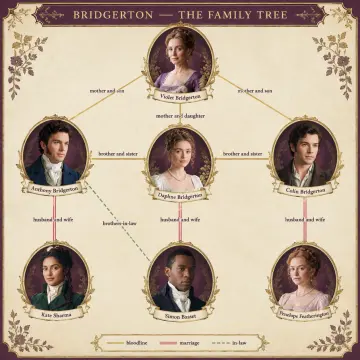
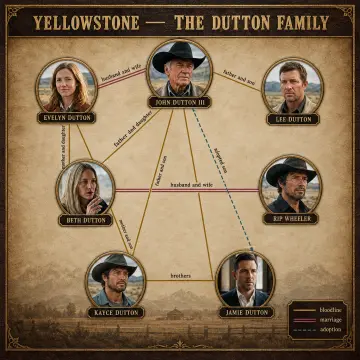
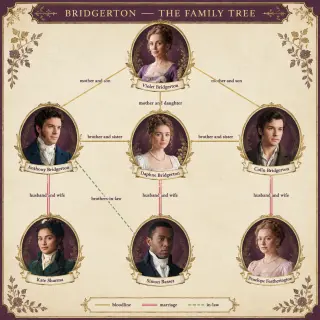
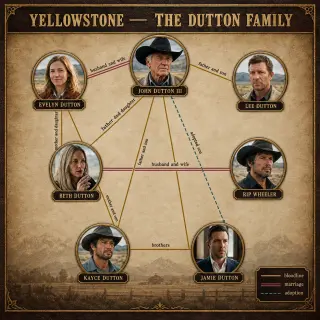
Family trees are the fastest way to see the engines at work. Each of these worlds uses names as inheritance, claim or class, and you can read the rules straight off the diagram.


Inheritance is a naming system
The Harry Potter family tree works because the surname carries the magic: Black, Potter, Malfoy and Weasley each announce a position in the world before anyone speaks. Game of Thrones runs the same trick with houses, where the name is a legal claim on land and violence.
When one name spans a century
The Joestar family tree follows a single surname across generations and continents, which is the most literal test of whether a name can carry a story. Bridgerton goes the other way: alphabetical siblings and a title, names as social machinery rather than destiny.
How to generate a coherent set
Choose one engine per region
A valley of tradesmen, a coast of patronymics, a capital full of place names from elsewhere. One engine per place is what makes a map feel inhabited.
Build the family from a stem
Pick a root and vary it: a father’s name for the parent generation, a trade for the branch that moved, a place for the one that married in. Related names should look related.
Test three ways
Say it in a shout, in a formal introduction, and in a nickname. If it survives all three, it will survive the manuscript.
The trees, as reference





Name them, then put them in a room
The character-sheet skill writes the person the name belongs to. The roleplay hub is where that person has to answer to it.
Built with the character-sheet skill
The character-sheet skill writes a character with a name that follows the world’s rules — family stem, region, class and the generation they were born into — instead of a random string. The world-builder skill is what fixes the rules in the first place: which engine each region uses, and what a surname is allowed to claim.
FAQ
Is there a surname generator on this site?
No. There is no button that outputs a list of surnames here, and this page does not pretend otherwise. What you get is the method plus a skill that can generate a coherent family set.
What is the most common surname in the world?
By raw count, Chinese surnames dominate — Wang, Li and Zhang are each carried by tens of millions of people. Korean surnames are even more concentrated: Kim, Lee and Park cover a large share of the population.
Why do so many English surnames end in -son?
Patronymic naming: Johnson is “son of John”, Williamson is “son of William”. It was a description that hardened into inheritance over a few centuries.
How do I make a fantasy surname sound real?
Follow one engine consistently and borrow the sound of a real language rather than its spelling. A name that breaks its own rules reads as invented; one that follows them reads as discovered.
Should siblings share a surname?
In most naming systems yes, but not all: Icelandic patronymics give a brother and sister different surnames, and some cultures use clan names that skip the household. Decide the system before you name the family.
Can an AI name a whole cast consistently?
Yes, if you give it the rules rather than examples. Tell it the engine, the region and the generation, and ask for a family with a shared stem — that is what keeps ten names from reading like ten different books.
Keep reading
Platform: Neta Studio · Type: Surname generator · Hub: neta.art/app/agent-skills · Works: Harry Potter Family Tree · Game of Thrones Family Tree · Joestar Family Tree · Bridgerton Family Tree · Yellowstone Family Tree · Wizarding World Atlas